

Monday, October 26, 2026
Science
No Result
View All Result
  • Login
  • HOME
  • SCIENCE NEWS
  • CONTACT US
  • HOME
  • SCIENCE NEWS
  • CONTACT US
No Result
View All Result
Scienmag
No Result
View All Result
Home Science News Technology and Engineering

Foam pad outperforms gauze at stripping wound biofilms in pig-skin model

October 26, 2026
in Technology and Engineering
Denise Maddox
By Denise Maddox Scienmag Editorial Profile - Mechanical Engineering
Reading Time: 3 mins read
0
Foam pad outperforms gauze at stripping wound biofilms in pig-skin model

Foam pad outperforms gauze at stripping wound biofilms in pig-skin model

65
SHARES
587
VIEWS
Share on FacebookShare on Twitter
ADVERTISEMENT

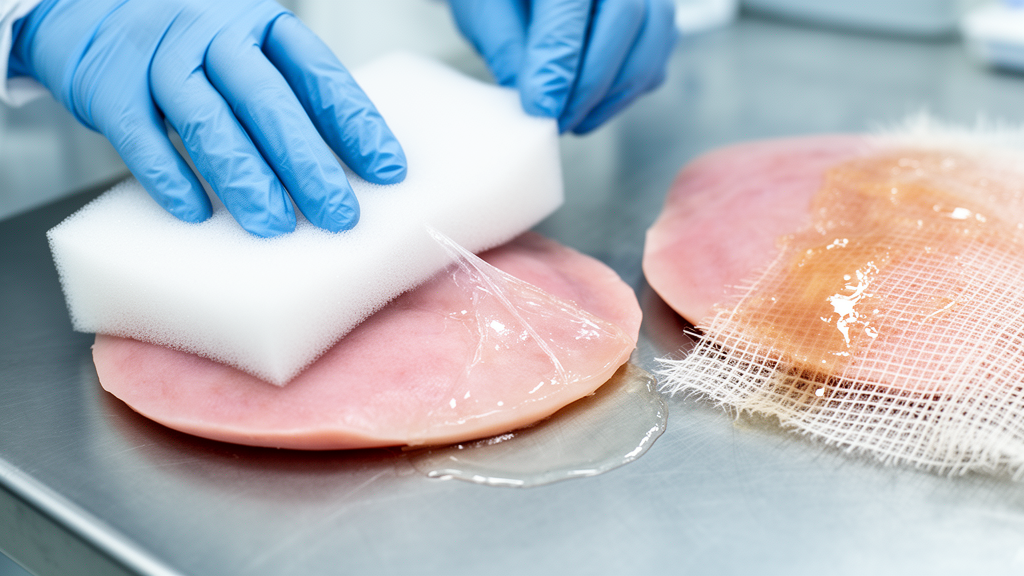
A two-sided foam pad with distinct loosening and absorptive surfaces removed more than 90% of viable bacteria from laboratory-grown wound biofilms in an ex vivo porcine wound model, consistently outperforming traditional cotton gauze, according to a peer-reviewed study published in Scientific Reports. The research compared four mechanical cleansing and debridement tools head-to-head under standardised conditions. The team, led by Christopher Doherty and Andrew J. McBain, cultivated dual-species biofilms of Staphylococcus aureus and Pseudomonas aeruginosa on porcine skin.

The devices tested were a one-sided straight monofilament fibre pad, a one-sided looped monofilament fibre pad, the two-sided foam pad, and conventional cotton gauze. To eliminate operator variability, debridement was performed with a mechanical simulator that applied identical conditions across all trials. The researchers evaluated the tools at three stages of biofilm maturity: 24 hours, 72 hours and seven days after inoculation.

They also ran repeated debridement schedules over seven days, performing the procedure once, twice or three times, to simulate outpatient dressing-change schedules. Removal was quantified by colony counting to measure viable bacteria remaining per wound, and by viability mapping to visualise where living cells persisted on the wound surface. In the single-debridement experiments, both the one-sided looped monofilament fibre pad and the two-sided foam pad removed significantly more biofilm than gauze at the 24-hour time point.

The foam pad, however, was the only device to maintain its performance across biofilm ages: it achieved greater than 90% model-derived reduction in viable colony-forming units per wound at every single-debridement time point, and its removal was significantly greater than gauze at 24, 72 and 168 hours. Viability staining with PrestoBlue supported the colony-count data, showing corresponding reductions in the PrestoBlue-positive wound-surface coverage after treatment with the foam pad. The repeated-debridement experiments reinforced the pattern.

The two-sided foam pad sustained greater than 90% model-derived reduction in viable bacteria and significantly outperformed gauze under every debridement schedule tested, whether the wounds were treated once, twice or three times over the seven days. Effect-size analysis underscored the magnitude of the differences. Hedges' g values for the foam pad relative to gauze and to the single-sided devices frequently exceeded 2.0, indicating pronounced effects under the predefined interpretation thresholds used by the authors.

The findings are model-derived results. The experiments used an ex vivo porcine wound model with laboratory-cultured dual-species biofilms rather than infected human wounds, and debridement was performed by a mechanical simulator rather than clinicians, so the results cannot be directly translated into clinical outcomes without further work. Nevertheless, by standardising force, motion, biofilm maturity and measurement methods, the researchers isolated device performance as the variable of interest.

Subject of Research: Comparative biofilm removal performance of four mechanical wound cleansing and debridement devices in an ex vivo porcine wound model

Article Title: Evaluation of the comparative biofilm removal properties of four cleansing and debridement tools, in an ex vivo porcine wound model

Article References: Doherty, C., Baqader, S., Mercer, S., & McBain, A. J. (2026). Evaluation of the comparative biofilm removal properties of four cleansing and debridement tools, in an ex vivo porcine wound model. Scientific Reports. https://doi.org/10.1038/s41598-026-75044-8

Image Credits: AI Generated

DOI: 10.1038/s41598-026-75044-8

Keywords: wound care, biofilm, debridement, porcine wound model, Staphylococcus aureus, Pseudomonas aeruginosa, Scientific Reports, mechanical cleansing, foam pad, cotton gauze, ex vivo model, Evaluation

Cite Scienmag News

Denise Maddox. (October 26, 2026). Foam pad outperforms gauze at stripping wound biofilms in pig-skin model. Scienmag. https://scienmag.com/foam-pad-outperforms-gauze-at-stripping-wound-biofilms-in-pig-skin-model/

Denise Maddox. "Foam pad outperforms gauze at stripping wound biofilms in pig-skin model." Scienmag, 26 October 2026, https://scienmag.com/foam-pad-outperforms-gauze-at-stripping-wound-biofilms-in-pig-skin-model/. Accessed 26 October 2026.

Denise Maddox. "Foam pad outperforms gauze at stripping wound biofilms in pig-skin model." Scienmag. October 26, 2026. https://scienmag.com/foam-pad-outperforms-gauze-at-stripping-wound-biofilms-in-pig-skin-model/


Tags: biofilmbiofilm debridement tools comparisonbiofilm mechanical cleansingbiofilm viability mappingcotton gauzedebridementdebridement schedule optimizationevaluationex vivo modelex vivo wound cleaning studyfoam debridement efficiencyfoam padfoam pad versus gauzemechanical cleansingpig skin wound modelporcine wound modelPseudomonas aeruginosaScientific ReportsStaphylococcus aureusStaphylococcus aureus Pseudomonas aeruginosa biofilmswound bacteria removal techniqueswound biofilm removalwound carewound infection control methods
Share26Tweet16
Previous Post

Rotating shift workers eat more, but diet inflammation scores match daytime workers

Next Post

Nanoparticle-Infused Cutting Fluids Cut Heat and Force in Stainless Steel Turning

Related Posts

Nanoparticle-Infused Cutting Fluids Cut Heat and Force in Stainless Steel Turning
Technology and Engineering

Nanoparticle-Infused Cutting Fluids Cut Heat and Force in Stainless Steel Turning

October 26, 2026
Titanium Dioxide Microsphere Scattering Layer Boosts Dye-Sensitized Solar Cell Efficiency
Technology and Engineering

Titanium Dioxide Microsphere Scattering Layer Boosts Dye-Sensitized Solar Cell Efficiency

October 26, 2026
Edible capacitive tilt sensor tracks continuous tilt for sustainable soft robotics
Technology and Engineering

Edible capacitive tilt sensor tracks continuous tilt for sustainable soft robotics

October 26, 2026
Waste powders cut concrete’s carbon footprint while boosting strength and durability
Technology and Engineering

Waste powders cut concrete’s carbon footprint while boosting strength and durability

October 26, 2026
EPICCAD benchmark gives AI the rules behind editable engineering designs
Technology and Engineering

EPICCAD benchmark gives AI the rules behind editable engineering designs

October 26, 2026
Physics-guided neural networks outperform data-only models on fractional LCR circuit
Technology and Engineering

Physics-guided neural networks outperform data-only models on fractional LCR circuit

October 26, 2026
Next Post
Nanoparticle-Infused Cutting Fluids Cut Heat and Force in Stainless Steel Turning

Nanoparticle-Infused Cutting Fluids Cut Heat and Force in Stainless Steel Turning

  • Mothers who receive childcare support from maternal grandparents show more optimized

    Mothers who receive childcare support from maternal grandparents show more parental warmth, finds NTU Singapore study

    27656 shares
    Share 11059 Tweet 6912
  • University of Seville Breaks 120-Year-Old Mystery, Revises a Key Einstein Concept

    1061 shares
    Share 424 Tweet 265
  • Bee body mass, pathogens and local climate influence heat tolerance

    682 shares
    Share 273 Tweet 171
  • Researchers record first-ever images and data of a shark experiencing a boat strike

    546 shares
    Share 218 Tweet 137
  • Groundbreaking Clinical Trial Reveals Lubiprostone Enhances Kidney Function

    531 shares
    Share 212 Tweet 133
Science

Embark on a thrilling journey of discovery with Scienmag.com—your ultimate source for cutting-edge breakthroughs. Immerse yourself in a world where curiosity knows no limits and tomorrow’s possibilities become today’s reality!

RECENT NEWS

  • Nanoparticle-Infused Cutting Fluids Cut Heat and Force in Stainless Steel Turning
  • Foam pad outperforms gauze at stripping wound biofilms in pig-skin model
  • Rotating shift workers eat more, but diet inflammation scores match daytime workers
  • Titanium Dioxide Microsphere Scattering Layer Boosts Dye-Sensitized Solar Cell Efficiency

Categories

  • Agriculture
  • Anthropology
  • Archaeology
  • Athmospheric
  • Biology
  • Biotechnology
  • Blog
  • Bussines
  • Cancer
  • Chemistry
  • Climate
  • Earth Science
  • Editorial Policy
  • Marine
  • Mathematics
  • Medicine
  • Pediatry
  • Policy
  • Psychology & Psychiatry
  • Science Education
  • Science News
  • Social Science
  • Space
  • Technology and Engineering

Subscribe to Blog via Email

Enter your email address to subscribe to this blog and receive notifications of new posts by email.

Join 5,151 other subscribers

© 2025 Scienmag - Science Magazine

Welcome Back!

Login to your account below

Forgotten Password?

Retrieve your password

Please enter your username or email address to reset your password.

Log In
No Result
View All Result
  • HOME
  • SCIENCE NEWS
  • CONTACT US

© 2025 Scienmag - Science Magazine

Discover more from Science

Subscribe now to keep reading and get access to the full archive.

Continue reading