


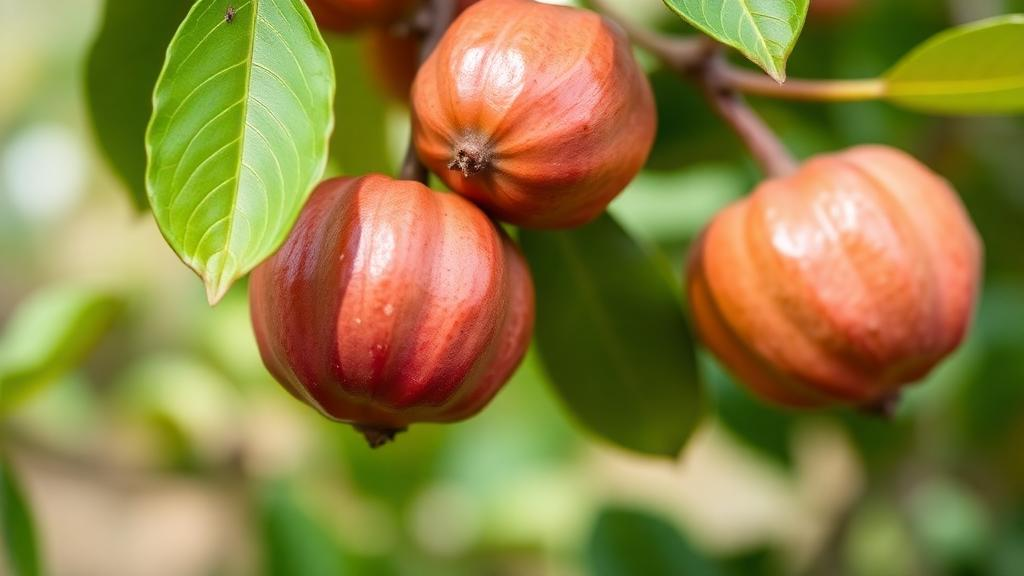
A team of researchers in Himachal Pradesh, India, has wrapped a beneficial soil bacterium in a microscopic armor made of seaweed extract, corn starch, and chitosan nanoparticles, and the result is a biofertilizer that stays alive on the shelf for a full year while dramatically boosting the growth of guava seedlings. The work, published in Discover Plants, tackles one of the most stubborn obstacles in sustainable agriculture: beneficial bacteria are wonderful in the lab but tend to die long before they ever reach a farmer’s field. By immobilizing the endophytic strain Serratia sp. ABU35 inside a composite biopolymer capsule, the researchers report encapsulation efficiency above 99 percent, sustained bacterial release over two months, and survival of nearly 9 log colony-forming units per gram after twelve months of refrigerated storage, a figure that dwarfs the performance of conventional liquid inoculants.
The bacterium at the heart of the study was not chosen at random. The team isolated eleven endophytic bacterial strains from surface-sterilized guava roots collected in Una district, Himachal Pradesh, and screened them for the classic toolkit of plant growth promotion: indole-3-acetic acid production, phosphate solubilization, siderophore secretion, hydrogen cyanide production, and antagonism against fungal pathogens. One isolate, designated U35, consistently outperformed the rest, solubilizing 342.20 micrograms of phosphate per milliliter, producing 93.10 micrograms per milliliter of the auxin IAA, and inhibiting the growth of Fusarium oxysporum by 57.67 percent and Rhizoctonia solani by 61.33 percent. Sequencing of its 16S rRNA gene, submitted to GenBank under accession number PX919715, placed the isolate in the genus Serratia, a group increasingly recognized for its dual talents as a growth promoter and a biocontrol agent.
Free-living inoculants, however, face a hostile world once they leave the fermenter. Introduced cells must compete with established soil microbes, endure temperature swings and desiccation, and survive months of transport and storage before they ever encounter a root. The standard answer to this problem is microencapsulation, the immobilization of viable cells within a polymer matrix that shields them from stress and meters out their release over time. Sodium alginate, a gel-forming polysaccharide derived from brown algae, is the workhorse material for this purpose because it is biodegradable, non-toxic, inexpensive, and gels under gentle room-temperature conditions. But plain alginate beads are porous and prone to cracking, which compromises both their mechanical integrity and the protection they afford.
The Indian team’s solution was to reinforce the alginate with two additives. Corn starch acts as a filler that reduces shrinkage and porosity, maintains the sphericity of the beads, and improves bacterial viability during drying and storage. Chitosan nanoparticles, particles of a deacetylated chitin derivative measuring 80 to 100 nanometers, bring biocompatibility, film-forming ability, and antimicrobial properties to the matrix. Crucially, the researchers found that the nanoparticles’ effect on the encapsulated bacterium is concentration dependent. At 25 micrograms per milliliter, chitosan nanoparticles showed no inhibitory effect on Serratia sp. ABU35, but at 100 to 200 micrograms per milliliter they produced clear zones of bacterial killing, with the largest inhibition zone, 21.33 millimeters, appearing at the highest concentration. That dose-response relationship dictated the formulation: 25 micrograms per milliliter was the sweet spot at which the nanoparticles could improve the matrix without massacring its cargo.
The capsules themselves were made by ionic external gelation, a technique in which a sterile solution of 2 percent sodium alginate, 2 percent corn starch, and the nanoparticle suspension is mixed with a concentrated bacterial suspension and dripped into calcium chloride. Calcium ions cross-link the alginate into a gel network within 30 to 45 minutes, trapping the cells inside ovoid to near-spherical beads roughly 100 micrometers in diameter. Field emission scanning electron microscopy revealed smooth surfaces with minor irregularities that the authors suggest may actually aid bacterial immobilization and controlled release. Fourier transform infrared spectroscopy confirmed the chemical integration of all three components, showing the overlapping hydroxyl and amine stretching bands expected of a composite, while X-ray diffraction demonstrated that the sharp crystalline peaks of the individual polymers broadened and attenuated in the composite, indicating a predominantly amorphous structure, a property generally associated with better solubility and release behavior.
Performance testing showed that the optimized formulation, dubbed AlgSC, excelled on every metric the team measured. Encapsulation efficiency reached 99.23 percent, a 6.39 percent improvement over plain alginate beads. The swelling ratio climbed to 156.67 percent and moisture content to 78.33 percent, both the highest among the formulations tested, reflecting the hydrophilic character that starch and chitosan impart to the matrix. When beads were immersed in saline for sixty days, viable cells leaked out slowly at first, reached roughly 10 to the sixth CFU per milliliter by day ten, surged to 10 to the eleventh by day forty, and then stabilized near 10 to the eighth CFU per milliliter. Fitting the data to standard release models revealed a biphasic pattern best described by zeroth-order kinetics, meaning the bacteria emerged at a nearly constant rate independent of the remaining cell population, exactly the behavior a slow-release agricultural product should exhibit.
Shelf life was the study’s headline achievement. After twelve months at 4 degrees Celsius, the encapsulated bacteria retained 8.94 log CFU per gram, a survival rate of 75.19 percent, and even at room temperature they maintained 5.66 log CFU per gram, surviving at 43.98 percent. Free cells fared far worse: liquid cultures lost most of their viability within months, retaining only 19.44 percent survival after nine months in the refrigerator and 40.74 percent after just three months at ambient temperature. Just as importantly, the encapsulated cells kept their functional talents. After a full year in storage, the immobilized bacteria still produced 47.85 micrograms per milliliter of IAA, compared with 30.50 for free cells, and continued to form visible halos of phosphate solubilization on Pikovskaya medium. Antifungal activity also persisted, with the encapsulated formulation inhibiting F. oxysporum by 49.33 percent and R. solani by 53.33 percent, modestly below the liquid culture but still substantial.
The real test came in the greenhouse. In a one-year pot trial at Dr. Y.S. Parmar University of Horticulture and Forestry, six-month-old guava plants received either nothing, a full recommended dose of chemical fertilizer, liquid Serratia culture, encapsulated bacteria without nanoparticles, encapsulated bacteria with nanoparticles, or a combination of liquid and encapsulated inoculant. Every growth parameter responded significantly to the encapsulated treatment. Compared with untreated controls, plants given the nanoparticle-loaded capsules showed 125.26 percent greater shoot length, 83.75 percent greater root length, 92.32 percent greater shoot biomass, 158 percent greater root biomass, 136.08 percent greater plant height, 104.71 percent greater leaf area, and 142.86 percent more leaves. Against the liquid culture treatment, the encapsulated formulation delivered further gains of 21 to 49 percent across the measured traits, and plants receiving capsules containing chitosan nanoparticles outperformed those given nanoparticle-free capsules by 21.03 percent in shoot biomass and 30.45 percent in root biomass. The best overall results came from combining the liquid and encapsulated forms, an outcome the authors attribute to free cells colonizing the rhizosphere quickly while the capsules sustain the population over time.
The soil itself changed under the treatment. Rhizosphere soil from plants given the combined inoculant recorded the highest levels of total nitrogen at 428.45 kilograms per hectare, available phosphorus at 47.40 kilograms per hectare, and available potassium at 346.33 kilograms per hectare, along with the largest populations of bacteria, fungi, and actinomycetes. Dehydrogenase activity, a proxy for overall microbial metabolism, rose from 2.47 to 3.14 micrograms of triphenyl formazan per gram of soil, and phosphatase activity climbed from 6.30 to 8.61 micrograms of p-nitrophenol per gram, while urease activity remained statistically unchanged. Principal component analysis confirmed that the encapsulated treatments separated cleanly from the control and fertilizer-only groups, with the first two components explaining 99.87 percent of the variation in growth attributes.
The authors are careful to note the limits of their evidence. The pot trial used sterilized soil, an artificial environment stripped of the native microbial competition that inoculants face in real orchards, and all results come from controlled conditions rather than open fields. Field validation will be needed before the capsules can be promoted as a genuine alternative to synthetic fertilizer for guava, a crop that ranks fourth in cultivated area in India and is prized as a nutritional powerhouse rich in vitamins A and C. Still, the study demonstrates something rare in biofertilizer research: a formulation that solves the shelf-life problem in a single, elegant materials-engineering step, preserving both the viability and the functional repertoire of a beneficial bacterium for a full year. If the greenhouse promise survives contact with real soil, nanoparticle-reinforced biopolymer capsules could become a standard delivery vehicle for the next generation of microbial crop inputs.
Subject of Research: Encapsulation of the endophytic bacterium Serratia sp. ABU35 in a sodium alginate-corn starch-chitosan nanoparticle matrix for controlled-release biofertilizer delivery in guava
Article Title: Development of an encapsulated biofertilizer using a sodium alginate-corn starch-chitosan nanoparticle matrix for improved shelf life and controlled delivery of Serratia sp. ABU35 to enhance growth performance of guava (Psidium guajava L.)
Article References: Kalotra, S., Chauhan, A., Thakur, M., Tomar, M., & Kumar, G. (2026). Development of an encapsulated biofertilizer using a sodium alginate-corn starch-chitosan nanoparticle matrix for improved shelf life and controlled delivery of Serratia sp. ABU35 to enhance growth performance of guava (Psidium guajava L.). Discover Plants, 3(1), Article 423. https://doi.org/10.1007/s44372-026-00891-8
Image Credits: AI Generated
DOI: 10.1007/s44372-026-00891-8
Keywords: biofertilizer, Serratia sp. ABU35, microencapsulation, sodium alginate, chitosan nanoparticles, corn starch, guava, plant growth-promoting bacteria, shelf life, controlled release, soil health, sustainable agriculture
Cite Scienmag News
Alan Morgan. (October 2, 2026). Nanoparticle Capsules Keep Guava Biofertilizer Alive for a Full Year. Scienmag. https://scienmag.com/nanoparticle-capsules-keep-guava-biofertilizer-alive-for-a-full-year/
Alan Morgan. "Nanoparticle Capsules Keep Guava Biofertilizer Alive for a Full Year." Scienmag, 2 October 2026, https://scienmag.com/nanoparticle-capsules-keep-guava-biofertilizer-alive-for-a-full-year/. Accessed 17 October 2026.
Alan Morgan. "Nanoparticle Capsules Keep Guava Biofertilizer Alive for a Full Year." Scienmag. October 2, 2026. https://scienmag.com/nanoparticle-capsules-keep-guava-biofertilizer-alive-for-a-full-year/


