


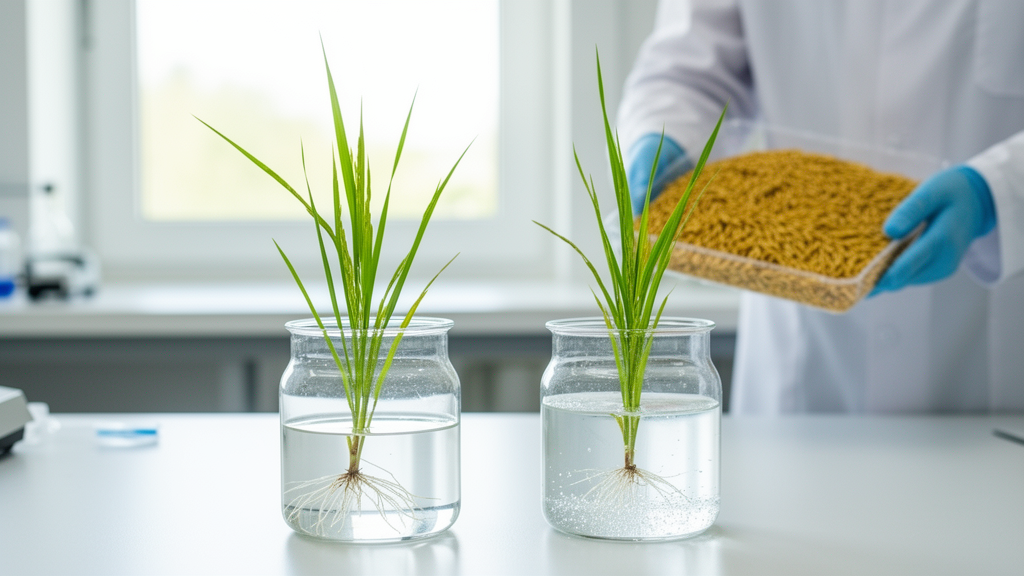
Salt is quietly strangling rice harvests across coastal South Asia, and a team at ICAR-Central Rice Research Institute in Cuttack, India, has now shown that a blast of gamma radiation can fix the problem without ruining what makes a premium rice variety worth growing. In a study published in the Indian Journal of Genetics and Plant Breeding, researchers led by Krishnendu Chattopadhyay irradiated seeds of Satabdi, a popular early-duration, long-slender grain variety widely cultivated in eastern India, and screened roughly 500 mutant lines across multiple generations. From that population, eight lines emerged with robust salinity tolerance, and the best of them carried nearly the entire genome of the parent variety while surviving salt levels that devastate the original.
The challenge the researchers set out to solve is one of the most stubborn in crop breeding. Introducing salinity tolerance into an adopted, farmer-favorite variety usually means crossing it with a tolerant donor and then spending years backcrossing to recover the original grain quality, often with mixed results. Mutation breeding offers a shortcut: bombard seeds with radiation, let the plants grow, and select individuals whose randomly mutated genes happen to confer stress tolerance. The risk is collateral damage, since radiation mutates the entire genome indiscriminately, potentially degrading the very traits that made the variety popular in the first place.
To generate the mutant population, the team treated Satabdi seeds with 300, 400, and 500 Gy doses of gamma rays, then advanced the surviving plants through successive generations to stabilize the mutations. By the fourth mutant generation, or M4, they had roughly 500 lines to work with. Screening at the seedling stage under salinity stress identified eight tolerant lines, designated SM-1 through SM-8, and the researchers confirmed that this tolerance persisted through the sixth mutant generation, ruling out chance environmental effects.
What makes the results technically striking is the physiological mechanism behind the tolerance. Under salt stress, the tolerant mutants accumulated significantly lower sodium ion concentrations in their shoots while maintaining higher potassium levels, resulting in lower sodium-to-potassium ratios than the parent Satabdi. This ion discrimination is the hallmark of effective salinity tolerance in rice, since excess sodium disrupts enzyme function and photosynthesis while potassium is essential for cellular processes. Lines SM-1, SM-6, and SM-8 scored a tolerance rating of 3 on the standard SES scale, indicating strong tolerance, while the remaining lines ranged from moderately tolerant to tolerant.
The researchers did not stop at the seedling stage, which is where many salinity studies end. They also evaluated the mutants under salinity stress at the reproductive stage, when the plant is forming grain and yield losses are most economically painful. Here the difference was dramatic: while Satabdi suffered a severe yield penalty with a yield stability index of just 0.22, the mutant lines maintained indices between 0.43 and 0.56, meaning they lost roughly half as much yield under salt stress. This dual-stage tolerance is rare and valuable, since tolerance at one life stage often does not translate to the other.
Perhaps the most important finding for farmers and consumers is what did not change. Using the standard DUS descriptors for distinctiveness, uniformity, and stability, the researchers found that all eight mutant lines were morphologically identical to Satabdi in every measured character except panicle length. Grain physicochemical analysis confirmed that the premium long-slender grain quality of the parent was largely retained across the mutants. For a variety whose market value depends on grain appearance and cooking properties, this preservation is the difference between a useful breeding product and an academic curiosity.
Molecular genotyping with trait-specific SNP markers confirmed the visual assessment. SM-1 and SM-3 retained approximately 96 percent of the Satabdi genome, meaning the radiation had introduced only a small number of targeted changes rather than scrambling the whole genome. Lines SM-2 and SM-8, which showed tolerance at both seedling and reproductive stages, carried higher numbers of mutated favorable alleles for stress tolerance, suggesting the radiation had hit multiple genes involved in salt response simultaneously.
The implications for coastal rice-growing regions, particularly in eastern India where Satabdi is widely grown, are significant. Salinity intrusion from rising seas and cyclone-driven storm surges is an escalating threat to rice productivity in these areas, and farmers there face a difficult choice between adopting tolerant varieties with unfamiliar grain quality or sticking with preferred varieties that fail under salt stress. Mutant lines derived from Satabdi could offer a third path: the same variety farmers already know and trust, but engineered through radiation to withstand the salt that increasingly threatens their fields.
The study also demonstrates the broader value of mutation breeding as a complement to conventional hybridization. While transgenic approaches and marker-assisted backcrossing have produced salt-tolerant rice lines, they face regulatory hurdles and require extensive breeding cycles. Gamma-ray mutagenesis, by contrast, generates genetic variation without introducing foreign DNA, and the resulting mutants can be deployed more rapidly. The researchers note that their work confirms gamma-ray-induced mutagenesis can generate promising salinity-tolerant lines that retain the parent’s agronomic and grain-quality traits, offering potential for deployment in coastal saline rice-growing areas.
What remains to be seen is how these mutants perform in multi-location field trials across diverse coastal environments and whether the tolerance holds up under the combined stresses of salinity, flooding, and temperature extremes that characterize real-world conditions. But the core result stands: eight lines, derived from a single premium variety through radiation alone, that survive salt stress at both seedling and reproductive stages while remaining genetically and morphologically nearly indistinguishable from the parent. For the millions of rice farmers on the front lines of soil salinization, that combination of tolerance and trait preservation may prove to be exactly what they need.
Subject of Research: Gamma-ray mutagenesis of the premium rice variety Satabdi to develop salinity-tolerant mutant lines retaining grain quality
Article Title: Integrative Phenotypic, Agro-morphological, Grain Physicochemical, and Molecular Characterization of Salinity-Tolerant Mutants Derived from the Premium Rice Variety Satabdi
Article References: Chattopadhyay, K., Molla, K. A., Anilkumar, C., Das, M. P., Preethi, B., Mohapatra, S. S., Dehury, P., Bagchi, T. B., Sarkar, S., Marndi, B. C., & Chakraborty, K. (2026). Integrative Phenotypic, Agro-morphological, Grain Physicochemical, and Molecular Characterization of Salinity-Tolerant Mutants Derived from the Premium Rice Variety Satabdi. Indian Journal of Genetics and Plant Breeding. https://doi.org/10.1007/s44489-026-00054-9
Image Credits: AI Generated
DOI: 10.1007/s44489-026-00054-9
Keywords: rice, salinity tolerance, gamma-ray mutagenesis, mutation breeding, Satabdi, grain quality, SNP genotyping, sodium-potassium ratio, coastal agriculture, crop yield stability, India, plant genetics
Cite Scienmag News
Alan Morgan. (October 17, 2026). Gamma-Ray Mutants Turn Premium Rice Variety Satabdi Salt-Tolerant Without Losing Grain Quality. Scienmag. https://scienmag.com/gamma-ray-mutants-turn-premium-rice-variety-satabdi-salt-tolerant-without-losing-grain-quality/
Alan Morgan. "Gamma-Ray Mutants Turn Premium Rice Variety Satabdi Salt-Tolerant Without Losing Grain Quality." Scienmag, 17 October 2026, https://scienmag.com/gamma-ray-mutants-turn-premium-rice-variety-satabdi-salt-tolerant-without-losing-grain-quality/. Accessed 17 October 2026.
Alan Morgan. "Gamma-Ray Mutants Turn Premium Rice Variety Satabdi Salt-Tolerant Without Losing Grain Quality." Scienmag. October 17, 2026. https://scienmag.com/gamma-ray-mutants-turn-premium-rice-variety-satabdi-salt-tolerant-without-losing-grain-quality/


