


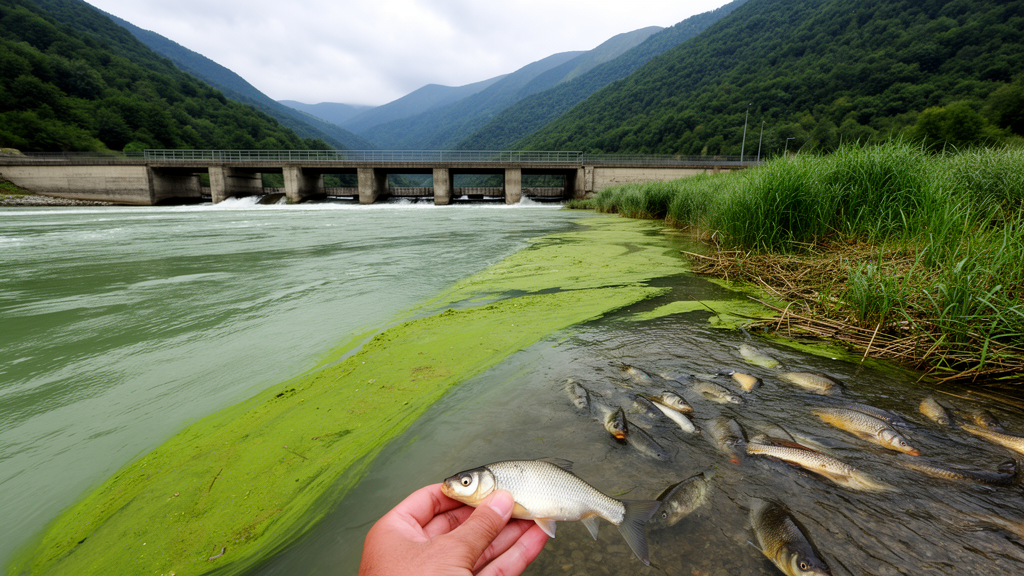
Deep in the Caucasus biodiversity hotspot, a river that has never been scientifically documented is now telling its story for the first time, and the picture is alarming. The Algeti River, a 118-kilometre waterway in southeastern Georgia that drains into the Caspian Sea basin, has been the subject of the first comprehensive survey of its fish diversity and distribution. Conducted between 2016 and 2022 across 17 sampling localities, the study identified 19 fish species belonging to 19 genera and 10 families. Of these, only nine are native to the Kura River basin, while six were introduced from Western Georgia’s Black Sea drainage and four are invasive in the Caucasus region. The findings reveal a river ecosystem fractured by a hydroelectric dam, poisoned by pollution, and increasingly dominated by non-native species that threaten the remaining native fish populations.
The Algeti River originates on the southern slopes of the Lesser Caucasus mountains at 1,900 metres above sea level, within the boundaries of Algeti National Park. With 188 tributaries stretching over 508 kilometres and a catchment area of approximately 762 square kilometres, the river supports a dense network of freshwater habitats in the Kvemo Kartli region. Yet despite this ecological richness, the fish fauna had never been studied or documented before this research. In the early 1980s, an Algeti hydro power plant dam was constructed on the river, and without any prior baseline data, it has been impossible to quantify the impact of the dam and its reservoir on fish communities or on the broader river ecosystem.
The dam, which lacks a fish pass, has effectively divided the Algeti River basin into three relatively isolated sections: the upstream river above the reservoir, the reservoir itself, and the downstream section below the dam. Each section now hosts a distinct fish community shaped by its own set of environmental conditions. The upstream section, flowing through steep, narrow riverbeds covered with boulders and large sandstones, is home to six species. The most notable is the Caspian trout (Salmo caspius), the only species found within the National Park, whose downstream limit lies a few kilometres upstream from the reservoir. This isolated headwater population is particularly vulnerable to local extinction.
The Algeti Reservoir, commissioned in 1983 primarily to store water for irrigation, covers 2.3 square kilometres at maximum water level and reaches depths of about 42 metres. The survey revealed ten fish species in the reservoir, with the non-native European perch (Perca fluviatilis) being the most abundant, representing 33.5% of the total catch. Four other species — gibel carp, Kura chub, khramulya, and European catfish — are also common, each comprising 10 to 17% of the catch. The remaining species, including pike-perch, common carp, Kura spirlin, Kura bleak, and stone moroko, are relatively rare, each making up less than 2% of the total.
The downstream section, extending from the dam to the confluence with the Kura River near Kesalo II village, is the most species-rich with 14 fish species. However, distribution here is highly heterogeneous. Only three species — Kura spirlin, Kura barbell, and rainbow trout — are found immediately below the dam. The rainbow trout entered the river from a trout farm near Tbisi village, just hundreds of metres from the dam. Further downstream, near Marabda village, eight species were recorded, but the picture deteriorates dramatically towards the Kura confluence, where irrigation water extraction and escalating pollution have created conditions too harsh for fish survival.
The mid-downstream section near Marneuli municipality represents the most degraded part of the river. Here, household waste and sewage pollution peak dramatically, with recent detections of ammonium compounds, sulphates, phenols, heavy metals, and petroleum products. The riverbed is covered with municipal sediment reaching 50 to 70 centimetres deep in places. A field survey at one location in this section yielded no fish species at all — the habitat is nearly sterile, devoid of even macroinvertebrates. Several native species from the Kura River basin, such as Luciobarbus mursa, Acanthobrama microlepis, and Alburnus chalcoides, would be expected to utilise the Algeti River but do not enter this section due to the pollution.
The introduction of non-native species poses a substantial and ongoing threat to the native fish fauna. Beyond the legally introduced common carp — whose population is now endangered, with only one individual caught in 2021 — most introductions have been accidental or illegal. Anglers deliberately released gibel carp, European catfish (approximately 16 years ago), European perch (2016-2017), and pike-perch (2022), all species of interest to recreational fishing. Accidental introductions include stone moroko, sharpbelly, monkey goby, Colchic gudgeon, and rainbow trout, which may have spread as hitchhikers with other species or entered independently via the Kura River. According to local fishermen, populations of all commercially important species in the reservoir have recently declined to extremely low densities following the introduction of European perch.
The ecological consequences of these pressures extend beyond fish alone. In the reservoir, the invasive crayfish Pontastacus leptodactylus has been introduced and was found in the gut contents of European catfish, contributing to a homogenised biota dominated by widespread non-native taxa. Poaching remains a significant negative factor throughout the river and reservoir, with numerous abandoned gill nets observed during periods of lowered water levels. Habitat modification, riparian forest clearance, excessive sediment input, and water abstraction for irrigation of 2,034 hectares of agricultural land near Marneuli have further degraded the ecosystem, reducing river flow to ecological minimum during dry seasons.
Two species found in the river — golden loach (Sabanejewia aurata) and Caspian trout (Salmo caspius) — are listed as vulnerable in the Red List of Georgia, and the river’s headwaters fall within a protected area. However, the researchers conclude that these conservation designations alone are insufficient to safeguard the local fish fauna. Effective conservation strategies must include stricter law enforcement against poaching and other illegal activities, better pollution control, and habitat modification management. An illegal steel barrier near Tbisi village, built by a restaurant owner for rainbow trout releases, further disrupts connectivity and violates Georgian administrative law. Without urgent and comprehensive intervention, the remaining native fish populations of the Algeti River face continued decline and potential local extinction.
This baseline study provides critical data for future research and conservation planning in the Caucasus biodiversity hotspot, where freshwater ecosystems are being degraded faster than any other terrestrial environments. With freshwater vertebrate populations having declined by 80% over the past 50 years — twice the rate seen in marine and terrestrial systems — the Algeti River serves as a stark reminder that even rivers flowing through protected landscapes cannot escape the cumulative impacts of dams, pollution, and invasive species. The researchers emphasise that preserving the biodiversity of this ecologically important water body requires immediate action to mitigate the negative pressures that have already pushed the river’s ecological condition to a critical state.
Subject of Research: Fish diversity, distribution and conservation threats in the Algeti River Basin, Georgia
Article Title: Distribution, community composition and vulnerability of fish species in the Algeti River Basin (Georgia)
Article References: Epitashvili, G., Ramazashvili, G., Japoshvili, B., & Mumladze, L. (2025). Distribution, community composition and vulnerability of fish species in the Algeti River Basin (Georgia). Caucasiana, 4, 45-58. https://doi.org/10.3897/caucasiana.4.e155494
Image Credits: AI Generated
DOI: 10.3897/caucasiana.4.e155494
Keywords: Algeti River, Georgia, freshwater fish, Caucasus biodiversity hotspot, invasive species, hydropower dam, water pollution, fish migration, conservation, Algeti Reservoir, Kura River basin, habitat degradation
Cite Scienmag News
Violet Maxwell. (October 17, 2026). Dam, pollution and invaders reshape fish life in Georgia’s Algeti River. Scienmag. https://scienmag.com/dam-pollution-and-invaders-reshape-fish-life-in-georgias-algeti-river/
Violet Maxwell. "Dam, pollution and invaders reshape fish life in Georgia’s Algeti River." Scienmag, 17 October 2026, https://scienmag.com/dam-pollution-and-invaders-reshape-fish-life-in-georgias-algeti-river/. Accessed 17 October 2026.
Violet Maxwell. "Dam, pollution and invaders reshape fish life in Georgia’s Algeti River." Scienmag. October 17, 2026. https://scienmag.com/dam-pollution-and-invaders-reshape-fish-life-in-georgias-algeti-river/


