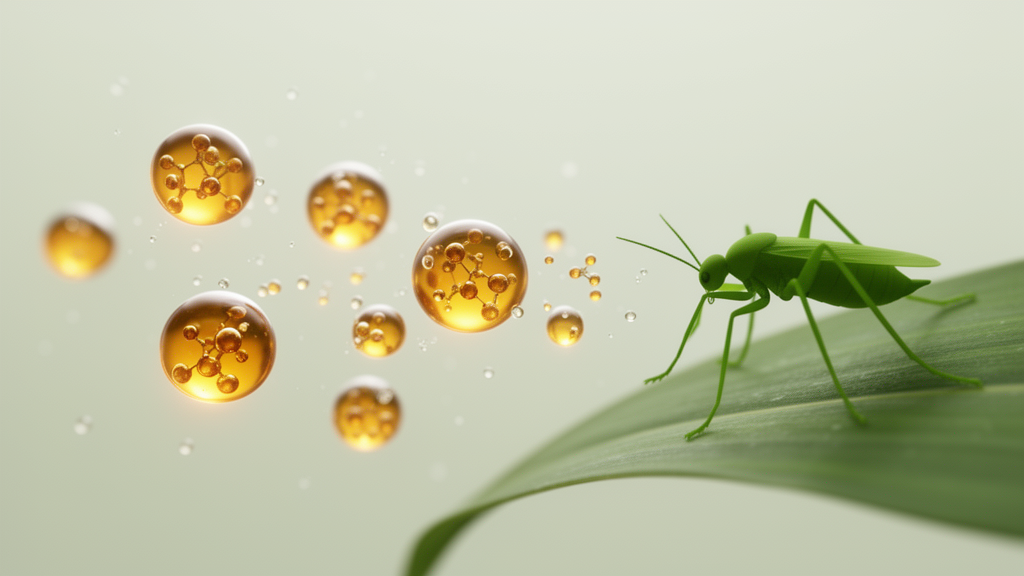
Essential oils from aromatic plants have long been known to kill or repel insects, but their volatility, poor water solubility and chemical instability have kept them from performing reliably in the field. A review published on 11 June 2026 in Biotechnology for Sustainable Materials argues that nanotechnology can close that gap. The authors, led by Parshant Mishra and Sonu Dwivedi, survey how essential oil nanoemulsions—droplets typically 20 to 200 nanometres across—improve the stability, bioavailability and targeting of plant-derived insecticides while limiting harm to non-target organisms.
The incentive is enormous. Recent estimates cited in the review indicate that 20 to 40 percent of global crop yields are lost each year to pest infestations, causing economic losses exceeding 220 billion US dollars. Termites alone are estimated to cost the global economy around 40 billion dollars annually, and insect damage during storage can claim up to 10 percent of the world’s grain supply, with developing countries particularly vulnerable. Synthetic insecticides remain the primary defence, but over half of the world’s insecticide consumption occurs in Asia, and older chemistry such as DDT, organophosphates, endosulfan and dieldrin carries neurotoxic and carcinogenic hazards while accumulating in terrestrial and aquatic food chains. Some insect species have also evolved resistance to chemical insecticides, sharpening the search for greener alternatives.
Essential oils—volatile, hydrophobic mixtures of monoterpenes, sesquiterpenes, phenylpropenes and aldehydes produced by more than 17,000 aromatic plant species—show neurotoxic, ovicidal, larvicidal and repellent effects against many pests. Their weakness is physical: they evaporate quickly, barely dissolve in water and degrade under field conditions. Nanoemulsions address all three problems at once. These oil-in-water or water-in-oil systems trap the active compounds in nanoscale droplets whose small size reduces the adhesive forces between droplets, giving the formulations kinetic stability against flocculation, coalescence and sedimentation. The tiny droplets also vastly increase the surface area available for contact with the insect cuticle, improving penetration into the hemolymph where the active compounds act.
Producing these formulations requires energy, and the review divides the methods into two camps. Low-energy approaches exploit the system’s own chemistry. In the phase inversion temperature method, changing temperature alters the surfactant’s affinity for the oil and water phases, driving emulsification without high shear; a black pepper essential oil nanoemulsion made this way reached a droplet size of 82.4 nanometres. Phase inversion composition achieves the same by adjusting the ratio of oil to aqueous phase, while spontaneous emulsification simply adds surfactant to the oil and mixes rapidly—a peppermint oil nanoemulsion made this way measured 50 nanometres and maintained storage quality for up to 90 days. Membrane emulsification pushes a coarse emulsion through pores of controlled size; using 20-nanometre-pore aluminium membranes, researchers produced droplets with mean diameters between roughly 50 and 90 nanometres. The trade-off is that low-energy methods depend heavily on surfactant type and concentration, and high surfactant loads risk phytotoxicity to exposed plants.
High-energy methods use mechanical force instead. High-pressure homogenizers force a coarse emulsion through a narrow aperture at 500 to 5000 psi, where turbulence, shear and cavitation shatter droplets to between 10 and 100 nanometres. Microfluidizers pump the liquid phases through intersecting microchannels at pressures up to 20,000 psi, colliding streams that shear the oil into stable nanodroplets; a clove oil formulation processed this way reached 66.9 nanometres. Ultrasonication, which the review calls the most efficient high-energy method for herbal nanoemulsions, uses a probe to generate cavitation—a cinnamon oil nanoemulsion treated at 400 W produced droplets as small as 25 nanometres. These techniques offer smaller droplets and greater formulation versatility but are energy-intensive, a point that returns later in the review’s assessment of industrial scalability.
Characterization is where the engineering becomes measurable. Dynamic light scattering reports droplet size and distribution, though it cannot resolve individual particles inside aggregates; transmission electron microscopy provides direct visual confirmation of morphology and true nanoscale size, imaging thyme and clove nanoemulsion droplets between 25.6 and 41.0 nanometres. Zeta potential signals physical stability: values at or beyond ±30 mV indicate electrostatic repulsion strong enough to keep droplets apart, while low values invite aggregation. A polydispersity index below 0.25 indicates a tight droplet distribution and long-term physical stability—one Nigella sativa oil nanoemulsion recorded 0.182. Differential scanning calorimetry probes thermal behaviour, showing, for example, that chitosan beads loaded with clove and peppermint oils remained stable up to 100 °C. Fourier-transform infrared spectroscopy identifies functional groups and confirms oil loading, nuclear magnetic resonance tracks molecular interactions and diffusion, refractometry assesses isotropy and stability, and atomic force microscopy resolves surface structure at high resolution.
The review’s survey of bioassays shows why the nanoemulsion route attracts attention. A jojoba oil nanoemulsion with 45 ± 5 nanometre droplets showed superior acaricidal and aphicidal action against the two-spotted spider mite Tetranychus urticae and the peach aphid Myzus persicae, with noticeably lower LC50 values than the bulk oil. A 1,8-cineole nanoemulsion of 14.7 nanometres delivered roughly 50 percent greater fumigant activity against T. urticae, the grain aphid Rhopalosiphum maidis and the whitefly Bemisia tabaci than the free monoterpenoid. Camphor nanoemulsion killed Spodoptera littoralis with an LC50 of 88.67 ppm, far below the bulk comparison. Peppermint and palmarosa nanoemulsions combined with the pyrethroid β-cypermethrin boosted that insecticide’s bioactivity 4.22 to 16 times and 3.90 to 10.6 times, respectively, against mosquito and stored-product pests. Against mosquitoes, a Deverra tortuosa oil nanoemulsion achieved 100 percent larval mortality of Aedes albopictus at 40 µl/mL and full repellency for up to 180 minutes, while a Vitex negundo formulation killed 94.33 percent of second- and third-instar Aedes aegypti larvae.
The picture is not uniformly rosy, and the review does not pretend otherwise. In a fumigant bioassay on American cockroaches, a Matricaria chamomilla nanoemulsion caused only 44.44 percent mortality at 10 mg/L after 72 hours, while the plain essential oil reached 100 percent within one hour. Garlic oil nanoemulsions showed strong larvicidal activity and reduced feeding in Spodoptera littoralis but also produced some phytotoxicity symptoms. Thyme-loaded nanostructured lipid carriers showed only moderate activity against western flower thrips, and rosemary carriers showed limited effects. These cases underline a recurring theme: nanoformulation changes delivery and persistence in ways that can help or hurt, and each oil–pest–formulation combination must be tested on its own merits.
Beyond simple nanoemulsions, the review catalogues a growing family of nanocarriers. Carum copticum oil loaded into myristic acid–chitosan nanogels was 8.9 times more toxic than the free oil against Sitophilus granarius and 3.7 times more toxic against Tribolium confusum after 48 hours of fumigant exposure. Nanoliposomes carrying thymol achieved an LC50 of 20 µg/mL against Aedes aegypti larvae. Electrospun nanofibers loaded with citronella oil in coaxial polyvinyl alcohol remained as effective as DEET in repellency bioassays even after a week. Composite films of basil and thyme nanoemulsions in cellulose nanocrystal matrices raised mortality of the rice weevil Sitophilus oryzae from 32 to 51 percent even after 14 days, and chitosan films aromatized with C. aurantium oil repelled the same pest for up to 28 days, with a median repellent time of 7.184 days.
The mechanism of action explains why resistance may develop more slowly than with single-target synthetics. Nanoemulsion droplets penetrate the insect cuticle, and the released compounds inhibit acetylcholinesterase, causing acetylcholine to accumulate at synapses and producing paralysis. Monoterpenes may also bind to octopamine receptors—a neurotransmitter system unique to insects and absent in mammals—disrupting neuromuscular coordination, while interference with GABA receptors triggers excessive neuronal excitation, tremors and convulsions. Simultaneously, the formulations suppress detoxification enzymes including cytochrome P450 monooxygenases, glutathione S-transferases, ATP-binding cassette transporters and mixed-function oxidases, undermining the insect’s ability to eliminate the toxin. This multi-target attack on nervous signalling, metabolism and respiration, the authors argue, lowers the likelihood of resistance development.
Whether any of this reaches a farmer’s sprayer depends on problems the review spells out candidly. Most published work comes from controlled laboratory settings; large-scale field trials are needed to test efficacy, persistence and environmental behaviour under real temperature swings, UV exposure and rainfall. Scaling high-pressure homogenization, microfluidization and ultrasonication to industrial throughput while keeping droplet size and encapsulation efficiency consistent remains unsolved, and long-term stability threats such as droplet aggregation, Ostwald ripening and phase separation persist during storage. Because nanoscale sizing can alter mobility, persistence and bioavailability in soil and aquatic ecosystems, comprehensive ecotoxicological assessment on pollinators, soil microbes and aquatic species is essential, and regulatory frameworks from bodies such as the OECD, the EPA and the FAO have yet to adapt specifically to nanoformulated biopesticides. Cost is the final barrier: specialized equipment and high-quality surfactants are expensive, pushing the authors toward biodegradable natural emulsifiers—proteins, polysaccharides, saponins and biosurfactants—and low-energy production methods as the path to economically viable, commercially applicable green insecticides.
Subject of Research: Use of essential oil nanoemulsions as enhanced eco-friendly insecticides against agricultural and public-health pests
Article Title: Nanoemulsified essential oils as next-generation insecticides: preparation, enhanced efficacy, and future prospects
Article References: Mishra, P., Singh, N., Chandraker, S. K., Ahirwar, G. K., Shukla, R., Rao, D. P., & Dwivedi, S. (2026). Nanoemulsified essential oils as next-generation insecticides: preparation, enhanced efficacy, and future prospects. Biotechnology for Sustainable Materials, 3(1), Article 10. https://doi.org/10.1186/s44316-026-00059-0
Image Credits: AI Generated
DOI: 10.1186/s44316-026-00059-0
Keywords: essential oils, nanoemulsions, bioinsecticides, nanotechnology, pest management, insecticidal mechanism, acetylcholinesterase inhibition, green pesticides, nanocarriers, integrated pest management, insect resistance, ecotoxicology
Cite Scienmag News
Alan Morgan. (October 28, 2026). Nanoemulsions Turn Volatile Essential Oils into Next-Generation Insecticides. Scienmag. https://scienmag.com/nanoemulsions-turn-volatile-essential-oils-into-next-generation-insecticides/
Alan Morgan. "Nanoemulsions Turn Volatile Essential Oils into Next-Generation Insecticides." Scienmag, 28 October 2026, https://scienmag.com/nanoemulsions-turn-volatile-essential-oils-into-next-generation-insecticides/. Accessed 29 October 2026.
Alan Morgan. "Nanoemulsions Turn Volatile Essential Oils into Next-Generation Insecticides." Scienmag. October 28, 2026. https://scienmag.com/nanoemulsions-turn-volatile-essential-oils-into-next-generation-insecticides/