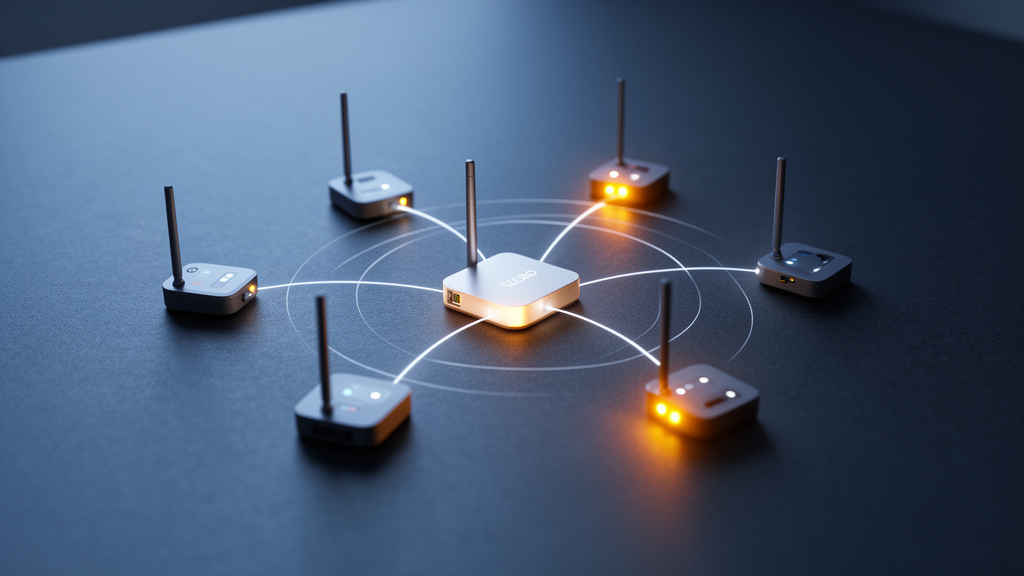
Battery-powered sensors in the Internet of Things face a stubborn problem: their radios burn through energy even when no data is flowing. A new systematic review published in Discover Internet of Things examines whether wake-up radio (WuR) technology, which lets nodes sleep in an ultra-low-power state until a signal wakes them, can solve this problem, and takes the first full inventory of the multi-hop routing protocols built around it. The authors, Ahmed S. Kashkool, Ariel Aguirre and Jochen Seitz, screened five major academic databases and selected 22 routing protocols described in 21 publications, covering work from 2002 to November 2025.
The core idea behind wake-up radio is simple. Each node carries a second, extremely frugal radio circuit called the wake-up receiver, which continuously monitors the channel for a specific wake-up signal while the main radio and microcontroller sit in deep sleep. The receiver draws only a few microwatts, so it can listen indefinitely. When a transmitter wants to communicate, it sends a wake-up signal; the receiver interrupts the microcontroller, the main radio switches on, data is exchanged, and everything powers down again. The wake-up transmitter, the wake-up receiver and the specially patterned signal itself form the three fundamental elements of the system.
This on-demand design attacks the main weakness of duty cycling, the technique most commonly used to save energy in wireless sensor networks. In duty cycling, a node wakes at predetermined intervals to listen for traffic, which wastes energy on idle listening and overhearing and forces a transmitting node to wait until its receiver happens to be awake. That sleep-wake mismatch compounds with every hop in a multi-hop network, as packets queue at intermediate nodes that are not yet active. Wake-up radio removes the scheduled listening entirely, but it introduces its own trade-offs, including the cost of extra hardware and the latency of transmitting the wake-up signal itself, which at low data rates such as 1 kbps can rival the delays of moderate duty cycling.
The most consequential limitation is a range mismatch. To keep the wake-up receiver’s power consumption in the microwatt range, its sensitivity must be reduced, and lower sensitivity means a shorter communication range than the main radio enjoys. Boosting the wake-up signal’s transmission power would drain the sender’s battery, so many designs instead rely on short-range multi-hop forwarding, which increases the number of hops, the end-to-end latency and the total node count. The review notes that this disparity between the two radios is what creates the multi-hop routing problem the surveyed protocols all attempt to solve.
To judge whether wake-up radio is actually ready for IoT networks, the authors compared several benchmark studies against duty-cycled medium access control protocols. In one comparison, the SCM-WuR platform achieved nearly 100% packet delivery in a single hop with average power consumption around 30 microwatts and a lifetime approaching 9000 days, with a wake-up latency of 12.2 milliseconds. In a static multi-hop scenario its lifetime fell to 140 days, but that still outperformed the best duty-cycled protocol tested, RI-MAC, which lasted only 20 days under the same traffic. In a mobile multi-hop scenario, SCM-WuR reached 1300 days against 119 days for RI-MAC at 2% duty cycling.
Other studies sharpen the picture of when the technology wins and when it does not. The cross-layer protocol ALBA-WuR consumed up to 100 times less energy than its duty-cycled counterpart ALBA-R at 1% duty cycling and up to 300 times less at 3%, with packet delivery holding constant at 100%, though its latency at 5 kbps was about twice that of ALBA-R with no duty cycling. Against preamble sampling, wake-up radio recorded 2.520 mW and 1.32 ms of latency versus 10.980 mW and 27 ms, but only for short ranges, since receiver sensitivity below −80 dBm limits applicability. Under heavy or saturated traffic, the advantage can invert entirely: one analysis found wake-up radio roughly 1000 times more efficient than synchronous and asynchronous MAC protocols in light traffic, yet worse than S-MAC once traffic became heavy or continuous. A latency-focused study concluded that for networks requiring under 100 ms of delay, wake-up radio consumed less than 1 mW where duty cycling needed at least 3.1 mW, making it especially promising for industrial wireless networks but considerably less effective where latency is not critical.
The review’s central contribution is a taxonomy of the 22 routing protocols. They divide first into routing-only designs, where decisions rest solely on the network layer, and cross-layer designs, which let information flow between layers so route choices reflect the state of the whole stack. By network structure, the protocols split into flat, hierarchical and location-based schemes, with hierarchical further divided into cluster-based and tree-based families. By routing metric, they range from hop-count, energy-awareness, bandwidth, load-balancing and flood-based approaches to quality-of-service and multi-criteria designs that weigh several parameters at once, such as residual energy, delay, link quality and node mobility.
Representative protocols illustrate the design space. CTP-WUR extends the Collection Tree Protocol by relaying wake-up requests through intermediate nodes, achieving 65 ms end-to-end latency, a packet delivery ratio of 99.999% and network lifetimes of 10 to 33 years, though it suffers from a single point of failure when a parent node goes down. REFLOOD floods wake-up signals across the WuR link with a hop-count field and forwarding timers to suppress duplicates, extending network lifetime by 300% compared with traditional solutions while matching ContikiMAC’s roughly 99% delivery rate. GreenRoutes and its successors WHARP and G-WHARP combine energy harvesting with semantic addressing and Markov decision processes to pick energy-rich relays; G-WHARP consumed 59% less energy than GreenRoutes in low-traffic simulations and delivered packets up to 2.9 times faster in moderate traffic. CMH-CLP, a fuzzy-inference clustering protocol, improved energy efficiency by 200 to 300% over comparison protocols even at 1000 nodes, though it did not report latency.
The comparative analysis yields a clear pattern: cross-layer protocols generally outperform routing-only designs in energy efficiency and packet delivery because they exploit link quality, queue state and collision history, but their complexity makes them better suited to small networks, while routing-only protocols remain competitive in static topologies where simplicity matters. Hierarchical structures suit static deployments but are vulnerable to single points of failure, and none of the surveyed hierarchical protocols addresses node mobility. Flat protocols adapt more easily but concentrate energy drain near the sink, and location-based routing such as ALBA-WuR achieves excellent delivery and energy figures but needs positioning information and adds latency when selecting relays toward the sink.
The authors close with four open problems that temper the technology’s promise. Most protocols have been validated only in simulators such as GreenCastalia, COOJA and MATLAB, and the few tested on real hardware, including CWM, TEW, T-ROME, RS-CPR and ZIPPY, were confined to small-scale, static, indoor networks, with no outdoor validation at all. Mobility is almost entirely absent from performance evaluations. Security is unaddressed: existing addressing schemes guard against accidental false wake-ups, but no surveyed protocol handles adversarial wake-up signal attacks, in which malicious nodes transmit signals to drain batteries or disrupt routing, and no cryptographic authentication compatible with microwatt receivers has been investigated. Scalability is similarly thin, with only four protocols reporting network size, most under five nodes; CMH-CLP’s 1000-node evaluation stands alone. The review concludes that wake-up radio can substantially reduce power consumption under low-to-moderate traffic, but that large-scale, outdoor, mobile and adversarial testing remains an open requirement before its energy benefits can be considered conclusively established.
Subject of Research: A systematic review of multi-hop routing protocols for wake-up radio driven IoT networks
Article Title: A systematic review and emerging research directions for multi hop routing protocols in wake up radio driven IoT networks
Article References: Kashkool, A. S., Aguirre, A., & Seitz, J. (2026). A systematic review and emerging research directions for multi hop routing protocols in wake up radio driven IoT networks. Discover Internet of Things, 6(1), Article 207. https://doi.org/10.1007/s43926-026-00526-0
Image Credits: AI Generated
DOI: 10.1007/s43926-026-00526-0
Keywords: wake-up radio, IoT, wireless sensor networks, routing protocols, energy efficiency, duty cycling, multi-hop routing, systematic review, network lifetime, packet delivery rate, cross-layer design, low-power communication
Cite Scienmag News
Denise Maddox. (October 29, 2026). Wake-up radio routing for IoT: a systematic review maps 22 protocols and open gaps. Scienmag. https://scienmag.com/wake-up-radio-routing-for-iot-a-systematic-review-maps-22-protocols-and-open-gaps/
Denise Maddox. "Wake-up radio routing for IoT: a systematic review maps 22 protocols and open gaps." Scienmag, 29 October 2026, https://scienmag.com/wake-up-radio-routing-for-iot-a-systematic-review-maps-22-protocols-and-open-gaps/. Accessed 29 October 2026.
Denise Maddox. "Wake-up radio routing for IoT: a systematic review maps 22 protocols and open gaps." Scienmag. October 29, 2026. https://scienmag.com/wake-up-radio-routing-for-iot-a-systematic-review-maps-22-protocols-and-open-gaps/