


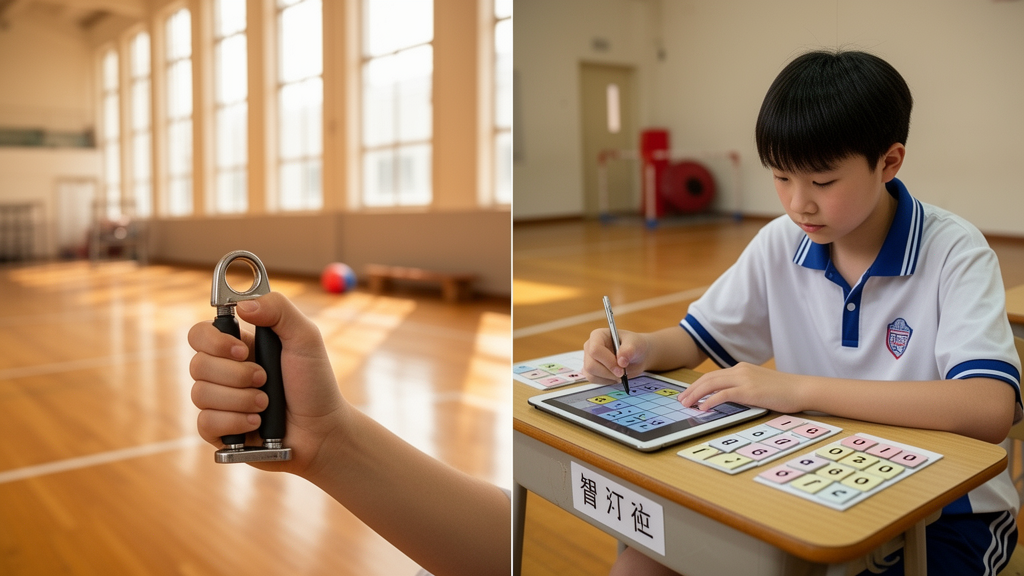
A large cross-sectional study of Chinese adolescents has found that greater muscle strength is associated with better performance on specific components of executive function. Researchers assessed 10,145 adolescents aged 13 to 18 years, recruited through stratified cluster random sampling across five distinct regions of China. Each participant completed measures of grip strength and the standing long jump, from which the team derived a composite muscle strength index, alongside tests of executive function and relevant covariates.
The analysis revealed a consistent pattern: in stratified analyses, higher muscle strength index values were associated with progressively lower odds of showing deficits in executive function during mid-to-late adolescence. The association was not uniform across cognitive domains. After adjusting for relevant covariates, each one-standard-deviation increase in the muscle strength index corresponded to faster reaction times for working memory (a reduction of 41.185 milliseconds) and shifting (a reduction of 20.311 milliseconds), with all comparisons reaching statistical significance at P < 0.01. Inhibition showed a much smaller difference of 0.254 milliseconds, and the authors concluded that muscle strength correlates with working memory and shifting abilities but shows no association with inhibitory control.
Sex differences added a notable layer to the findings. The inverse association between muscle strength and working-memory insufficiency was stronger in girls, with an odds ratio of 0.802 (95% confidence interval: 0.763–0.843, P = 0.006), than in boys, whose odds ratio was 0.888 (95% confidence interval: 0.792–0.996, P = 0.006). In practical terms, higher muscle strength was linked to lower odds of working-memory deficits in both sexes, but the magnitude of that association appeared larger among girls.
Executive function is regarded as a core cognitive function of the brain, encompassing working memory, inhibitory control, and cognitive shifting, and it holds significant importance for adolescents’ academic performance and future achievements. Prior research on the strength-cognition link in this age group has been relatively limited, and the authors note that the present study may provide theoretical support for promoting and intervening on executive function in Chinese adolescents. The large, regionally diverse sample strengthens the observational evidence base, but the study’s cross-sectional nature means the data capture a single point in time and cannot establish whether stronger muscles lead to sharper cognition, whether cognitively capable adolescents are simply more physically active, or whether shared factors drive both.
The research team is explicit about this limitation: because the data are cross-sectional, longitudinal and intervention studies are needed to determine whether promoting muscle strength can actually enhance executive function. Until such studies are conducted, the findings stand as an association rather than a causal effect, and they highlight working memory and cognitive shifting, rather than inhibition, as the domains most tightly coupled to muscular strength in this population of Chinese adolescents.
Subject of Research: The association between muscle strength and executive function in Chinese adolescents
Article Title: The associations between muscle strength and executive function among Chinese adolescents
Article References: Li, L., Zhang, M., Zhang, F., Bi, C., & Sun, P. (2026). The associations between muscle strength and executive function among Chinese adolescents. Scientific Reports. https://doi.org/10.1038/s41598-026-76586-7
Image Credits: AI Generated
DOI: 10.1038/s41598-026-76586-7
Keywords: muscle strength, executive function, adolescents, working memory, cognitive shifting, inhibition, grip strength, standing long jump, cross-sectional study, China, physical fitness, associations
Cite Scienmag News
Denise Maddox. (October 26, 2026). Muscle Strength Linked to Working Memory and Shifting in Chinese Teens. Scienmag. https://scienmag.com/muscle-strength-linked-to-working-memory-and-shifting-in-chinese-teens/
Denise Maddox. "Muscle Strength Linked to Working Memory and Shifting in Chinese Teens." Scienmag, 26 October 2026, https://scienmag.com/muscle-strength-linked-to-working-memory-and-shifting-in-chinese-teens/. Accessed 26 October 2026.
Denise Maddox. "Muscle Strength Linked to Working Memory and Shifting in Chinese Teens." Scienmag. October 26, 2026. https://scienmag.com/muscle-strength-linked-to-working-memory-and-shifting-in-chinese-teens/


