


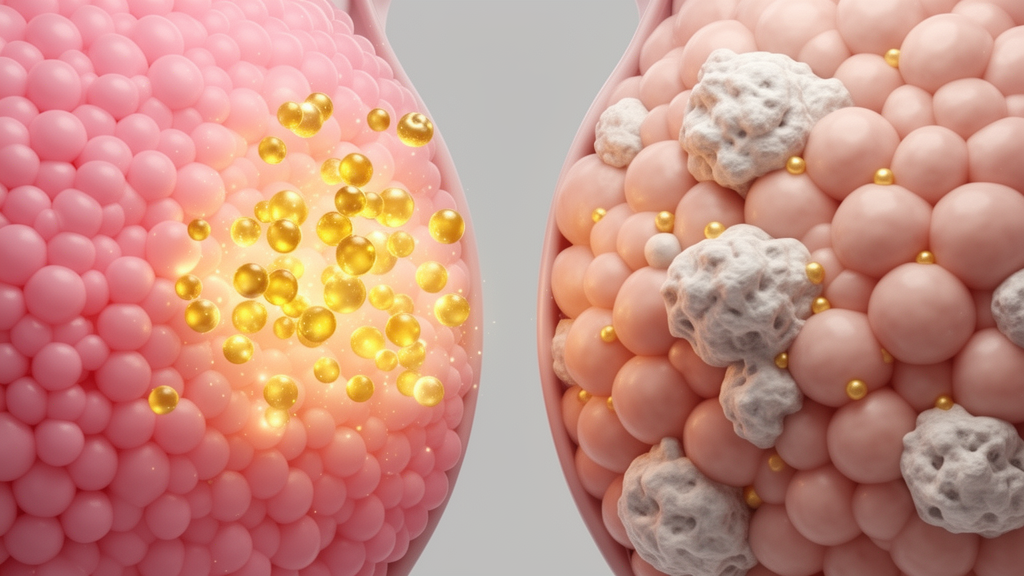
Obesity appears to disable one of the body’s own defenses against breast cancer, according to a new study from Huntsman Cancer Institute at the University of Utah. Researchers led by Keren Hilgendorf, PhD, and first author Meghan Curtin report in the journal Science that fat cells in lean breast tissue produce a fatty acid molecule called 9S-HODE, which promotes the death of cancerous cells, and that this molecule is markedly reduced in obese tissue. In preclinical models, restoring 9S-HODE in obese fat cells suppressed breast tumor growth, suggesting that the loss of this lipid — rather than only the gain of tumor-promoting signals — may help explain why obesity is a risk factor for the disease.
The finding emerged from a shift in perspective. Breast tissue is largely composed of fat, particularly fat cells known as adipocytes, and these cells differ dramatically depending on body weight. In obesity, adipocytes become enlarged compared with their lean counterparts, and the two cell states create distinctly different microenvironments surrounding potential cancer cells. “We uncovered the role of a molecule that normally appears in lean tissue that restrains breast cancer growth but is less present with obesity,” said Hilgendorf, a Huntsman Cancer Institute investigator and assistant professor of biochemistry at the University of Utah, and senior author of the study. “We know obesity is often a driver of breast cancer, and researchers in our field usually consider how obesity is promoting the disease. But we hadn’t really considered that obesity could also be the loss of something that naturally protects us.”
The molecule at the center of the study, 9S-HODE, is an oxylipin — a lipid derived from fatty acids — that plays an important role in promoting cell death, particularly a form of programmed cell death called ferroptosis. Ferroptosis is one of the mechanisms the body uses to purge old and damaged cells, including cells that could become cancerous. Using preclinical models that included breast tissue from human donors, the team found that lean adipocytes produce substantially more 9S-HODE than obese adipocytes. “This means that cancerous cells die more readily in lean tissue,” said Curtin, a doctoral candidate in molecular biology at the University of Utah. “By producing more 9S-HODE, our bodies are actively protecting us, under lean circumstances, in a way it cannot with obesity.”
The therapeutic implications were tested directly in preclinical mouse models. When the researchers increased the amount of 9S-HODE in the obese adipocytes of these models, breast cancer tumor growth was suppressed. Because the lipid is naturally present in the body and simply diminished in obesity, the authors argue that replenishing it could offer a feasible strategy for slowing breast cancer growth. “From a clinical perspective, this discovery is incredibly empowering,” Hilgendorf said. “Because 9S-HODE is naturally present in the body but is lost with obesity, we may be able to restore this protection by putting it back. That could become a very feasible therapeutic approach to slow breast cancer growth.”
The researchers are careful to frame the scope of the work. Obesity is only one of many factors that contribute to breast cancer, and the disease can develop for reasons unrelated to body weight. The team also notes that 9S-HODE appears to be produced primarily by fat cells within the breast, although fat cells elsewhere in the body may carry out a similar protective function — a question that will require further research. The findings so far come from preclinical systems, including donor tissue and mouse models, and the researchers describe their work as an early step rather than an established therapy. “We believe this shift in the understanding of the roles of lean and obese adipocytes is the start of something,” Curtin said. “This is just one discovery, and it’s not the end of the road. This opened our eyes to new ways to think about science, and hopefully we can harness what our bodies are already doing to make progress against this disease.”
Subject of Research: Obesity may remove a natural defense against breast cancer
Article Title: Obesity may remove a natural defense against breast cancer
Article References: Obesity may remove a natural defense against breast cancer. Original publication (Bibliographic details unavailable.)
Image Credits: AI Generated
DOI: Not provided
Keywords: Obesity, remove, natural, defense, against, breast, cancer, scientific research
Cite Scienmag News
Nathaniel Bowman. (October 26, 2026). Obesity strips away a fatty molecule that naturally suppresses breast cancer. Scienmag. https://scienmag.com/obesity-strips-away-a-fatty-molecule-that-naturally-suppresses-breast-cancer/
Nathaniel Bowman. "Obesity strips away a fatty molecule that naturally suppresses breast cancer." Scienmag, 26 October 2026, https://scienmag.com/obesity-strips-away-a-fatty-molecule-that-naturally-suppresses-breast-cancer/. Accessed 26 October 2026.
Nathaniel Bowman. "Obesity strips away a fatty molecule that naturally suppresses breast cancer." Scienmag. October 26, 2026. https://scienmag.com/obesity-strips-away-a-fatty-molecule-that-naturally-suppresses-breast-cancer/


