


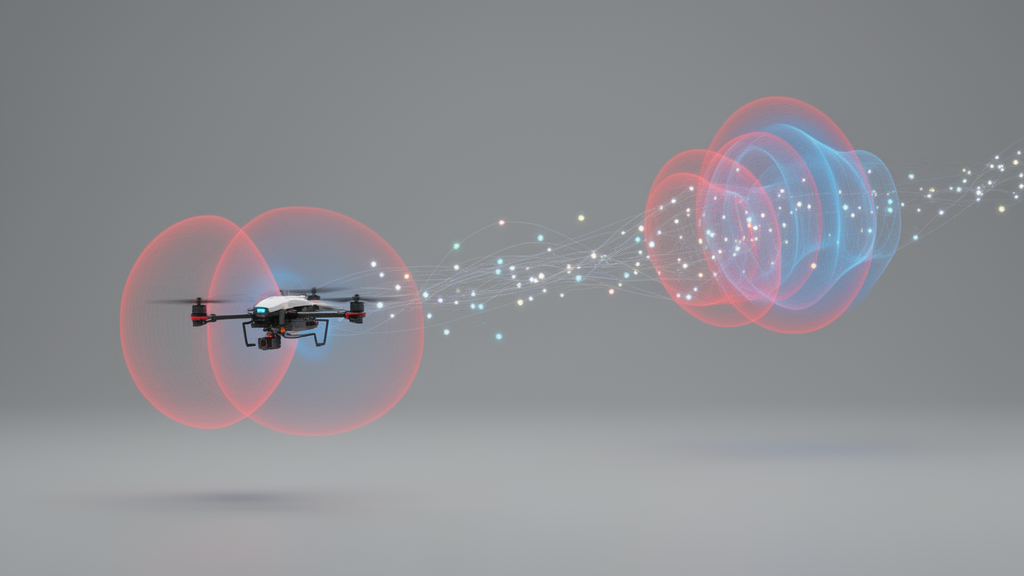
Researchers have developed a hybrid artificial intelligence framework that reconstructs three-dimensional electric field distributions from sparse, irregularly spaced airborne measurements, according to a peer-reviewed study published in Scientific Reports. The work, carried out by Joanna Michałowska and Paweł Tomiło and published on 22 October 2026 as an open-access article, addresses a growing challenge in general aviation: as aircraft systems become increasingly electrified and autonomous technologies mature, accurate characterization of electromagnetic field (EMF) distributions under real operational conditions is needed, yet dense in-flight measurements are difficult to obtain.
The study draws on more than 80 hours of real-world measurements collected during operational activities involving four aircraft types. A low-cost, high-sensitivity sensing platform recorded synchronized electric-field and geospatial data across the 1-8000 MHz frequency range, providing the raw material for the reconstruction task.
Because airborne observations are typically sparse, irregularly distributed, and gathered under varying flight conditions, the team treated the problem as one of three-dimensional spatial reconstruction from limited data points rather than direct dense mapping of the airspace.
To solve this reconstruction problem, the researchers evaluated several geostatistical and machine-learning approaches, including Kriging, Kolmogorov-Arnold Networks, and Exact Gaussian Processes, comparing their performance on the airborne dataset.
Based on this comparison, the team built a hybrid model called the Deep Gaussian Process Kolmogorov-Arnold Feature Extractor, abbreviated DGKAN. According to the authors, the model combines nonlinear feature representation with probabilistic spatial modeling and uncertainty estimation, pairing the strengths of the tested approaches in a single framework.
DGKAN achieved the highest predictive accuracy among all tested models, with a mean absolute error of 0.0381 and a mean squared error of 0.0071. Relative to the strongest baseline model, the hybrid approach reduced the mean absolute error by approximately 27.6 percent.
The authors report that these results demonstrate that pairing Kolmogorov-Arnold representations with probabilistic Gaussian Process modeling enables accurate reconstruction of three-dimensional electromagnetic field distributions from sparse airborne measurements. The reported accuracy figures apply to the electric field component recorded by the sensing platform across the four aircraft types and flight conditions included in the study.
The framework offers a data-driven approach for electromagnetic environment assessment in general aviation and, according to the authors, establishes a basis for further development of intelligent EMF monitoring and prediction methods under operational flight conditions.
As the study scope covers four aircraft types and the measurement conditions of the collected dataset, the reported reconstruction accuracy reflects the operational general aviation settings in which the data were gathered rather than a universal mapping capability across all aviation environments.
Subject of Research: AI-based three-dimensional reconstruction of electromagnetic fields from airborne measurements in general aviation
Article Title: A hybrid artificial intelligence framework for three-dimensional electromagnetic field mapping using airborne measurements in general aviation
Article References: Michałowska, J., & Tomiło, P. (2026). A hybrid artificial intelligence framework for three-dimensional electromagnetic field mapping using airborne measurements in general aviation. Scientific Reports. https://doi.org/10.1038/s41598-026-77076-6
Image Credits: AI Generated
DOI: 10.1038/s41598-026-77076-6
Keywords: artificial intelligence, electromagnetic fields, general aviation, Gaussian Processes, Kolmogorov-Arnold Networks, Kriging, airborne measurements, spatial reconstruction, uncertainty estimation, Scientific Reports, hybrid model, DGKAN
Cite Scienmag News
Denise Maddox. (October 26, 2026). Hybrid AI reconstructs 3D electromagnetic fields from sparse airborne measurements. Scienmag. https://scienmag.com/hybrid-ai-reconstructs-3d-electromagnetic-fields-from-sparse-airborne-measurements/
Denise Maddox. "Hybrid AI reconstructs 3D electromagnetic fields from sparse airborne measurements." Scienmag, 26 October 2026, https://scienmag.com/hybrid-ai-reconstructs-3d-electromagnetic-fields-from-sparse-airborne-measurements/. Accessed 26 October 2026.
Denise Maddox. "Hybrid AI reconstructs 3D electromagnetic fields from sparse airborne measurements." Scienmag. October 26, 2026. https://scienmag.com/hybrid-ai-reconstructs-3d-electromagnetic-fields-from-sparse-airborne-measurements/


