


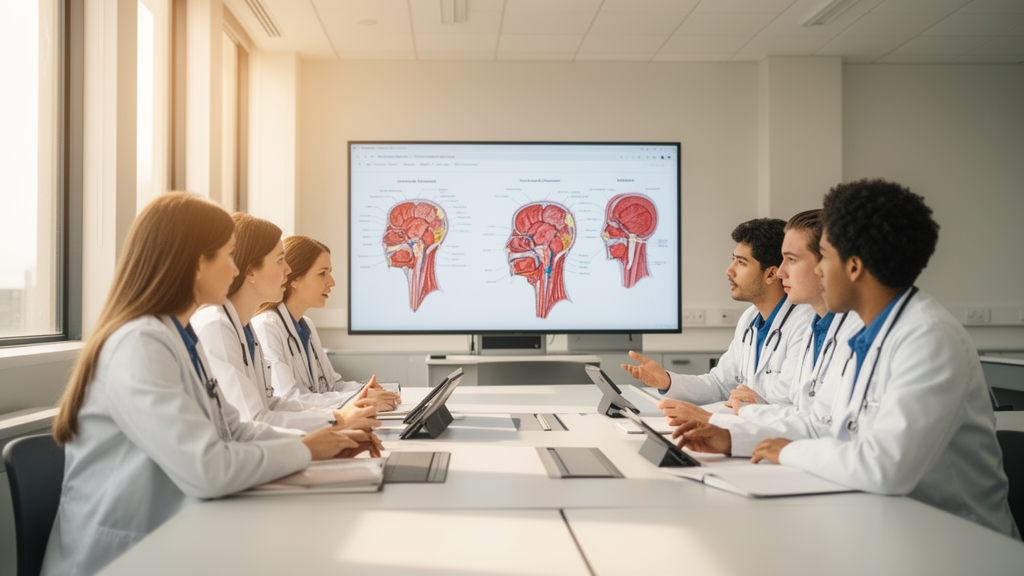
Medical students at a Japanese university perceived a patient's condition more clearly and weighed a wider range of differential diagnoses when problem-based learning cases were presented with video, audio, and imaging rather than text alone, according to a comparative study of three sequential cohorts published in BMC Medical Education. The research, led by Yuriko Abe and colleagues at Nihon University School of Medicine, followed third-year medical students through problem-based learning sessions on three diseases between 2021 and 2023, comparing traditional text-based scenarios with multimedia versions that incorporated medical interview videos, recorded auscultation sounds, and computed tomography imaging videos. Textual cases remain the most common format in problem-based learning, but the authors note that students often find it difficult to fully understand a patient's condition on the basis of written descriptions alone.
The study set out to compare multimedia and text-based scenarios with respect to two outcomes: how well students believe they understand the patient, and which topics they choose to explore in the written reports they submit after each session. The cohorts were sequential rather than randomized. A total of 123, 114, and 118 students enrolled in 2021, 2022, and 2023, respectively, each working through scenarios on Parkinson's disease, lung cancer, and hypersensitivity pneumonitis.
After each session, students completed a survey and submitted a report, and the researchers categorized the report topics into three groups: symptoms, physical and diagnostic findings, and differential diagnoses. Because the cohorts were studied in sequence rather than randomly assigned, the findings describe associations observed across cohorts, not the effect of a controlled intervention. The clearest result concerned the Parkinson's disease scenario, which presented visible symptoms such as tremors and gait abnormalities.
In that scenario, 83 percent of students reported that they could understand the patient's condition, significantly more than the 58 percent who said so for lung cancer or the 53 percent for hypersensitivity pneumonitis. For the two diseases that are identified mainly through tests rather than visible signs, the multimedia additions changed what students wrote about. Introducing auscultation sounds and computed tomography imaging videos was significantly associated with a higher proportion of students selecting differential-diagnosis topics in the lung cancer scenario, with a p-value below 0.05, and in the hypersensitivity pneumonitis scenario, with a p-value below 0.01.
When students could hear abnormal breath sounds or view lung imaging, their written reports ranged more broadly across alternative diagnoses that needed to be considered and ruled out. The multimedia medical interviews also appeared to be associated with different patterns of student responses depending on the characteristics of each disease. Greater perceived understanding was observed for Parkinson's disease, where the interview made motor symptoms directly visible, while broader consideration of differential-diagnosis topics emerged for lung cancer and hypersensitivity pneumonitis, where imaging and auscultation carried the diagnostic weight.
Tutors, who observe the discussions directly, generally reported that students could understand the patient's condition in the multimedia scenarios. Taken together with the student survey data, this indicates that the perceived gains were not confined to student self-report alone. The authors are careful about what their design can and cannot show.
Because the three cohorts were studied in sequence, cohort-to-cohort differences other than the scenario format could have contributed to the observed patterns, and the outcomes measured were students' perceptions and their chosen report topics rather than objective measures of diagnostic reasoning skill. The conclusions are therefore framed in associative terms: multimedia scenarios were associated with greater perceived understanding of patient conditions and broader consideration of differential-diagnosis topics, compared with traditional text-based formats. For diseases with prominent physical features, multimedia medical interviews were particularly associated with students' perceived understanding of the patient's condition, while for diseases identified mainly through imaging or auscultation, the multimedia elements were associated with broader consideration of differential-diagnosis topics during discussion.
The authors conclude that the use of multimedia in problem-based learning may be associated with both perceived understanding of patient conditions and broader consideration of differential-diagnosis topics in PBL discussions.
Subject of Research: Multimedia scenarios in problem-based learning for Japanese medical students
Article Title: Impact of multimedia scenarios on students’ perceptions and discussion tendencies in problem-based learning: a comparative study of three sequential cohorts among Japanese medical students
Article References: Abe, Y., Jego, E. H., Maruoka, S., Nakajima, H., Otani, N., Suzuki, S., Taniguchi, T., Uchiumi, Y., Masuda, S., & Hidai, C. (2026). Impact of multimedia scenarios on students’ perceptions and discussion tendencies in problem-based learning: a comparative study of three sequential cohorts among Japanese medical students. BMC Medical Education. https://doi.org/10.1186/s12909-026-10302-x
Image Credits: AI Generated
DOI: 10.1186/s12909-026-10302-x
Keywords: problem-based learning, medical education, multimedia scenarios, differential diagnosis, Parkinson's disease, lung cancer, hypersensitivity pneumonitis, Japanese medical students, auscultation, computed tomography, Impact, multimedia
Cite Scienmag News
Courtney Benton. (October 26, 2026). Multimedia Scenarios Linked to Better Perceived Understanding in Medical PBL. Scienmag. https://scienmag.com/multimedia-scenarios-linked-to-better-perceived-understanding-in-medical-pbl/
Courtney Benton. "Multimedia Scenarios Linked to Better Perceived Understanding in Medical PBL." Scienmag, 26 October 2026, https://scienmag.com/multimedia-scenarios-linked-to-better-perceived-understanding-in-medical-pbl/. Accessed 26 October 2026.
Courtney Benton. "Multimedia Scenarios Linked to Better Perceived Understanding in Medical PBL." Scienmag. October 26, 2026. https://scienmag.com/multimedia-scenarios-linked-to-better-perceived-understanding-in-medical-pbl/


