


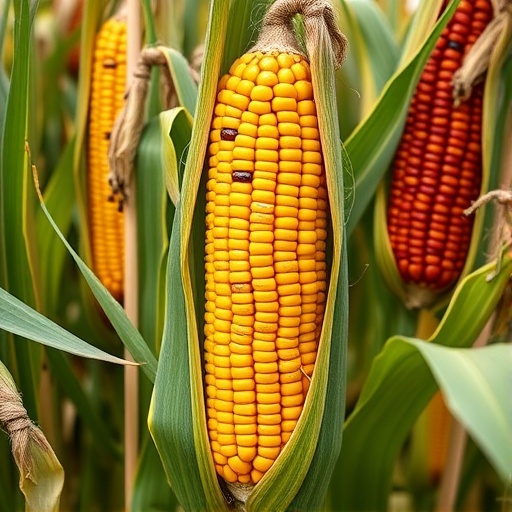
Southern corn rust, a fast-moving fungal disease capable of cutting maize yields across warm agricultural regions, may be confronted more effectively by combining genetic resources from temperate and tropical maize. A new study in Plant Cell Reports has compared the molecular defenses of two highly resistant maize inbred lines and found that they reach a similar level of protection through strikingly different biological routes. The findings suggest that durable resistance will not come from a single universal defense gene, but from assembling complementary immune strategies that operate at different stages of pathogen invasion.
Southern corn rust is caused by Puccinia polysora, a fungus that produces airborne spores capable of spreading rapidly through maize fields. Once the pathogen reaches a susceptible leaf, it can establish infection, form rust pustules and divert plant resources toward fungal growth. Severe epidemics reduce photosynthetic capacity and can cause major yield losses, particularly in warm and humid environments where the disease thrives. Although breeders have identified resistant maize lines, the genetic and biochemical mechanisms behind that resistance remain complex. Some forms depend on highly specific immune receptors, while others rely on broader physiological barriers that are less easily overcome by evolving pathogen populations.
The research team examined two resistant inbred lines representing contrasting maize gene pools. R241, designated Temp_R, originated from a temperate background, while Nei50205, designated Tr_R, represented tropical maize. Both lines displayed stable, high-level resistance to southern corn rust, but their early responses to infection differed. The tropical line produced callose deposits more rapidly and showed stronger signs of cell-wall reinforcement. Callose is a glucose-based polymer that plants deposit around attempted penetration sites. By rapidly sealing the cell wall and narrowing channels between neighboring cells, callose can create a physical barrier that slows or prevents fungal entry and movement.
To investigate the underlying mechanisms, the scientists integrated several layers of biological data. They combined disease phenotyping with transcriptomics, which measures changes in gene activity, and metabolomics, which tracks shifts in small molecules produced by the plant. They also used weighted gene co-expression network analysis, or WGCNA, to identify groups of genes whose activity changed together during infection. This network-based approach can reveal biological modules rather than isolated candidate genes, helping researchers distinguish coordinated defense programs from genes that merely respond as a side effect of stress. Finally, the team used gene silencing experiments to test whether selected candidates were functionally connected to resistance.
The analysis identified jasmonic acid signaling as the central defense foundation shared by both resistant maize lines. Jasmonic acid, commonly abbreviated JA, is a plant hormone that coordinates responses to wounding, herbivory and many fungal pathogens. When infection is detected, JA signaling can activate transcription factors, antimicrobial compounds, oxidative responses and structural defenses. In both R241 and Nei50205, infection stimulated JA-associated pathways, suggesting that this hormone acts as a conserved immune backbone even when the upstream recognition systems differ. The result is important because it points to a common physiological framework that breeders may be able to strengthen across diverse maize backgrounds.
The temperate resistant line, however, appeared to depend more heavily on an intracellular immune cascade associated with effector-triggered immunity, or ETI. ETI is activated when plant immune receptors recognize pathogen effector molecules, which are proteins secreted by microbes to manipulate host cells. In R241, the researchers identified a regulatory connection involving a noncoding RNA, the susceptibility-associated regulator EDR1 and the immune-related gene RPP13L3. Noncoding RNAs do not encode proteins but can influence gene expression, RNA stability and regulatory networks. EDR1 is known as a negative regulator of certain disease-resistance responses, while RPP13-family proteins are associated with nucleotide-binding leucine-rich repeat immune receptors. Together, the data indicate that the temperate line may detect fungal attack inside the cell and then release a strong receptor-centered defense response.
The tropical resistant line used a broader combination of defenses. In addition to JA signaling, Nei50205 activated molecular signatures linked to pattern-triggered immunity, or PTI. PTI begins when cell-surface pattern-recognition receptors detect conserved molecules associated with pathogens or cellular damage. The study connected this response with leucine-rich repeat receptor-like kinases, known as LRR-RLKs, and with CRK40, a cysteine-rich receptor-like kinase. These membrane-associated proteins can perceive danger signals outside the cell and transmit information inward through phosphorylation cascades, calcium signals, reactive oxygen species and mitogen-activated protein kinases. The resulting response is generally faster and broader than highly specific ETI, allowing the plant to react to diverse pathogen threats.
Nei50205 also showed a stronger connection between immune signaling and phenylpropanoid metabolism. The phenylpropanoid pathway produces a wide range of compounds, including lignin precursors, flavonoids and other phenolic metabolites. Lignification strengthens the cell wall by depositing rigid polymers that make tissues more difficult for fungal hyphae to penetrate. The researchers’ multi-omics results suggested that PTI-associated receptor activity in the tropical line potentiated this metabolic reinforcement. In practical terms, the plant appeared to combine external surveillance with rapid construction of a biochemical and structural barricade. This may help explain why callose deposition and cell-wall fortification occurred earlier in the tropical material than in the temperate line.
Despite these differences, the study identified one gene that operated as a shared positive regulator: PER1, which encodes a plant peroxidase. Peroxidases participate in the control of reactive oxygen species, molecules that can act both as antimicrobial agents and as signals that activate defense genes. They also contribute to the formation of lignin and other cell-wall polymers. The researchers found that silencing PER1 weakened resistance in both resistant lines, supporting the conclusion that it is not merely a marker of infection but an active component of the defense response. The result places peroxidase activity at a strategic intersection between hormone signaling, oxidative regulation and physical reinforcement of leaf tissues.
The study does not suggest that tropical and temperate maize possess completely separate immune systems. Instead, it reveals a layered architecture in which a conserved JA response is combined with lineage-specific signaling networks. R241 emphasizes intracellular ETI and the ncRNA–EDR1–RPP13L3 regulatory route, whereas Nei50205 adds cell-surface PTI, LRR-RLK and CRK40 activity, and stronger phenylpropanoid-driven fortification. Additional resistant lines were examined for selected markers: tropical lines showed PTI-associated LRR-RLK and CRK40 responses, while temperate lines displayed patterns involving RPP13L3 and EDR1. These comparisons suggest that the molecular distinctions observed in the two principal lines may reflect broader breeding resources rather than isolated genetic curiosities.
For maize improvement, the findings offer a practical strategy. Breeders could combine genes that support rapid PTI and cell-wall reinforcement with genes that enable strong ETI, while retaining the shared contribution of PER1. Such pyramiding may provide broader and more durable protection than relying on a single resistance gene, especially because fungal populations can evolve to evade specific immune receptors. Tropical germplasm may be particularly valuable because it appears to contribute rapid structural defenses and broad pathogen recognition, traits that can complement receptor-mediated resistance in temperate breeding materials. The authors emphasize that their conclusions emerge from integrated molecular and functional analyses, but further validation in diverse genetic backgrounds and field environments will be needed. Even so, the research offers a vivid picture of maize immunity as a flexible defense system—one that can use different molecular playbooks to stop the same pathogen.
Cite Scienmag News
Alan Morgan. (August 26, 2026). Multi-omics reveal conserved and lineage-specific defenses against southern corn rust in maize. Scienmag. https://scienmag.com/multi-omics-reveal-conserved-and-lineage-specific-defenses-against-southern-corn-rust-in-maize/
Alan Morgan. "Multi-omics reveal conserved and lineage-specific defenses against southern corn rust in maize." Scienmag, 26 August 2026, https://scienmag.com/multi-omics-reveal-conserved-and-lineage-specific-defenses-against-southern-corn-rust-in-maize/. Accessed 6 September 2026.
Alan Morgan. "Multi-omics reveal conserved and lineage-specific defenses against southern corn rust in maize." Scienmag. August 26, 2026. https://scienmag.com/multi-omics-reveal-conserved-and-lineage-specific-defenses-against-southern-corn-rust-in-maize/


