


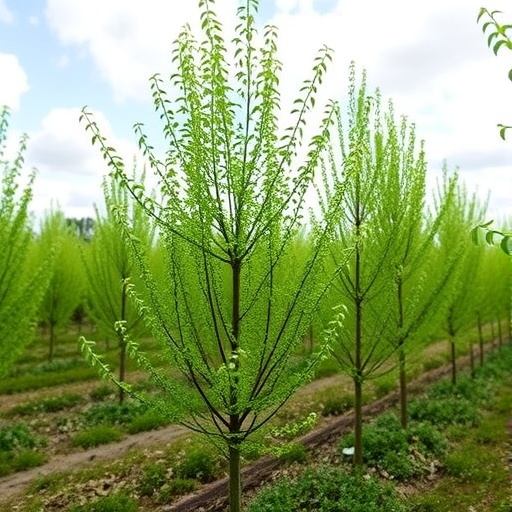
A quiet revolution is taking root along Ireland’s riverbanks, and it is being written in DNA. Common alder, Alnus glutinosa, the nitrogen-fixing broadleaf that stabilizes waterways and shelters understory biodiversity across Europe, has been in trouble for decades. Since the early 1990s, the invasive water mold Phytophthora alni has swept through alder populations across the continent, killing trees that had no evolved resistance, while habitat fragmentation and the species’ intolerance of shade have further undermined natural regeneration. Now, a team of Irish researchers has delivered the first integrated assessment combining progeny testing, genome-wide genetic diversity analysis and genomic prediction for this ecologically vital species, and their results offer a detailed roadmap for rebuilding alder’s genetic future. The study, published in Discover Plants, evaluated an Irish national breeding programme launched in 2005, genotyping 103 selected elite trees and field-testing 80 of their half-sib families over more than a decade, and it demonstrates that even a modest national breeding population can leverage modern genomic tools to balance genetic gain with long-term resilience.
The scientific premise behind the work is straightforward but demanding. Tree improvement programmes depend on identifying superior parent trees, or plus-trees, and verifying through field trials that their offspring genuinely outperform ordinary material. Conventional breeding, however, is notoriously slow in long-lived species, requiring repeated phenotypic measurements across years and sometimes decades before selection decisions can be trusted. Genomic selection, which uses tens of thousands of DNA markers scattered across the genome to estimate the breeding value of an individual, promises to compress those timelines by predicting performance early. The Irish team, led by Jie Huang and Dheeraj Singh Rathore of Teagasc, together with colleagues at Trinity College Dublin, the National Botanic Gardens and other institutions, set out to test how far that promise extends to a minor broadleaf species with a small breeding population.
Their field experiment is a textbook example of patient forestry science. Between 2005 and later surveys, 114 plus-trees were selected from wild and plantation stands across counties including Carlow, Wicklow, Galway, Clare, Mayo and Cork, chosen for maturity, health, straight stems, symmetric branching and high timber volume. Height among the selected trees ranged from 13 to 23 meters and diameter at breast height from 30 to 99 centimeters, and candidate trees were sampled at least 50 meters apart to minimize relatedness. Open-pollinated seed from these trees was sown in 2007, and in spring 2008 a replicated half-sib progeny trial of 88 families plus a commercial seed control was planted on a drumlin site at Corcovety, County Cavan, in a randomized complete block design with three blocks and trees spaced at two by two meters. Height was measured in 2008, 2010, 2015, 2017 and 2020 with a hypsometer, while diameter was recorded from 2015 onward. Crucially, the researchers analyzed relative growth rather than absolute measurements, a metric that normalizes for starting size and site conditions and allows fair comparison among trees of different initial stature, a standard approach in forest ecology that also correlates positively with final tree size.
The results were encouraging. Most families eventually outgrew the commercially sourced control, despite the control having a head start at planting. By 2020 the majority of families had surpassed it in absolute height, and from 2015 onward most exceeded it in diameter. Twenty families, roughly 23 percent of those tested, showed superior relative growth in both height and diameter, and twelve families, about 14 percent, consistently outperformed the control from early growth stages onward. All twenty of the top families also displayed greater absolute height and diameter from 2017 onward, providing robust candidates for future seed orchards. Heritability estimates added further optimism: relative growth in height showed family-mean heritability between 0.45 and 0.53, indicating moderate to relatively high genetic control, while relative growth in diameter, more sensitive to competition and environmental noise in an unthinned stand, ranged from 0.28 to 0.32. The genetic coefficient of variation was highest for early-period height growth, and the researchers concluded that relative height growth measured between 2008 and 2017 was the most informative early predictor of later performance, consistent with previous findings that alder growth traits up to around age ten strongly correlate with mature outcomes.
Alongside the field data, the team sequenced the genomes of the 103 plus-trees using genotyping-by-sequencing, a reduced-representation sequencing strategy that uses the restriction enzyme MsII to slice the genome into a manageable fraction before Illumina NextSeq sequencing at roughly 1.5 million paired-end 150-base-pair reads per sample. Reads were aligned to the newly available chromosome-level alder reference genome, variants were called with bcftools, and filtering for minor allele frequency, read depth, genotype quality and missingness yielded a remarkably dense dataset: 95,139 high-quality single nucleotide polymorphisms. Population genetic analysis revealed no significant differences among source counties in observed heterozygosity, which ranged from 0.34 to 0.36, within-population gene diversity from 0.32 to 0.36, and inbreeding coefficients spanning −0.19 to 0.01 with an overall value of −0.02. In plain terms, the breeding population harbors high genetic diversity and shows no evidence of inbreeding, a finding the authors attribute to the species’ self-incompatibility, wind pollination, outcrossing mating system and long-distance seed dispersal by rivers.
A discriminant analysis of principal components, or DAPC, painted a nuanced picture of population structure across the island. Three clusters emerged: a large primary cluster grouping samples from Cork, Leitrim, Limerick, Roscommon, Sligo, Wicklow and two trees of unidentified origin; a distinct Cavan cluster; and a Kerry cluster. Within the primary cluster, Leitrim and Sligo samples tended to group together, while Cork and Roscommon trees formed a separate subcluster, hinting at regional genetic similarity. The first two discriminant functions explained 56.23 percent of the variance in group separation. This admixed structure mirrors patterns seen across European alder populations and confirms previous phylogeographic work on Irish alder, while the diversity values exceed those reported for small continental populations in Belgium, France and Denmark using comparable SNP methods.
The genomic prediction experiments, however, delivered a more sobering lesson about the limits of small reference populations. Using genomic best linear unbiased prediction, or GBLUP, with a genomic relationship matrix built from the imputed SNP data, the team predicted relative growth traits at the family level and validated the models through 500 iterations of Monte Carlo cross-validation, splitting the data 70:30 between training and testing in each run. Predictive ability, measured as the Pearson correlation between genomic estimated breeding values and observed family means, ranged from 0.22 to 0.41 for relative height growth, a low-to-moderate figure, and hovered around zero, from −0.03 to 0.03, for relative diameter growth. Accuracy also declined as the measurement period lengthened, reflecting how competition and environmental variation increasingly obscure genetic signals as trees mature. These numbers fall within the range reported for Eucalyptus hybrids and below those achieved in large conifer datasets such as interior spruce and loblolly pine, where training populations of nearly a thousand individuals were available. The authors candidly attribute the limitations to the small training population, the use of family-level means rather than individual phenotypes, and the limited relatedness among maternal parents, factors that constrain predictive ability and inflate uncertainty.
Yet the story does not end with the prediction statistics, because the researchers emphasize that genome-wide markers deliver immediate, practical value even when they cannot yet forecast growth with high accuracy. Marker-based paternity testing can verify that orchard seed genuinely descends from selected plus-trees rather than from uncontrolled background pollen, a well-documented source of genetic gain erosion in seed orchards. Molecular fingerprinting can monitor and prevent the over-representation of individual parents, maintain balanced contributions to the production population, catch human labelling errors that accumulate over decades of programme turnover, and confirm seed lot identity. The team proposes distilling the 95,139-SNP resource into compact diagnostic panels, such as Kompetitive allele-specific PCR assays or targeted amplicon sequencing panels, for routine orchard monitoring, an approach proven in apple, Japanese cedar and almond breeding. They also recommend concrete breeding actions: the top twenty half-sib families could seed new orchards for farm forestry, controlled crosses among elite individuals could launch an F1 generation, and the existing seed orchard can be refined by roguing out poorly performing parents to raise the genetic gain of its output.
Beyond the practical prescriptions, the study carries a broader significance for conservation genetics and the emerging science of breeding underutilized tree species. Breeding populations founded on a narrow set of phenotypically superior trees risk progressive inbreeding, reduced heterozygosity and diminished fitness, which in turn can erode disease resistance precisely when pathogens like Phytophthora alni are intensifying. The Irish experience shows that a national programme can simultaneously capture genetic gain and preserve adaptive potential, provided diversity is monitored with molecular tools from the outset. The researchers frame their results as a scalable model for other minor or underutilised broadleaf species, arguing that improved seed orchards built from genetically diverse, high-performing material will enhance the resilience of forest ecosystems and support sustainable hardwood production across temperate regions. With sequencing data deposited in the NCBI Sequence Read Archive and phenotypic data and analysis scripts shared openly on Zenodo, the work offers both a template and a toolkit.
For alder, a tree that filters water, fixes nitrogen into impoverished soils, anchors riverbanks and supplies timber prized for furniture and joinery, the implications extend well beyond Irish borders. As climate stress and invasive pathogens reshape European forests, the ability to identify resilient genotypes early, verify their parentage cheaply and maintain genetic breadth in production populations may determine whether riparian woodlands of the future resemble their ancestors or fade into ecological memory. The Irish alder programme, two decades in the making, suggests that the answer lies not in choosing between traditional field testing and modern genomics, but in fusing them, letting long-term progeny trials ground-truth the data that DNA markers quickly deliver, and letting the markers guide the next generation of crosses before the first seedling of that generation has even germinated.
Cite Scienmag News
Juliet Wilcox. (September 5, 2026). Genomic tools boost alder seed orchards for sustainable forestry. Scienmag. https://scienmag.com/genomic-tools-boost-alder-seed-orchards-for-sustainable-forestry/
Juliet Wilcox. "Genomic tools boost alder seed orchards for sustainable forestry." Scienmag, 5 September 2026, https://scienmag.com/genomic-tools-boost-alder-seed-orchards-for-sustainable-forestry/. Accessed 5 September 2026.
Juliet Wilcox. "Genomic tools boost alder seed orchards for sustainable forestry." Scienmag. September 5, 2026. https://scienmag.com/genomic-tools-boost-alder-seed-orchards-for-sustainable-forestry/


