


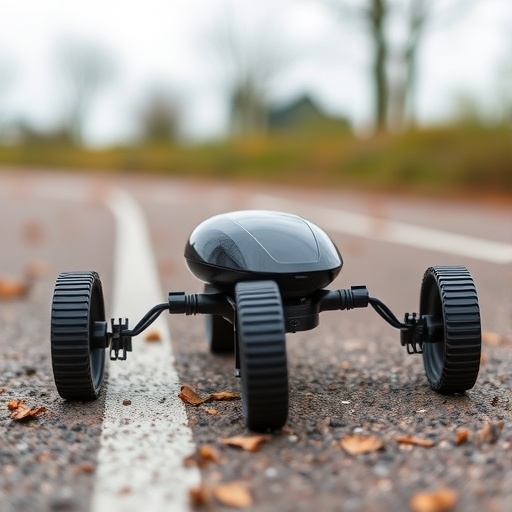
When a fleet of wheeled robots must sweep through a warehouse, an orchard, or a disaster site as a coordinated unit, the math problem behind the choreography is deceptively hard. Each robot cannot simply slide sideways to its assigned slot; wheeled platforms are bound by nonholonomic constraints, meaning their velocity is always directed along their heading, so smooth motion toward a formation requires carefully orchestrated turning and translation. Worse, the robots must exchange information constantly to stay in step, and in cluttered spaces they must dodge both obstacles and each other. A team of researchers in China has now unveiled a control architecture that tackles all three challenges at once, and their secret weapon is a simple idea with large consequences: the robots only talk when they genuinely need to.
The new study, published in the International Journal of Intelligent Robotics and Applications, addresses the distributed formation control problem for nonholonomic multi-mobile robots, abbreviated NMMRs, operating in obstacle-rich environments. Led by Ziyu Xu, Dongdong Wang, Yunhui Li, Wei Zhang, and corresponding author Zhonghua Miao, with affiliations at Shanghai University and Henan University of Science and Technology, the work develops a dynamic event-triggered control, or ETC, strategy under a leader-follower structure. Rather than sampling and broadcasting control updates at a fixed clock rate, each robot evaluates a triggering condition and communicates only when the condition is satisfied. The result, demonstrated in both comparative simulations and real-platform experiments, is a substantial reduction in communication burden with essentially no loss in tracking accuracy.
The core of the innovation lies in how the triggering mechanism is designed. In conventional periodic control, every robot in the team updates its neighbors at every sampling instant, regardless of whether anything meaningful has changed. This brute-force synchronization wastes bandwidth, clogs wireless channels, and drains onboard batteries, problems that grow quickly as the number of robots increases. Static event-triggered schemes were previously proposed as a remedy, updating only when the state error exceeds a fixed threshold. But the Shanghai-led team went a step further by introducing a dynamic triggering mechanism, in which the threshold itself is governed by an auxiliary internal variable that evolves over time. This dynamic buffer absorbs fluctuations in the error signal and, crucially, enlarges the inter-event intervals, meaning robots can remain silent for longer stretches between updates. The mechanism is woven directly into the kinematic controller by exploiting the very nonholonomic constraints that make wheeled robots awkward in the first place, turning a modeling nuisance into a design resource.
Formations, however, are only half of the story. The second layer of the architecture handles safety. The researchers incorporated artificial potential functions into an adaptive torque controller through a backstepping-based design paired with a sliding-mode error formulation. In this scheme, attractive potentials pull each robot toward its desired position within the geometric formation relative to the leader, while repulsive potentials activate near neighboring robots and obstacles, generating corrective forces and torques that steer the machine away before contact can occur. Backstepping, a recursive design technique, allows the team to bridge the gap between the kinematic level, where desired velocities are computed, and the dynamic level, where actual motor torques must be produced, and the sliding-mode formulation provides robustness against model uncertainty and disturbances that inevitably plague real hardware. Adaptive elements in the torque controller estimate unknown parameters on the fly, so the robots do not need a perfect dynamic model of themselves to behave correctly.
The combination is mathematically demanding, because stability must be guaranteed not only for the continuous-time closed-loop system but also for the aperiodic, event-triggered updates that punctuate it. The authors report that their framework maintains Lyapunov-based stability guarantees despite the irregular communication pattern, ensuring that the formation errors converge while collisions between robots, and between robots and obstacles, are avoided. This is the central theoretical achievement: proving that speaking less often does not break the contract of safety and convergence that formation flying depends on.
To test whether the theory survives contact with reality, the team carried out comparative simulations against both periodic control and static event-triggered schemes. The metrics of interest were the number of communication updates, or triggering events, and the resulting tracking accuracy of the formation. The dynamic ETC scheme significantly reduced communication updates compared with both baselines while maintaining comparable tracking accuracy, a result with immediate practical weight. In multi-robot systems, the communication channel is a shared, finite resource; every unnecessary message is one that competes with telemetry, perception data, and other teammates. Cutting the message count translates directly into larger scalable swarms, lower latency for the messages that do matter, and longer mission endurance for battery-powered platforms.
The simulations were followed by experiments on a real robot platform, where the proposed formation controller was asked to drive a team of nonholonomic mobile robots through an obstacle-populated workspace while holding a prescribed geometric pattern. The hardware trials demonstrated stability, adaptability, and practical effectiveness, confirming that the torque-level adaptive and sliding-mode components behave as designed when wheel slip, actuator dynamics, and sensor noise enter the picture. The full study includes thirteen figures documenting the trajectory evolution, event-triggering instants, formation error convergence, and obstacle avoidance maneuvers observed in the experimental campaign.
The applications targeted by this line of research extend well beyond the laboratory. Multi-robot systems are increasingly deployed in agriculture, where fleets of machines must coordinate planting, weeding, and harvesting across fields dotted with trees, posts, and irrigation equipment. They are central to warehouse logistics, where squads of mobile shelving units weave between human workers and static racks. They also underpin search-and-rescue operations, environmental monitoring, and coordinated transport of large objects, scenarios in which a dropped communication packet or a mid-formation collision can derail an entire mission. Previous efforts, including graph-based motion planners and null-space-based behavioral controllers, have addressed pieces of this puzzle, but few have simultaneously offered bandwidth efficiency, formal stability, and collision avoidance for robots with nonholonomic constraints.
The leader-follower structure adopted by the team also deserves attention. In this paradigm, one robot, the leader, follows a reference trajectory or navigates autonomously, while the followers track transformed versions of the leader’s state to realize the desired formation shape. This distributed architecture avoids the single-point-of-failure risk of a central planner and scales naturally, since each follower only needs information from the leader and its designated neighbors. The dynamic event-triggering mechanism is applied at the kinematic layer of this structure, governing when each follower refreshes its view of the leader and its peers, while the adaptive torque controller at the dynamic layer runs continuously to execute the latest commanded velocities with precision.
What makes the dynamic, as opposed to static, trigger so effective can be understood through the internal variable that accompanies it. In static ETC, the triggering threshold is a fixed constant, and conservative tuning is required to guarantee stability, which forces frequent updates. The dynamic mechanism introduces an extra state, sometimes likened to an energy reservoir, that grows between events and relaxes the threshold when the system is doing well. When tracking errors are small and the formation is healthy, the reservoir fills and robots happily delay communication. When a disturbance strikes, the reservoir drains, the threshold tightens, and updates become more frequent exactly when they are needed. The closed loop thus allocates its own communication budget adaptively, which is precisely the behavior one wants in uncertain, cluttered environments.
The work arrives amid a broader surge of interest in event-triggered and self-triggered control for multiagent systems, a field that has produced surveys and specialized results spanning consensus, formation tracking, and resilient control under cyberattacks. What distinguishes the new contribution is the union of that communication-efficiency machinery with the specific and thorny dynamics of nonholonomic platforms, together with a fully integrated obstacle-avoidance layer implemented at the torque level rather than as an afterthought in the planner. The authors also ground the work in a lineage of prior results on adaptive consensus and event-triggered integral formation control for networked nonholonomic robots, extending those efforts with the dynamic trigger and the potential-function-based safety guarantees.
Funding for the research came from the National Natural Science Foundation of China under grants 52375107 and 32401712, the Shanghai Agriculture Applied-Technology Development Program under grant T20252014, and the China National Postdoctoral Program for Innovative Talents under grant BX20240217, an agricultural tilt that hints at near-term field trials in orchards and farm environments where multi-constraint navigation is already being explored by overlapping groups.
For the robotics community, the message of the study is that communication efficiency and control performance need not be traded against each other. By letting each robot decide, moment by moment, whether its latest state estimate is good enough to act upon, the dynamic event-triggered framework achieves the same geometric fidelity as a chatty, clock-driven fleet while transmitting far fewer messages, and it does so while threading the fleet safely between obstacles. As multi-robot deployments multiply across farms, factories, and hazardous environments, architectures of this kind may become the quiet backbone that lets large teams move as one without ever raising their voices on the network. The code supporting the findings is available from the corresponding authors upon reasonable request, offering other laboratories a concrete starting point for building on the approach.
Cite Scienmag News
Denise Maddox. (September 6, 2026). Obstacle-aware event-triggered formation control for nonholonomic mobile robots. Scienmag. https://scienmag.com/obstacle-aware-event-triggered-formation-control-for-nonholonomic-mobile-robots/
Denise Maddox. "Obstacle-aware event-triggered formation control for nonholonomic mobile robots." Scienmag, 6 September 2026, https://scienmag.com/obstacle-aware-event-triggered-formation-control-for-nonholonomic-mobile-robots/. Accessed 6 September 2026.
Denise Maddox. "Obstacle-aware event-triggered formation control for nonholonomic mobile robots." Scienmag. September 6, 2026. https://scienmag.com/obstacle-aware-event-triggered-formation-control-for-nonholonomic-mobile-robots/


