


A morphological taxonomic study of the wolf spider genus Ovia in China described five new species— Ovia chayu , Ovia dawai , Ovia dulong , Ovia medog and Ovia separata —and examined eight species in total. The authors also reassessed earlier records, identifying the reported Ovia alboannulata from Bhutan and the Ovia procurva records from India and Bhutan as misidentifications. The genus Ovia was established in 2017 with O. procurva , originally described as Pardosa procurva , as its type species.
Before the new study, the paper reported that the genus contained five species distributed from South Asia to southern China. The research was based on newly collected material from China and combined preserved-specimen examination with comparisons against published illustrations and the type specimens of O. procurva . All specimens were preserved in 75% ethanol before being examined, illustrated, photographed and measured with a Leica M205A stereomicroscope fitted with a drawing tube.
The researchers also used a Leica DFC450 camera and Leica Application Suite software version 4.6. Male palps and female epigynes were dissected for examination, and epigynes were cleared with pancreatin. Measurements were reported in millimetres.
Examined material was deposited in the spider collections at Southwest University in Chongqing, the Institute of Plateau Biology of Xizang Autonomous Region in Lhasa and Hunan Normal University. Because the male palps and female epigynes of Ovia are very similar, the authors used multiple characters to distinguish the species. Male diagnostic features included the form of the terminal apophysis, the median apophysis and its basal processes, and the number of apical claws on the cymbium.
Female comparisons included the inverted T-shaped septum, its posterior margin and the ridge running along it. The number of cymbial claws varied among the examined species: O. macritchie lacked an apical claw, O. procurva had two or three, and the remaining species had one. Ovia chayu was described from Chayu County in Xizang, where the type specimens were collected at an elevation of 1,464 metres.
In the male, the tips of the basal processes closely adhere to the edge of the median apophysis, whereas in O. alboannulata they are separated from that edge. The female O. chayu has a broad ridge on the septum rather than the thread-like ridge of O. alboannulata . O. medog is distinguished from all other species in the genus by a conspicuous broad yellowish-brown longitudinal band on the abdominal dorsum.
Its male holotype and paratypes came from several localities in Medog County collected between 2018 and 2022. The sympatric O. dawai , named for Dawa of the Tibet Plateau Institute of Biology, has an indistinct broad longitudinal abdominal band rather than the conspicuous band of O. medog . Ovia dulong was described from near Hapang Waterfall in Dulongjiang, Yunnan, with the male holotype and paratypes collected at 1,155 metres above sea level.
It resembles O. alboannulata in its palp structure and the relatively flat posterior margin of the septum, but its legs II–IV are uniformly coloured and lack the white annulations found on that species. O. separata was described from material collected in Guangdong and Yunnan. Its name refers to the two separated hoods of the female epigyne, and it differs from O. macritchie in male cymbial bristles and claws, female copulatory openings and hood arrangement.
Observations of living animals supplied additional characters for separating some species. Males of O. alboannulata and O. procurva have annulations formed by white setae on legs II–IV; living O. macritchie and O. separata have darker bodies with a metallic sheen; and O. medog has the distinct broad abdominal band. The authors also note that the tibia, tarsus and metatarsus of male first legs are densely covered with white setae.
They state that these setae may be related to courtship in dark environments, although the study did not experimentally test that proposed function. The reassessment of geographic records was based on differences visible in published illustrations and comparisons with type material. The Bhutan record of O. alboannulata showed nearly rounded apical processes on the male median apophysis and a curved posterior margin of the septum, unlike Chinese specimens; the authors classified it as a misidentification that may represent an undescribed species.
Published records of O. procurva from India and Bhutan differed from its type specimens in body markings, cymbial claws, terminal apophysis and spermathecal-stalk shape, and the authors concluded that they represent two distinct new species. Some historical Chinese records of O. procurva showed a single cymbial claw and came from areas close to the distribution of O. alboannulata . The authors treated these records as misidentifications of O. alboannulata and consequently listed O. procurva as occurring in Yunnan and Guangxi.
A Taiwanese record also showed a single cymbial claw, but the researchers did not examine specimens from Taiwan, so they could not determine its identity and excluded it from the study. Overall, the work was taxonomic and morphological rather than ecological or behavioural, with habitat information limited to observations such as grass and the moist forest floor.
Subject of Research: Morphological taxonomy of eight Ovia wolf spider species from China
Article Title: A taxonomic study on eight species of the Ovia ( Araneae , Lycosidae ) from China
Article References: Xu, Y.-Q., Wang, L.-Y., & Zhang, Z.-S. (2026). A taxonomic study on eight species of the Ovia (Araneae, Lycosidae) from China. Zoosystematics and Evolution, 102(3), 731-750. https://doi.org/10.3897/zse.102.188856
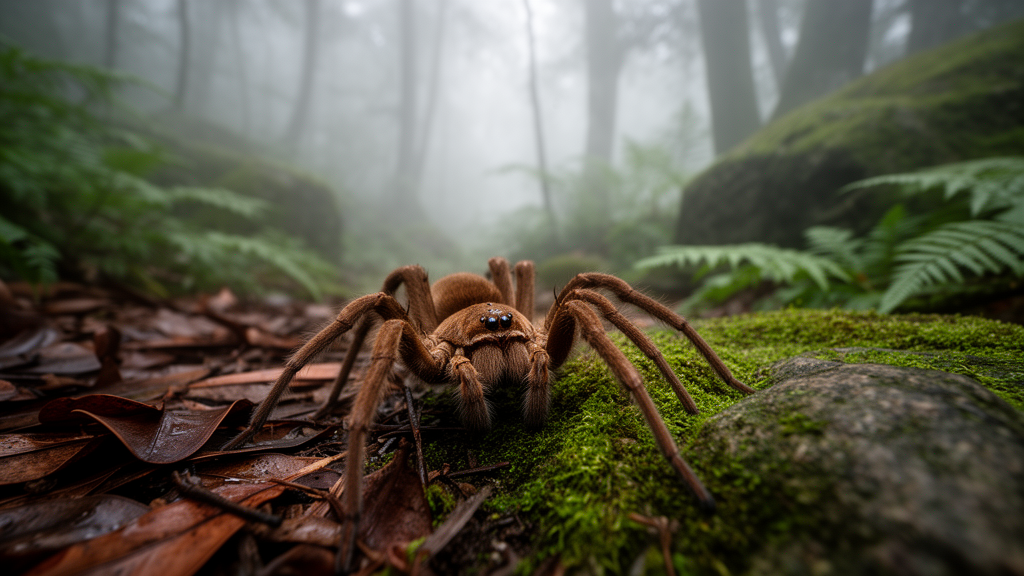
Image Credits: AI Generated
Keywords: Ovia, wolf spiders, Lycosidae, taxonomy, new species, China, morphology, Xizang, Yunnan, Guangdong, taxonomic, eight
Cite Scienmag News
Drew Townsend. (October 20, 2026). Morphological study describes five new Ovia wolf spider species from China. Scienmag. https://scienmag.com/morphological-study-describes-five-new-ovia-wolf-spider-species-from-china/
Drew Townsend. "Morphological study describes five new Ovia wolf spider species from China." Scienmag, 20 October 2026, https://scienmag.com/morphological-study-describes-five-new-ovia-wolf-spider-species-from-china/. Accessed 20 October 2026.
Drew Townsend. "Morphological study describes five new Ovia wolf spider species from China." Scienmag. October 20, 2026. https://scienmag.com/morphological-study-describes-five-new-ovia-wolf-spider-species-from-china/


