


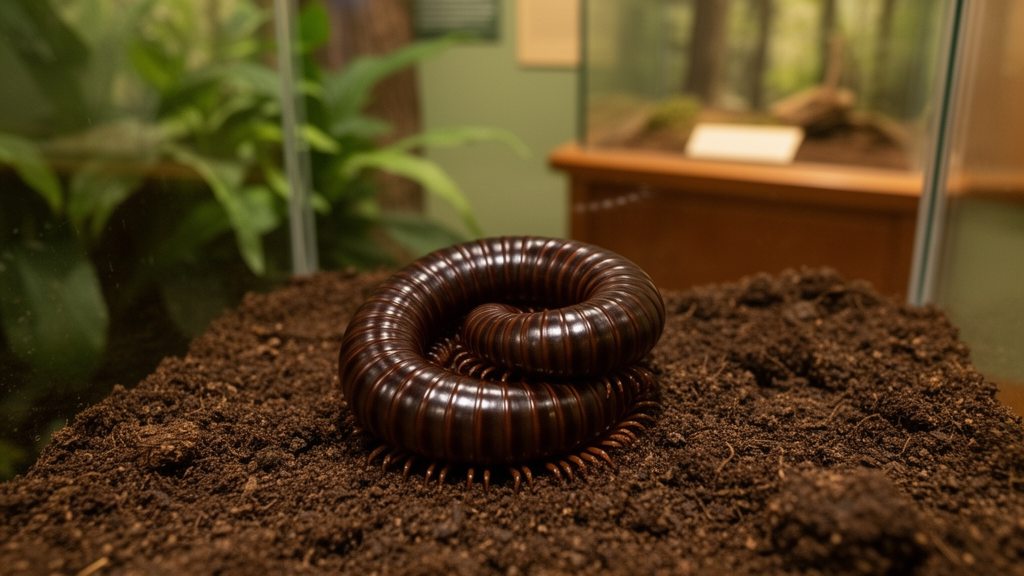
A taxonomic study determined that two male millipedes from United States zoos are Spiropoeus fischeri Brandt, 1833. The specimens were captive-bred animals from the Akron Zoo in Ohio and Omaha’s Henry Doorly Zoo and Aquarium in Nebraska, and both were identified through their morphology and mitochondrial cytochrome c oxidase subunit I (COI) sequences. The research addresses uncertainty surrounding large tropical millipedes maintained in zoos and educational collections in the United States.
Animals are often collectively described as “giant African millipedes,” but their provenance may be unclear because many come from the exotic pet trade or other sources with limited record-keeping. Difficulty obtaining specialist taxonomic literature and tracing specimens to their distributions can also complicate identification. The study examined male specimen MPE05526 from the Akron Zoo and MPE05527 from Omaha’s Henry Doorly Zoo and Aquarium.
Both were captive-bred, and their source locations were unknown. The specimens were deposited in the Virginia Tech Insect Collection, abbreviated VTEC. General morphology was examined with a Leica M125 stereomicroscope.
Their gonopods were dissected following published methods and photographed with a Canon EOS 5D dSLR camera fitted with a 65 mm Canon MP-E lens. The researchers identified the animals as members of the tribe Spirostreptini through a combination of features, including a terminally branched sperm canal. They also recorded four diagnostic structures: a metaplical structure bent 90 degrees with a triangular metaplical process, an apically acuminate antetorsal process, a long serpentine solenomere, and a projecting shelf on the mentum of the gnathochilarium.
Overall body form, gonopod shape and configuration, and the projecting mental shelf were consistent with published descriptions and illustrations of S. fischeri. The two zoo specimens closely matched illustrations of the gonopods of the type specimen of Scaphiostreptus parilis acuticonus Attems, 1914. They lacked the elongated prefemoral process of the first male leg pair shown in illustrations of type specimens identified as S. fischeri, Spiropoeus lingulatus Karsch, 1881, and Mardonius piceus Attems, 1952.
A 2001 taxonomic revision treated S. parilis acuticonus, S. lingulatus and six other names associated with West African material as junior subjective synonyms of S. fischeri. Those differences may reflect morphological variation across the species’ geographic range or a complex of closely related species, the researchers said. The study’s scope was limited to two captive-bred specimens whose source locations were unknown, so it did not establish where their captive lineages originated or resolve the broader taxonomic question surrounding S. fischeri and its synonyms.
DNA extraction, PCR amplification and sequencing of the COI gene were performed for both specimens using an established method. Their COI sequences were identical to one another. Because no S. fischeri COI sequences were available in public databases at the time, the sequences were deposited in the National Center for Biotechnology Information under accession numbers PX681997 for the Akron Zoo specimen and PX681998 for the Omaha specimen.
Genomic DNA from both specimens is held in the VTEC −80 °C freezer collection. The public-database comparisons did not provide a close match for the identified species. A National Center for Biotechnology Information BLAST search returned approximately 83% identity with sequences from Tropostreptus, a spirostreptid genus from Tanzania, and Heptischius, a Southeast Asian genus in the family Harpagophoridae.
A Barcode of Life Data System search produced an approximately 95% match to a sequence from Gabon labeled as a member of Nemasomatidae in the order Julida. Given that family’s distribution, the researchers considered the Gabonese voucher likely to be misidentified. Spiropoeus is a monotypic genus whose sole species, S. fischeri, was originally described from West African material without a precise locality.
Most verifiable records come from Cameroon, while historical synonyms were based on material from Cameroon and other West African countries, including Liberia and Benin. The type locality for S. lingulatus was recorded only as “Congo,” and that for S. parilis acuticonus was “N’Yong, Kamerun,” referring to locations in Cameroon’s Nyong River region. The available evidence suggests a broader distribution across the Guineo-Congolian rainforest region.
The authors concluded that S. fischeri is commonly bred and maintained for zoo exhibits and public outreach, while noting that other similar-looking large spirostreptids may remain unidentified in zoo collections.
Subject of Research: Taxonomic identification of captive-bred African millipedes from United States zoos
Article Title: Identification of Spiropoeus fischeri Brandt, 1833 from captive bred millipedes in Zoos ( Diplopoda , Spirostreptida , Spirostreptidae )
Article References: Alvear, S., Young, C., Vasquez-Valverde, L., & Marek, P. (2026). Identification of Spiropoeus fischeri Brandt, 1833 from captive bred millipedes in Zoos (Diplopoda, Spirostreptida, Spirostreptidae). Biodiversity Data Journal, 14, Article e196645. https://doi.org/10.3897/bdj.14.e196645
Image Credits: AI Generated
Keywords: Spiropoeus fischeri, millipedes, taxonomic identification, morphology, COI barcoding, zoo collections, West Africa, Spirostreptidae, Identification, Spiropoeus, fischeri, Brandt
Cite Scienmag News
Gavin Prescott. (October 20, 2026). Morphology and DNA barcodes identify two captive-bred zoo millipedes as Spiropoeus fischeri. Scienmag. https://scienmag.com/morphology-and-dna-barcodes-identify-two-captive-bred-zoo-millipedes-as-spiropoeus-fischeri/
Gavin Prescott. "Morphology and DNA barcodes identify two captive-bred zoo millipedes as Spiropoeus fischeri." Scienmag, 20 October 2026, https://scienmag.com/morphology-and-dna-barcodes-identify-two-captive-bred-zoo-millipedes-as-spiropoeus-fischeri/. Accessed 20 October 2026.
Gavin Prescott. "Morphology and DNA barcodes identify two captive-bred zoo millipedes as Spiropoeus fischeri." Scienmag. October 20, 2026. https://scienmag.com/morphology-and-dna-barcodes-identify-two-captive-bred-zoo-millipedes-as-spiropoeus-fischeri/


