


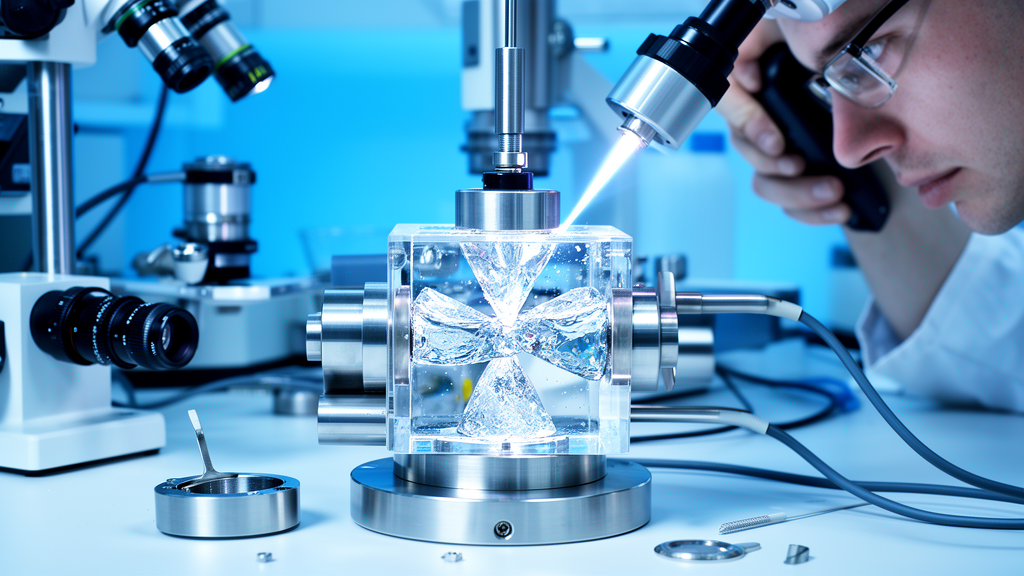
Solid water can adopt a lower-symmetry structure under extreme pressure, according to an experimental study from the University of Nevada, Las Vegas (UNLV). Researchers compressed water to pressures above 222 gigapascals (GPa) and found that its atomic arrangement became less symmetrical, contrary to the usual expectation that squeezing a material produces a more highly ordered structure. The peer-reviewed study, “Evidence for symmetry-reduction in solid H2O above 222 GPa,” was published in Communications Chemistry on October 15, 2026, by researchers from UNLV, the University of California, Berkeley, and Argonne National Laboratory.
The experiment took place at UNLV’s Nevada Extreme Conditions Lab, where the research team used spectroscopy to examine water squeezed between two diamonds, described in the university’s news release as the hardest known material. This arrangement generated extraordinary pressures, while X-rays were used to inspect the structural arrangement of atoms in the compressed sample. The measurements showed that increasing pressure reduced the symmetry of solid H2O in the pressure range examined. UNLV physicist Ashkan Salamat, the research lead and director of the lab, said the result demonstrated that water has more complex behavior under pressure than previously imagined and that its chemistry changes as it is squeezed.
The pressure applied was equivalent to approximately 35 million pounds per square inch (PSI), compared with about 30 PSI for a typical car tire. The researchers said the conditions were closer to those found in the interiors of Neptune and Uranus, which are described in the release as ice giants containing molten, metallic-like water, ammonia, and methane. Because researchers cannot directly enter the crusts or atmospheres of those planets, information obtained through programs such as Voyager provides estimates of their compositions, interior pressures, and temperatures. Laboratory experiments can then reproduce some of the relevant conditions and chemistry that may occur inside them, although this study directly examined solid water rather than a complete planetary interior.
Water’s newly observed structure is relevant to how high-pressure materials may behave away from familiar terrestrial conditions. The reported result does not establish a separate chemical formula or element, and the evidence presented in the release does not detail the complete sequence of structural changes or demonstrate how the compressed material behaves after pressure is released. Instead, the central experimental finding is a symmetry reduction in solid water above 222 GPa. The release also states that water could take unfamiliar forms at high pressure and might rearrange into a more familiar terrestrial structure if the pressure were removed, but that possibility was not presented as a measured outcome of the experiment.
The study provides a laboratory method for investigating water at pressures that are difficult to reproduce in ordinary environments and offers experimental information relevant to models of ice-giant interiors. “Understanding the mechanisms of our solar system and our observable universe is critical for the endeavor of human knowledge,” Salamat said. “When we eventually get to these worlds, what are we going to see? We’re really the initial pioneers in trying to answer these questions in the laboratory.” The authors include Ashkan Salamat, Zachary Grande, Victor Robinson, Dean Smith, Jesse Smith, Oliver Tschauner, and Burkhard Militzer. Their experiment does not show what future spacecraft will observe on Neptune or Uranus, nor does it establish that water has identical properties throughout either planet; it instead documents a measured structural response of compressed solid water beyond Earth-like conditions.
Subject of Research: Experimental study of pressure-induced symmetry reduction in solid water above 222 GPa
Article Title: Water as we’ve never known it: Physicists test water beyond Earth-like conditions
Article References: Water as we’ve never known it: Physicists test water beyond Earth-like conditions. Original publication (Bibliographic details unavailable.)
Image Credits: AI Generated
DOI: Not provided
Keywords: solid water, high-pressure physics, symmetry reduction, diamond anvil cell, spectroscopy, X-ray analysis, planetary interiors, ice giants, Neptune, Uranus, Water, never
Cite Scienmag News
Bethany Barker. (October 20, 2026). Water as we’ve never known it: Physicists test water beyond Earth-like conditions. Scienmag. https://scienmag.com/water-as-weve-never-known-it-physicists-test-water-beyond-earth-like-conditions/
Bethany Barker. "Water as we’ve never known it: Physicists test water beyond Earth-like conditions." Scienmag, 20 October 2026, https://scienmag.com/water-as-weve-never-known-it-physicists-test-water-beyond-earth-like-conditions/. Accessed 20 October 2026.
Bethany Barker. "Water as we’ve never known it: Physicists test water beyond Earth-like conditions." Scienmag. October 20, 2026. https://scienmag.com/water-as-weve-never-known-it-physicists-test-water-beyond-earth-like-conditions/


