


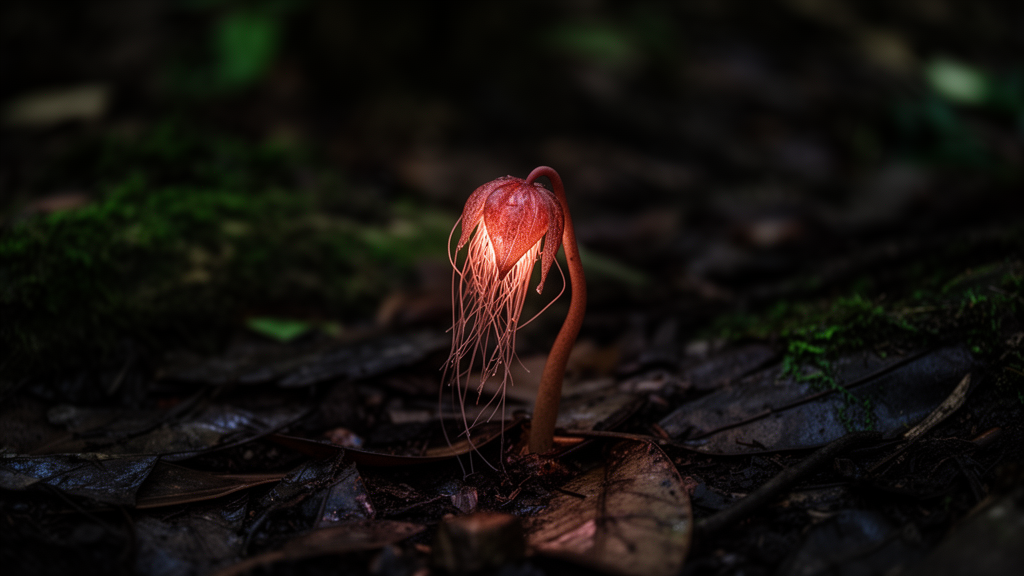
Researchers have identified and described Thismia daemona, a new species of fully mycoheterotrophic plant, from montane evergreen forest in Thong Pha Phum National Park, Kanchanaburi Province, western Thailand. The taxonomic study combined detailed morphological comparisons with molecular analyses of five DNA markers, providing evidence for the new species and its placement within Thismia section Geomitra.
The plant was collected during botanical surveys in 2025, when two specimens were found in lower montane forest with small bamboo. It grows among leaf litter in shade at elevations of 950–970 metres. Thismia daemona is an achlorophyllous herb with coralliform, pubescent, light-brown roots. Its erect, unbranched stem is 35–65 mm tall and bears one to three sessile flowers, while the complete plant reaches up to 125 mm including the flowers.
The flowers have a dark brown to blackish floral tube measuring 19–22 mm long and 7–14 mm wide. Its outer surface bears six longitudinal ribs, and its inner surface has 12 ribs, irregular transverse bars in the lower half and fine reticulations in the upper half. Translucent white trichomes cover the bars and reticulations. Three thick, fleshy, reddish-orange outer tepals accompany three dark brown to blackish inner tepals. The inner tepals unite apically into a dome-shaped mitre with three lateral openings, three hood-like accessory lobes and three claviform appendages measuring 18–23 mm long.
Six pendent stamens have translucent-blue filaments. Their broad blue connectives are fused laterally into a tube about 8 mm long, and each connective bears a conspicuous longitudinal rib along the inner surface. The species produces a cup-shaped capsule, although no seeds were observed. The name daemona refers to the flower’s devil-like appearance, with dark-orange outer lobes and horn-like appendages.
Morphological comparison found that T. daemona is most similar to T. limkokthayi, a species from Pahang in Peninsular Malaysia. The Thai species differs in having reddish-orange, fleshy outer tepals rather than thinner brownish-orange tepals, an irregularly papillose mitre rather than an almost glabrous one, transverse bars in the lower floral tube, translucent-blue stamens, and no mitre foveae between the bases of the claviform appendages. It can also be distinguished from T. betung-kerihunensis by its blackish flowers and thick outer tepals, whereas that Bornean species has blue-green flowers and thin outer tepals.
For the molecular analysis, the researchers sequenced one specimen of the new species and also generated sequences for T. clavigeroides collected at its type locality. The combined dataset comprised three nuclear markers, SSU, ITS and LSU, and two mitochondrial markers, atpA and matR. It contained 5,498 characters and 27 accessions representing 24 Thismia species, with Haplothismia exannulata from India included as the outgroup.
Individual and combined datasets were evaluated with Bayesian inference and maximum likelihood. The Bayesian analysis used two independent runs with four chains and 10 million generations, with trees sampled every 3,000 generations and 25% of the trees discarded as burn-in. Maximum-likelihood analysis used 10,000 rapid bootstrap replicates. The two methods produced congruent tree topologies. The combined reconstruction placed T. daemona in the Geomitra clade, in a sister position to the Bornean endemic T. betung-kerihunensis, although the authors noted that this relationship was inferred from a limited DNA sample.
The description brings the number of recognized species in Thismia section Geomitra to eight, and the study includes a key for distinguishing them. A preliminary conservation assessment classified T. daemona as Critically Endangered under IUCN criteria B2ab(iii), D. The species is known from one population in a protected area that receives regular tourist visits, which the authors identify as a threat to its habitat. Its extent of occurrence could not be calculated from the single known point; the formal area of occupancy was estimated at 4 km², while the known population occupies no more than 0.05 km² and fewer than 50 individuals were observed. The species is currently documented only at the type locality, although the authors state that similar vegetation elsewhere in western Thailand or Myanmar may also be suitable for it.
Subject of Research: Taxonomic identification and preliminary conservation assessment of a new Thismia species from Thailand
Article Title: Thismia daemona ( Thismiaceae ), a new species from Thailand supported by morphological and molecular evidence
Article References: Seelanan, T., Chantapram, I., Taosiri, N., Chuchuea, C., & Chantanaorrapint, S. (2026). Thismia daemona (Thismiaceae), a new species from Thailand supported by morphological and molecular evidence. PhytoKeys, 278, 177-189. https://doi.org/10.3897/phytokeys.278.202868
Image Credits: AI Generated
DOI: 10.3897/phytokeys.278.202868
Keywords: Thismia daemona, new species, plant taxonomy, mycoheterotrophy, Thismiaceae, Thailand, DNA phylogeny, morphology, Critically Endangered, biodiversity, Thismia, daemona
Cite Scienmag News
Margaret Porter. (October 20, 2026). Morphological and DNA analysis identifies a new Thismia species in Thailand. Scienmag. https://scienmag.com/morphological-and-dna-analysis-identifies-a-new-thismia-species-in-thailand/
Margaret Porter. "Morphological and DNA analysis identifies a new Thismia species in Thailand." Scienmag, 20 October 2026, https://scienmag.com/morphological-and-dna-analysis-identifies-a-new-thismia-species-in-thailand/. Accessed 20 October 2026.
Margaret Porter. "Morphological and DNA analysis identifies a new Thismia species in Thailand." Scienmag. October 20, 2026. https://scienmag.com/morphological-and-dna-analysis-identifies-a-new-thismia-species-in-thailand/


