


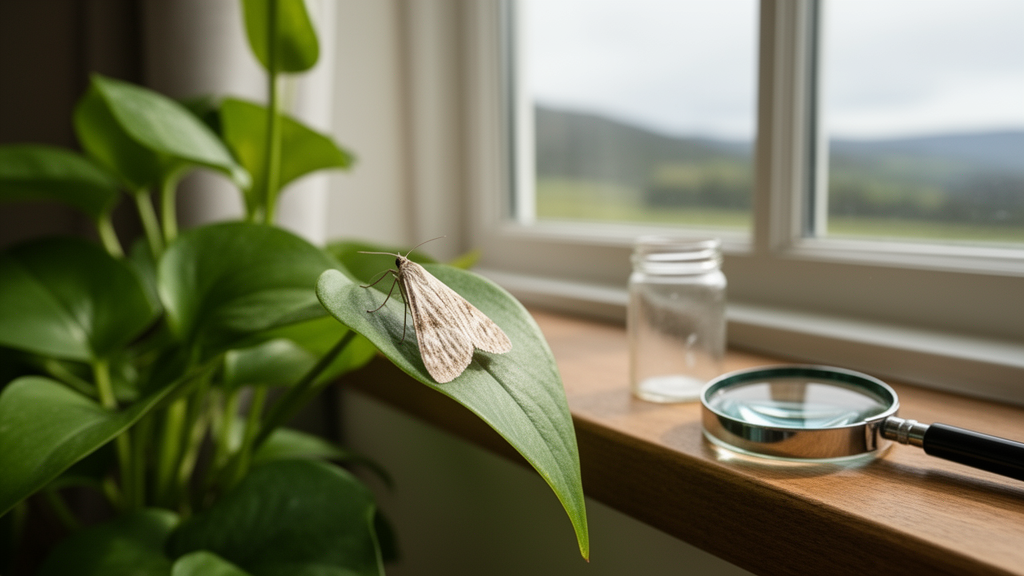
A morphological and DNA barcoding study has identified Sufetula culshawi as a previously undescribed species of crambid moth in the subfamily Lathrotelinae. The description was based on a male found in a house in Killearn, Stirlingshire, Scotland, in July 2022 and a female from the Natural History Museum collection that had been bred from palm roots in Japan. The authors also examined six externally diagnostic photographs that suggest the species occurs across parts of tropical and subtropical Asia.
The Scottish male was discovered by Martin Culshaw resting on an interior wall on 12 July 2022. It appeared to have emerged from a houseplant, most likely a young Areca palm, Chrysalidocarpus lutescens, bought from a local nursery in May 2022 and originating from a nursery in the Netherlands. Photographs posted to the Scottish Moths online forum prompted suggestions that it belonged to either Diplopseustis or Sufetula. Consultations with British, European and American microlepidopterists supported placement in Sufetula, a genus not previously reported in Britain, but did not establish its species identity.
The investigators then compared the moth’s wing pattern and dissected male genitalia with specimens and descriptions of named species. The genitalia did not match Sufetula diminutalis, and no clear match was found among other members of the genus. DNA barcoding was then used to assess the identification. The Scottish barcode was generated with Oxford Nanopore sequencing, but its initial BOLD search returned no lathroteline among its top 100 matches. A more detailed comparison with public sequences placed the specimen within Sufetula, while its precise position within the genus remained weakly resolved.
The second specimen was located among museum accessions from Japan. It was a female collected in Ibusuki, at the southern tip of Kyushu, in 1987 and bred from the living roots of a palm identified on its label as an Areca palm, probably C. lutescens. The researchers initially linked the two specimens through their external similarity and then tested that association genetically. The Japanese material yielded 1,441 base pairs across the COI region, while the Japanese and Scottish sequences differed by one base pair within the 658-base-pair COI-5P region. This near identity, together with phylogenetic analysis, supported their treatment as the same species.
For the broader phylogenetic comparison, the researchers used DNA-barcode sequences from the Barcode of Life Database and GenBank, including sequences attributed to 12 Barcode Index Number clusters and nine named species. Maximum-likelihood analysis used the GTR+G model selected through the Akaike information criterion and was rooted with the fern-feeding moth Musotima nitidalis. The resulting tree supported Sufetula as a clade with a posterior probability of 0.99, although that interpretation depended partly on a sequence labelled as an Australian “Diplopseustis” species being treated as a probable genus-level misidentification. Translated barcodes also showed a leucine at complete codon 13 in analysed members of the Sufetula clade, compared with valine or isoleucine, while true Diplopseustis species showed methionine at codon 88. The authors cautioned that the taxonomic utility of these character states requires broader taxon sampling.
The formal description rests on the female from Japan as the holotype and the Scottish male as a paratype. Sufetula culshawi has a wingspan of approximately 14.75–16.2 millimetres and a forewing length of 7–8.5 millimetres. Four visible characters were provisionally proposed for differentiation from other described species: comparatively uniform greyish forewings, a broad and relatively straight white hindwing fascia bordered internally in black, a right-angled forewing fascia below M3, and a white bar on the second abdominal tergite against an otherwise dark abdomen. The species also has ocelli and is larger than members of the S. diminutalis group. The authors did not provide a comprehensive differential diagnosis because that would require a revision of the genus.
Male and female genitalia were dissected and illustrated in detail, and the pupal exuvium preserved with the Japanese holotype was also described. The male phallus has a distally spiculose manica, while the female bursa copulatrix lacks signa and has two scobinate patches of differing density and extent on opposite sides. These structures may be diagnostic, but their value cannot yet be established because they have not been compared across a sufficiently broad range of Sufetula species. The Japanese pupal exuvium, 7 millimetres long, did not differ markedly from that of S. anania.
The Scottish moth was probably an accidental introduction associated with imported Areca palm. The same interpretation may apply to the Japanese specimen because C. lutescens is widely cultivated and originates from Madagascar. Nevertheless, the authors said they could not rule out native status in southern Japan, where several palms occur naturally. The evidence available here does not establish whether the Japanese specimen was bred locally from a native population or from imported horticultural material.
Six photographs reviewed in November 2024 possessed at least two of the proposed external diagnostic characters and came from Cambodia, the Philippines, Hong Kong, Guangdong Province in China and Timor-Leste. The authors considered the Timor-Leste attribution more cautious and found no matching photographs from Japan or other regions when they searched iNaturalist. These records support the possibility of a broad Southeast Asian distribution, but they are photograph-based identifications rather than genetically or morphologically examined specimens. The study therefore describes a new species from two examined moths and six suggested photographic records, while its native range, precise host-plant associations and status as a horticultural pest remain incompletely resolved.
Subject of Research: Taxonomic identification of the newly described palm-associated moth Sufetula culshawi using morphology and DNA barcoding
Article Title: Sufetula culshawi sp. nov. ( Lepidoptera , Crambidae , Lathrotelinae ): a previously unrecognised species affecting cultivated palms
Article References: Young, M. R., Hall, P. R., Richards, N. G. J., & Lees, D. C. (2025). Sufetula culshawi sp. nov. (Lepidoptera, Crambidae, Lathrotelinae): a previously unrecognised species affecting cultivated palms. Nota Lepidopterologica, 48, 1-14. https://doi.org/10.3897/nl.48.126042
Image Credits: AI Generated
DOI: 10.3897/nl.48.126042
Keywords: Sufetula culshawi, Lathrotelinae, Crambidae, new species, DNA barcoding, morphological taxonomy, houseplant moth, palm pest, Japan, Scotland, Sufetula, culshawi
Cite Scienmag News
Ophelia Keating. (October 20, 2026). Morphological and DNA barcoding study identifies palm-associated Sufetula culshawi as new species. Scienmag. https://scienmag.com/morphological-and-dna-barcoding-study-identifies-palm-associated-sufetula-culshawi-as-new-species/
Ophelia Keating. "Morphological and DNA barcoding study identifies palm-associated Sufetula culshawi as new species." Scienmag, 20 October 2026, https://scienmag.com/morphological-and-dna-barcoding-study-identifies-palm-associated-sufetula-culshawi-as-new-species/. Accessed 20 October 2026.
Ophelia Keating. "Morphological and DNA barcoding study identifies palm-associated Sufetula culshawi as new species." Scienmag. October 20, 2026. https://scienmag.com/morphological-and-dna-barcoding-study-identifies-palm-associated-sufetula-culshawi-as-new-species/


