


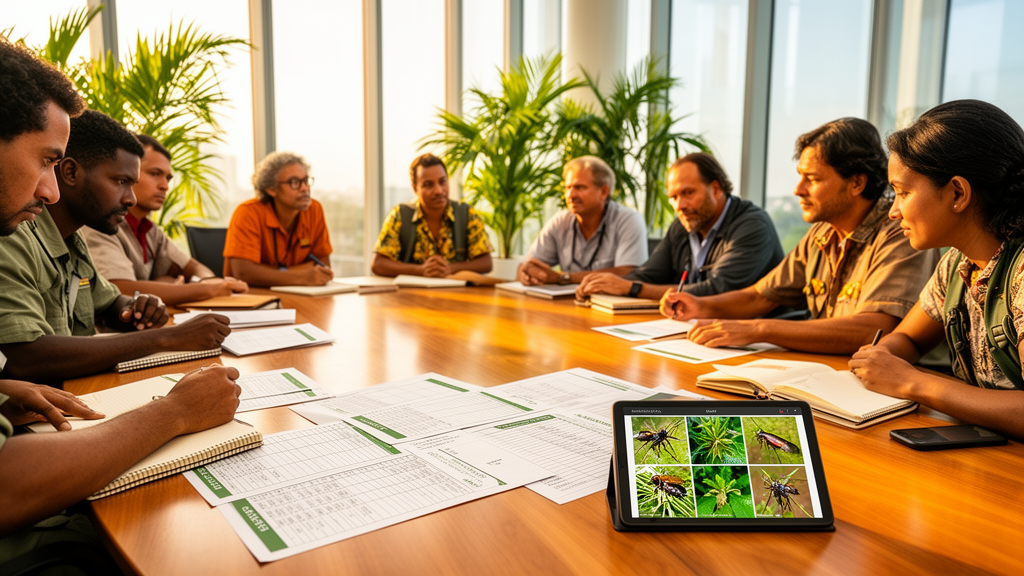
The initiative, coordinated by researchers working in Africa, Latin America and beyond, responds directly to a finding of the Intergovernmental Science-Policy Platform on Biodiversity and Ecosystem Services assessment on invasive alien species: the completeness and availability of lists of alien taxa in the Global South remain persistently inadequate. Lists of alien taxa, often called checklists, may sound mundane, but they are the backbone of integrated invasion governance. They collate observations from the field, from literature, from museum collections and from databases, and they attach crucial ancillary information: whether a species is casual or established, the pathway along which it was introduced, and the impacts it has caused.
The IPBES assessment incorporated information from more than 4,000 such lists to evaluate the global status of alien taxa. Without them, governments cannot report on their obligations under the Convention on Biological Diversity, whose Kunming-Montreal Global Biodiversity Framework requires regular reporting on which alien taxa are present and which are invasive. The new special issues comprise 11 articles in African Biodiversity & Conservation addressing Africa, five articles in Bioinvasiones covering Latin America and the Caribbean, and 12 articles in NeoBiota presenting work of broader interest.
The 28 papers, authored by 134 researchers, describe lists for entire countries such as Ecuador, Nicaragua, Zimbabwe, the Philippines and South Africa; for islands and marine regions off southern Brazil and the coast of Namibia; and for protected areas in Brazil and Johannesburg. Others compare regions, such as a floristic comparison between Mexico and South Africa, or focus on particular groups, including grasses in Madagascar and social wasps in the South Pacific. The guest editors deliberately chose journals that would not exclude researchers lacking well-resourced institutional backing.
African Biodiversity & Conservation and Bioinvasiones are platinum open access, meaning no author page charges, and Bioinvasiones accepts manuscripts in English, Portuguese or Spanish. NeoBiota, ranked in the top 25 percent of its category in Clarivate's Journal Citation Reports, does charge page fees, a compromise the editors acknowledged may have diverted at least one submission elsewhere. The proposal went out in July 2024, expressions of interest were solicited through academic networks, government contacts, the Global Register of Introduced and Invasive Species community and even snowball sampling, and the issues were published in early 2026.
Born from a 2011 GBIF workshop in Copenhagen and formalised through the Convention on Biological Diversity's GIASI Partnership, GRIIS presents validated national checklists of introduced and invasive taxa at country, territory and island level, covering all kingdoms of life. Its datasets are now identified as a key resource for the headline indicator of Target 6 of the Kunming-Montreal framework, the rate of invasive alien species establishment. Sub-national lists feed national databases, which in turn feed GRIIS, creating a chain from local observation to global reporting.
Many Global South countries are megadiverse, yet they face the greatest threats from global environmental change and from expanding trade pathways. Sub-Saharan Africa is the most vulnerable region to invasive agricultural pests, and some of the most damaging biological invasions occur in the Global South. African countries other than South Africa appear to have relatively few established alien taxa, but the editors caution that this apparent scarcity likely reflects a lack of monitoring and consolidation rather than genuine freedom from invasions.
Two barriers stand out: terminology and language. The IPBES assessment flagged a lack of standardised terminology for invasive alien species monitoring as having a moderate negative impact on understanding and management. Rather than enforcing their own sensibilities, the guest editors practised what they describe as avoiding verbal hygiene: authors were free to use their preferred terms, whether checklist, database, list or inventory, as long as terms were clearly defined and consistently applied.
To ensure interoperability, however, they recommend linking to formal data standards, such as the Darwin Core controlled vocabulary that states whether a species is native to a location, how it got there and to what extent it has become a permanent feature. Language matters just as much. One study cited in the introductory article showed that global databases of vertebrate abundance in Brazil increased roughly tenfold when data from non-English Brazilian journals were incorporated.
This raises a critical question: is the perceived data deficiency on alien species in various regions a genuine knowledge gap, or is the information sequestered in local-language reports excluded from global assessments? As a small contribution, the introductory article itself has been translated into French, Portuguese and Spanish, though the editors note these are all languages of European origin. The special issues also reveal practical lessons.
Workflows and protocols received detailed attention, with papers on developing watch lists, standardising names, translating names into indigenous languages, declaring taxa absent and identifying trees suitable for planting. Others incorporated citizen science, molecular information and roadside surveys into decision-ready lists. What was lacking, the editors admit, are articles explicitly analysing how lists are perceived and used, and how they deliver benefits.
Demonstrating the value of lists per se is difficult because the counterfactual is often unclear, yet measuring the impact of interventions is crucial if investment in their upkeep is to continue. The editors' recommendations are pragmatic: structure data and make them available, use data standards and metadata, list data sources and confidence levels, take a modular approach, document workflows, integrate with reporting requirements, commit dedicated resources, and learn by doing. Lists provide an imperfect snapshot of invasions at a particular time, but if they are FAIR and tidy, they can document change over time and facilitate adaptive management.
The hope is that this coordinated effort, alongside South-South collaboration and support from the Global North, will help lists serve local end-users and international science alike, turning scattered observations into the evidence base that integrated governance demands.
Subject of Research: Biodiversity and Conservation
Article Title: Developing lists of alien taxa in the Global South
Article References: Wilson, J. R. U., Dechoum, M. S., Faulkner, K. T., Langdon, B., Pagad, S., Pauchard, A., Seebens, H., Zengeya, T. A., & Ziller, S. R. (2026). Developing lists of alien taxa in the Global South. NeoBiota, 107, 269-286. https://doi.org/10.3897/neobiota.107.185317
Image Credits: AI Generated
DOI: 10.3897/neobiota.107.185317
Keywords: biological invasions, invasive alien species, Global South, biodiversity, IPBES, NeoBiota, Developing, lists, alien, taxa, Global, South
Cite Scienmag News
Margaret Porter. (October 20, 2026). Research report: Developing lists of alien taxa in the Global South. Scienmag. https://scienmag.com/research-report-developing-lists-of-alien-taxa-in-the-global-south/
Margaret Porter. "Research report: Developing lists of alien taxa in the Global South." Scienmag, 20 October 2026, https://scienmag.com/research-report-developing-lists-of-alien-taxa-in-the-global-south/. Accessed 20 October 2026.
Margaret Porter. "Research report: Developing lists of alien taxa in the Global South." Scienmag. October 20, 2026. https://scienmag.com/research-report-developing-lists-of-alien-taxa-in-the-global-south/


