


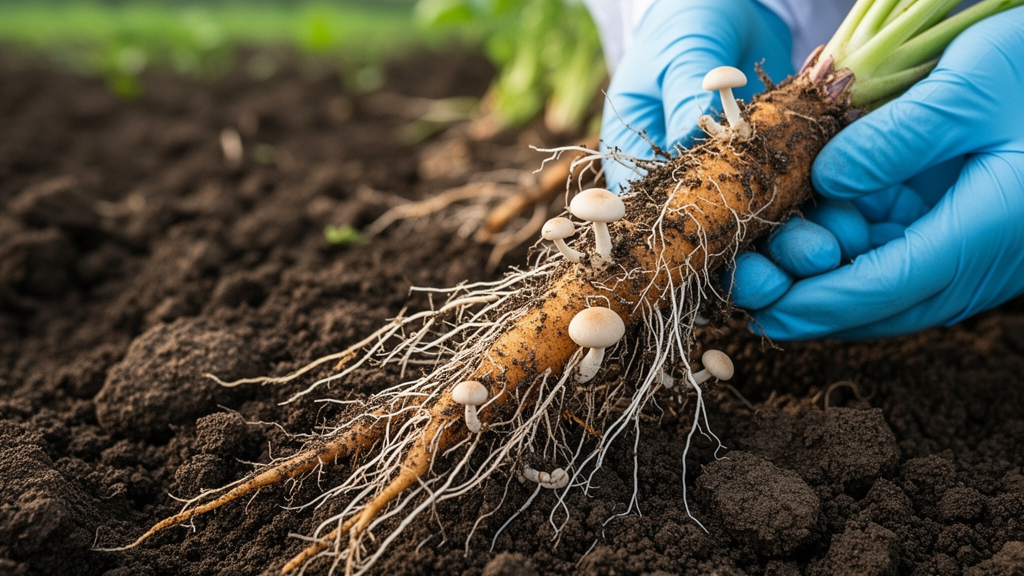
A taxonomic survey of root- and rhizosphere-associated fungi from the medicinal plant Lindera aggregata in Anhui Province, China, identified two previously undescribed species and documented a new host for Hawksworthiomyces taylorii. Hawksworthiomyces rhizosphaerae was isolated from rhizosphere soil, Melnikomyces linderae from roots, and H. taylorii from root tissue.
The investigators collected healthy L. aggregata individuals from wild populations in subtropical evergreen broad-leaved mountain forests in Huangshan City. Sampling took place in Shexian County at an elevation of 105 metres on 5 July 2023 and in Huangshan District at elevations of 290 metres on 8 August and 273 metres on 13 August 2023. Root samples and rhizosphere soil were processed separately. Rhizosphere microorganisms were isolated by serial dilution and cultivation on potato dextrose agar at 28 °C for two to seven days, while roots underwent surface sterilization before cultivation.
Colony characteristics were examined on potato dextrose agar, malt extract agar, cornmeal agar, oatmeal agar and water agar. Microscopic structures were measured and documented, and DNA was extracted from fresh mycelia. The phylogenetic study used six loci for Hawksworthiomyces—ITS, LSU, TEF1-α, RPB2, TUB2 and CAL—and six for Melnikomyces—ITS, LSU, SSU, TUB2, TEF1-α and ACT1. Alignments were analyzed using maximum-likelihood and Bayesian inference methods.
In the Hawksworthiomyces analysis, two isolates designated H. rhizosphaerae formed a distinct lineage with 100% maximum-likelihood bootstrap support and a Bayesian posterior probability of 1.00. This lineage was sister to a clade containing the ex-type strain of H. crousii and two strains of H. cylindroconidius. The new species differed from H. crousii in 3.13% of ITS sites and 4.68% of RPB2 sites, and from H. cylindroconidius in 1.78% of ITS sites.
Morphological observations supported recognition of H. rhizosphaerae as a new species. Its polyblastic conidiogenous cells measured 1.2–25.5 by 0.5–1.1 micrometres and bore short cylindrical denticles measuring 0.3–0.6 by 0.3–0.5 micrometres. Hyaline, guttulate, aseptate conidia measured 1.8–3.9 by 0.8–2.1 micrometres. Compared with H. crousii, the new species had narrower conidiogenous cells and smaller denticles, while its conidia were smaller and distinctly guttulate. Unlike H. cylindroconidius, which has monoblastic cells and longer unbranched conidiophores, H. rhizosphaerae has polyblastic cells with distinct denticles.
The second new species, M. linderae, was recovered from L. aggregata roots. Its six-locus phylogeny placed the two new isolates in a distinct clade sister to M. vietnamensis, supported by 93% maximum-likelihood bootstrap support and a Bayesian posterior probability of 0.97. The new species differed from M. vietnamensis in 4.55% of ITS sites and 1.06% of LSU sites.
M. linderae has narrow, pale-brown to brown conidiophores measuring 8.2–46.0 by 0.9–1.7 micrometres and polyblastic conidiogenous cells bearing cylindrical denticles. Its verrucose conidia measure 3.0–6.4 by 1.8–2.7 micrometres and are one-septate when mature, although some are two-septate; lateral, intercalary or terminal chlamydospores are also present. Its conidia and conidiophores are smaller and narrower than those of M. thailandicus and M. vietnamensis. The species epithet refers to the host genus Lindera.
Root material also yielded an isolate that grouped with the ex-holotype strain of H. taylorii with 100% maximum-likelihood bootstrap support and a Bayesian posterior probability of 1.00; its morphology was also consistent with that species. Earlier records included a Eucalyptus utility pole in South Africa, adult Hylurgus ligniperda beetles and the gut of the fungus-growing termite Macrotermes barneyi in China, and soil in China. The collection from L. aggregata roots therefore represents a new host record for H. taylorii.
This was a limited taxonomic investigation, not a functional or clinical study. Samples came from one plant species in one Chinese region, and the findings do not establish how the fungi affect plant growth, stress tolerance, nutrient acquisition or secondary metabolite production. The authors noted that the ecological significance of the root and rhizosphere associations remains unclear. They recommended broader sampling across hosts, substrates and regions, along with genome-scale analyses and further investigation of possible interactions with L. aggregata.
Subject of Research: Taxonomic discovery of novel root- and rhizosphere-associated fungi on Lindera aggregata in China
Article Title: Novel Hawksworthiomyces ( Ophiostomatales , Ophiostomataceae ) and Melnikomyces ( Venturiales , Sympoventuriaceae ) species and a new host record of Hawksworthiomyces on Lindera aggregata from China
Article References: Chen, M.-L., Mukjang, N., & Luo, X. (2026). Novel Hawksworthiomyces (Ophiostomatales, Ophiostomataceae) and Melnikomyces (Venturiales, Sympoventuriaceae) species and a new host record of Hawksworthiomyces on Lindera aggregata from China. MycoKeys, 139, 303-320. https://doi.org/10.3897/mycokeys.139.197994
Image Credits: AI Generated
DOI: 10.3897/mycokeys.139.197994
Keywords: taxonomy, fungal diversity, Hawksworthiomyces, Melnikomyces, Lindera aggregata, rhizosphere, plant-associated fungi, Anhui Province, new species, new host record, Novel, Ophiostomatales
Cite Scienmag News
Roger Howard. (October 20, 2026). Taxonomic survey identifies two novel fungi associated with Lindera aggregata roots in Anhui, China. Scienmag. https://scienmag.com/taxonomic-survey-identifies-two-novel-fungi-associated-with-lindera-aggregata-roots-in-anhui-china/
Roger Howard. "Taxonomic survey identifies two novel fungi associated with Lindera aggregata roots in Anhui, China." Scienmag, 20 October 2026, https://scienmag.com/taxonomic-survey-identifies-two-novel-fungi-associated-with-lindera-aggregata-roots-in-anhui-china/. Accessed 20 October 2026.
Roger Howard. "Taxonomic survey identifies two novel fungi associated with Lindera aggregata roots in Anhui, China." Scienmag. October 20, 2026. https://scienmag.com/taxonomic-survey-identifies-two-novel-fungi-associated-with-lindera-aggregata-roots-in-anhui-china/


