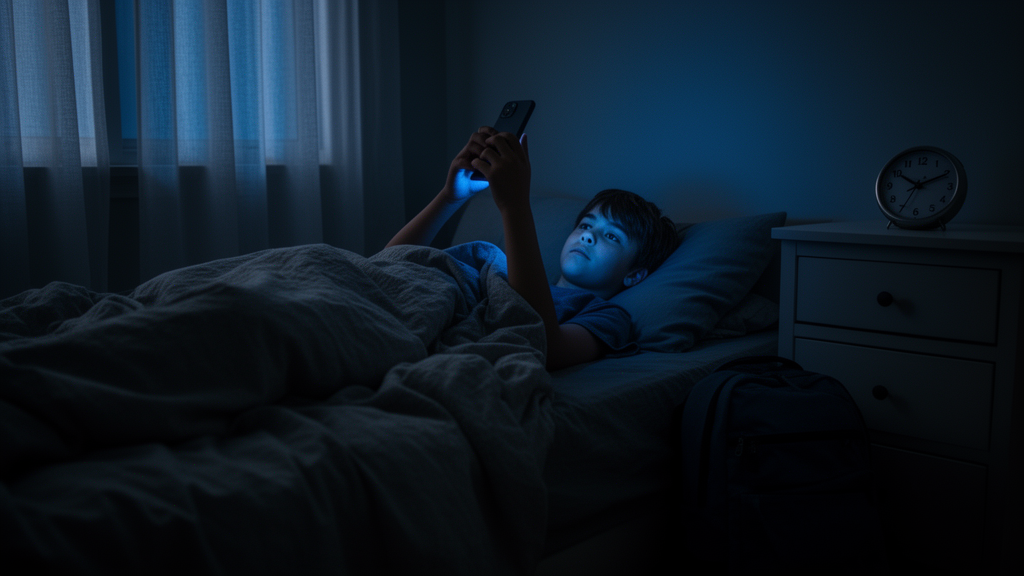
Children and adolescents in the United States who spend more time on recreational screens during the week are less likely to get the recommended amount of sleep, according to a new analysis of nationally representative survey data. The study, published in Discover Pediatrics, drew on the 2023–2024 National Survey of Children’s Health and included 58,881 young people aged 6 to 17 whose parents reported both weekday screen use and typical weeknight sleep duration. The findings reveal a graded pattern: as recreational screen time climbed from two hours or less per day to three hours and then four hours or more, the odds of adequate sleep fell steadily in both age groups.
The survey’s complex, stratified sampling design was fully accounted for in the analysis, with weights, strata, and primary sampling units incorporated into all estimates. Adequate sleep was defined using pediatric recommendations: nine to twelve hours per night for children aged 6 to 12, and eight to ten hours per night for adolescents aged 13 to 17. Screen time captured time spent in front of a television, computer, cellphone, or other device watching programs, playing games, accessing the internet, or using social media on most weekdays, explicitly excluding schoolwork.
The scale of the sleep problem in the underlying population is substantial. Previous estimates cited in the study indicate that 37.4 percent of U.S. children aged 6 to 12 and 31.2 percent of adolescents aged 13 to 17 do not get adequate sleep for their age. In the present sample, 60.6 percent of children met the sleep guideline, compared with about 70 percent of adolescents, and the researchers noted that a greater proportion of children than adolescents slept less than recommended, consistent with prior literature on age-related differences in total sleep time. Sleep adequacy also varied sharply by race and ethnicity: 67.0 percent of White children met the sleep guideline, compared with 58.1 percent of Hispanic children and 40.9 percent of Black children. Among adolescents, 42.0 percent of Black adolescents slept fewer than eight hours per day, compared with 29.4 percent of Hispanic and 27.0 percent of White adolescents.
Screen time followed a similarly uneven distribution. More than half of all children, 59.4 percent, met the national recommendation of two hours or less of recreational screen time per day, with 64.4 percent of White children meeting the guideline, followed by 56.0 percent of Hispanic children and 47.1 percent of Black children. Far fewer adolescents met the guideline, roughly one-third, with only small differences across racial and ethnic subgroups. Nearly twice as many adolescents as children in this sample spent four or more hours per day on screens of any type outside of schoolwork, a gap the authors suggest may reflect developmental differences in how screen use and sleep are patterned.
The core regression results showed a clear dose-response-like association among children. Compared with children who met the screen time guideline, those who spent three hours per day on screens had 30 percent lower odds of adequate sleep, and those spending four or more hours per day had 42 percent lower odds. These estimates were slightly attenuated in fully adjusted models that accounted for sex, family structure, federal poverty level, and the highest educational attainment of the responding adults. Among White children specifically, the association was even steeper: odds of adequate sleep fell by 34 percent at three hours per day and by 55 percent at four or more hours, compared with children meeting the screen use recommendation.
The pattern was less consistent among Black and Hispanic children. Black children who spent three hours per day on screens had 37 percent reduced odds of adequate sleep, while those at four or more hours had 33 percent reduced odds, with confidence intervals that overlapped considerably. Among Hispanic children, adequate sleep was slightly more likely at four or more hours of screen time than at three hours, but these estimates were weak and not statistically significant. Formal interaction tests indicated that race and ethnicity significantly modified the screen time–sleep relationship among children, meaning the subgroup differences were unlikely to be due to chance, although the authors emphasize that this statistical heterogeneity does not establish that the observed subgroup differences are causal.
Among adolescents, the inverse association was present but somewhat weaker. Compared with adolescents meeting the screen time guideline, those spending three hours per day on screens had 25 percent lower odds of adequate sleep, and those at four or more hours had 32 percent lower odds. For White adolescents, both exposure levels were associated with significantly lower odds of adequate sleep, whereas among Black and Hispanic adolescents, significantly lower odds emerged only at four or more hours per day, with the three-hour estimates not reaching statistical significance. Unlike the findings for children, formal testing showed that race and ethnicity did not significantly modify the association among adolescents, and a graded relationship appeared consistent across all three racial and ethnic groups in adjusted predicted probability models.
The authors propose several plausible mechanisms linking screen exposure to shorter sleep, including circadian disruption, cognitive stimulation, and the displacement of sleep time, while cautioning that the study did not directly measure bedtime screen use or light exposure and was not designed to identify the mechanisms underlying the observed disparities. They also point to contextual factors that may help explain the racial and ethnic heterogeneity among children. Prior qualitative work found that screen time can reduce parenting stress in some Black families, and cultural practices such as family-centered screen routines, including television viewing before bed documented among Mexican children, may shape how screen use fits into household life. The authors also note that caregiver work schedules, which vary across racial and ethnic groups and can influence household routines and bedtime practices, merit investigation in future studies.
The study has important limitations that temper interpretation. Its cross-sectional design precludes causal inference, so the findings show association rather than effect. Both screen time and sleep were parent-reported, and parent reports of children’s screen time have shown only modest agreement with objectively measured use, while adolescents themselves tend to report substantially higher screen time than their parents do. The data did not capture the timing, type, or purpose of screen use, and potential confounders such as physical activity, mental health status, school start times, bedtime routines, and household screen rules were not available in the survey instrument. The analysis also excluded children from Asian, American Indian or Alaska Native, Arab or Middle Eastern, and multiracial households due to small sample sizes, so the results apply only to Hispanic, Black, and White children and adolescents rather than the U.S. pediatric population as a whole.
Despite these constraints, the study extends the literature by using the most recent nationally representative U.S. data, evaluating a graded dose pattern rather than simple high-versus-low comparisons, and estimating adjusted predicted probabilities of adequate sleep. The authors conclude that greater recreational screen time is associated with lower odds of adequate sleep among U.S. children and adolescents, with racial and ethnic disparities in this association evident among children but not adolescents, and they call for longitudinal and intervention studies to clarify causality. For public health practice, they argue the findings support continued efforts to promote reduced recreational screen time as a component of sleep health, with outreach potentially tailored to the groups for whom the association is strongest, particularly Black children, who had the lowest observed prevalence of adequate sleep in this sample.
Subject of Research: Associations between recreational weekday screen time and adequate sleep among U.S. children and adolescents, examined by race and ethnicity
Article Title: Association of daily screen time with adequate sleep among U.S. children and adolescents
Article References: González, T., Chapa, G., & Basch, C. H. (2026). Association of daily screen time with adequate sleep among U.S. children and adolescents. Discover Pediatrics, 1(1), Article 11. https://doi.org/10.1007/s44571-026-00012-6
Image Credits: AI Generated
DOI: 10.1007/s44571-026-00012-6
Keywords: screen time, sleep health, children, adolescents, National Survey of Children's Health, health disparities, race and ethnicity, cross-sectional study, pediatric sleep, public health, obesity prevention, sleep recommendations
Cite Scienmag News
Harold Sullivan. (October 27, 2026). More Daily Screen Time, Less Adequate Sleep for U.S. Children and Teens. Scienmag. https://scienmag.com/more-daily-screen-time-less-adequate-sleep-for-u-s-children-and-teens/
Harold Sullivan. "More Daily Screen Time, Less Adequate Sleep for U.S. Children and Teens." Scienmag, 27 October 2026, https://scienmag.com/more-daily-screen-time-less-adequate-sleep-for-u-s-children-and-teens/. Accessed 28 October 2026.
Harold Sullivan. "More Daily Screen Time, Less Adequate Sleep for U.S. Children and Teens." Scienmag. October 27, 2026. https://scienmag.com/more-daily-screen-time-less-adequate-sleep-for-u-s-children-and-teens/