


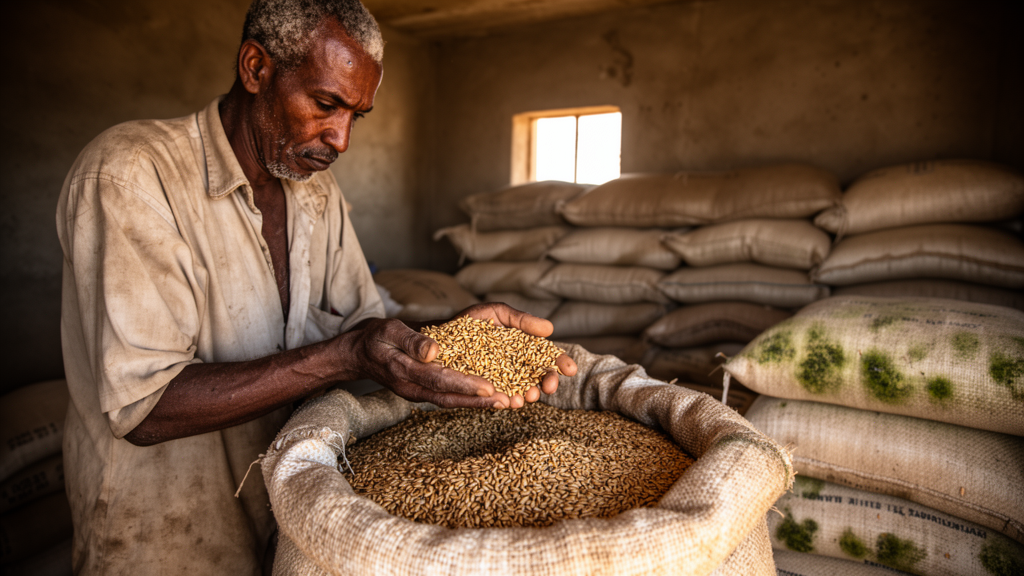
In the highlands and semi-arid lowlands of Eritrea, small-scale farmers grow maize and groundnuts that anchor local diets and household incomes. A new survey conducted between July and December 2023 across the Anseba, Debub and Maekel regions reveals a troubling blind spot: the farmers who produce these staple crops know remarkably little about the mold fungi that invade stored grain and the potent toxins those fungi can leave behind. The study, published in Innovations in Agriculture, is the first of its kind in the country and paints a stark picture of a food safety hazard unfolding in silence.
The research team, working from Hamelmalo Agricultural College, interviewed 80 farmers recruited through Ministry of Agriculture records using systematic random sampling. Fifty respondents came from the maize-producing highlands of Maekel and Debub, while thirty came from the groundnut-growing semi-arid zones of Anseba. Questionnaires administered in Tigrinya, the predominant local language, probed sociodemographics, awareness of mold contamination, knowledge of mycotoxins, uses of spoilt grain, and control measures. Alongside the interviews, the researchers collected 79 one-kilogram grain samples from household stores meant for human consumption and carried them to the college pathology laboratory for fungal isolation.
The demographic profile of the respondents matters for interpreting the findings. Ninety-one percent of the farmers were male, most were aged between 41 and 50, and farming on plots of three to six acres was the universal economic activity. Education levels were modest: 39 percent had achieved only primary schooling, a full 20 percent had no formal education at all, and just 7.5 percent had reached tertiary level. These figures set the stage for what the knowledge assessment would uncover, because formal schooling is often the primary channel through which rural communities encounter concepts like fungal contamination and toxic metabolites.
On the surface, the farmers showed practical familiarity with spoilage. More than half, 57.5 percent, said they could identify spoilt grains, and they described doing so through rotting, visible insects, and discolouration. All 80 respondents claimed they could distinguish well-dried pods and grain from poorly dried ones, and two-thirds said they cleaned their stores before introducing new harvests. Yet beneath this practical competence lay a deeper ignorance. When asked about the term mycotoxins, not a single farmer had heard of it. Ninety-five percent did not know the risks associated with consuming mold-infected grain, and 67 percent had no knowledge of measures for controlling mold fungal infection in storage.
The consequences of that ignorance are visible in what farmers do with spoilt grain. Roughly 34 percent admitted to consuming contaminated grain themselves, 26 percent fed it to livestock, and 18.4 percent sold it to unsuspecting customers in local markets. Only 12.5 percent sorted their grain after harvest, a practice that removes damaged and moldy cobs before they seed contamination through an entire store. The pattern echoes findings from Tanzania, Malawi and Zambia, where farmers aware of mycotoxin risks continued consuming contaminated grain due to food shortage, but in Eritrea the problem is compounded by the fact that awareness itself is absent.
Statistical analysis revealed a strong positive correlation between farmers’ knowledge of mold fungi and their ability to understand mycotoxin contamination, with a correlation coefficient of 0.804 at a significance level of p ≤ 0.001. This suggests that the two concepts travel together in the farmers’ mental models: those who grasp fungal infection also grasp toxin risk, and those who lack one lack both. Interestingly, education level showed a negative correlation with mold knowledge, likely because most respondents were primary school dropouts or had no basic education, meaning the topic of mycotoxins was never covered in the schooling they did receive. Age correlated positively with mold knowledge, hinting that accumulated farming experience transmits some awareness informally across generations.
Laboratory analysis confirmed the presence of the very fungi that produce the most dangerous mycotoxins. The researchers isolated Aspergillus niger, Aspergillus flavus, Aspergillus parasiticus, Fusarium verticillioides and Penicillium species from both maize and groundnut samples. Aspergillus flavus and A. parasiticus are the principal producers of aflatoxins, carcinogenic compounds associated with liver cancer, immune suppression, and growth retardation in children. Fusarium verticillioides produces fumonisins, which impair nutrient absorption and cause neural tube defects. The isolation of these species from grain destined for human consumption transforms the survey from an academic exercise into a public health warning.
Storage method emerged as a decisive factor in fungal contamination. Grain kept in the traditional Koffo structure showed the highest incidence of mycotoxigenic fungi across all species measured. Aspergillus niger reached 75.8 percent incidence in maize stored in Koffo, compared with 45.8 percent in plastic containers and 62.8 percent in plastic sacks. Fusarium verticillioides hit 45.6 percent in Koffo-stored maize. The researchers attribute the elevated contamination to farmers mixing old grain with new, leaving Koffo structures open for extended periods, and providing entry points for storage pests such as the maize weevil Sitophilus zeamais and the larger grain borer Prostephanus truncatus. Insect damage breaks grain kernels and raises local humidity, creating ideal conditions for fungal colonization.
The quality attributes observed in collected maize reinforce this pest-fungus synergy. Insect damage was the most common marker of poor grain quality, followed by moldy rot and shrivelling. These defects create pathways for inoculum to spread within stores, gradually contaminating entire grain lots over time. Comparable surveys in Togo and Honduras found similar patterns of Aspergillus, Penicillium and Fusarium dominating traditional storage facilities, suggesting that the Eritrean findings reflect a broader Sub-Saharan African challenge where agronomic, storage and climatic conditions conspire to encourage fungal growth and toxin production.
The study’s authors call for tailored interventions through the Eritrean Ministry of Agriculture to promote good agricultural practices aimed at reducing mold and mycotoxin contamination. They recommend awareness campaigns to inform farmers of the threats and effects of mycotoxins on human and animal health, expanded surveillance to monitor contamination levels, improved access to information, and an increase in the number of extension officers who can train farmers on fungal contaminants and management practices. Given that neighboring Uganda loses an estimated 577 million US dollars annually to mycotoxin-related losses, the economic stakes for Eritrea’s subsistent farming communities are considerable. The knowledge gap documented here is not merely an educational deficit but a silent pathway through which carcinogenic compounds enter the food chain, one contaminated grain at a time.
Subject of Research: Farmer awareness of mold infection and mycotoxin contamination in stored maize and groundnut in Eritrea
Article Title: Evaluation of awareness of mold infections in stored maize ( Zea mays L.) and groundnut ( Arachis hypogaea L.) in Anseba, Debub and Maekel Regions (Zoba) of Eritrea
Article References: Okumu, O. O., Sethumadhava, R., Melika, E. Z., Divora, T. M., Samuel, P. G., Even, B. F., Yasmin, S. J., & Abel, T. T. (2024). Evaluation of awareness of mold infections in stored maize (Zea mays L.) and groundnut (Arachis hypogea L.) in Anseba, Debub and Maekel Regions (Zoba) of Eritrea. Innovations in Agriculture, 7, 1-10. https://doi.org/10.3897/ia.2024.132491
Image Credits: AI Generated
Keywords: mycotoxins, aflatoxin, food safety, Eritrea, maize, groundnut, Aspergillus, storage, agriculture, public health, Evaluation, awareness
Cite Scienmag News
Alan Morgan. (October 17, 2026). Mold-Contaminated Grain Silently Threatens Eritrean Farmers and Consumers. Scienmag. https://scienmag.com/mold-contaminated-grain-silently-threatens-eritrean-farmers-and-consumers/
Alan Morgan. "Mold-Contaminated Grain Silently Threatens Eritrean Farmers and Consumers." Scienmag, 17 October 2026, https://scienmag.com/mold-contaminated-grain-silently-threatens-eritrean-farmers-and-consumers/. Accessed 17 October 2026.
Alan Morgan. "Mold-Contaminated Grain Silently Threatens Eritrean Farmers and Consumers." Scienmag. October 17, 2026. https://scienmag.com/mold-contaminated-grain-silently-threatens-eritrean-farmers-and-consumers/


