


In the rapidly evolving field of environmental and health monitoring, the development of reliable, compact, and versatile biosensors remains a critical challenge. Whole-cell bioelectronic sensors offer an intriguing solution by integrating living microbial cells with electronic readout circuits, facilitating real-time detection of various analytes in complex environments. Despite their promise, existing designs often suffer limitations in modularity, relying heavily on specific microbial chassis and sophisticated equipment for signal interpretation. Addressing these constraints, researchers have now unveiled an innovative platform—termed the electroactive co-culture sensing system (e⁻COSENS)—that fundamentally transforms the landscape of bioelectronic sensing by combining modularity, adaptability, and ease of use.
The crux of the e⁻COSENS technology lies in its elegant co-culture architecture, wherein two distinct bacterial strains collaborate to transduce chemical signals into measurable electrical outputs. The first, designated the ‘sender’ microorganism, is genetically engineered to sense target analytes and subsequently synthesize electron mediating compounds in response. These mediators act as biochemical messengers, shuttling electrons from the sender to the second partner in the system, the ‘receiver’ microbe. The receiver capitalizes on its extracellular electron transfer machinery to convert these chemical cues directly into electrical signals detectable by simple electronic instrumentation. By decoupling sensing from electron transfer functionality into separate biological entities, e⁻COSENS achieves an unprecedented level of modularity and robustness.
This novel approach dismantles the traditional single-chassis constraint of biosensor design, enabling researchers to seamlessly swap different sender strains tailored to detect a wide array of chemical species without modifying the fundamental electron transfer processes. Consequently, the e⁻COSENS system accommodates highly diverse sensing modalities, including metals, small molecules, and peptides, which are critical targets for environmental safety and public health applications. Such versatility is particularly vital given the heterogeneity of real-world samples, ranging from urban water bodies to complex biological fluids like milk and saliva.
Integral to the practical deployment of e⁻COSENS is the ability to operate effectively in complex sample matrices and microbial consortia, where interference and matrix effects may degrade sensor performance. Impressively, the co-culture design inherently mitigates many such challenges: the sender bacteria offer specificity through genetically encoded recognition circuits, while the receiver’s extrinsic electron transfer components provide a robust, amplification-ready electrical signal. This bifurcation of roles results in a sensor architecture that maintains sensitivity and selectivity across diverse and often harsh environments, representing a significant leap forward in whole-cell biosensing technology.
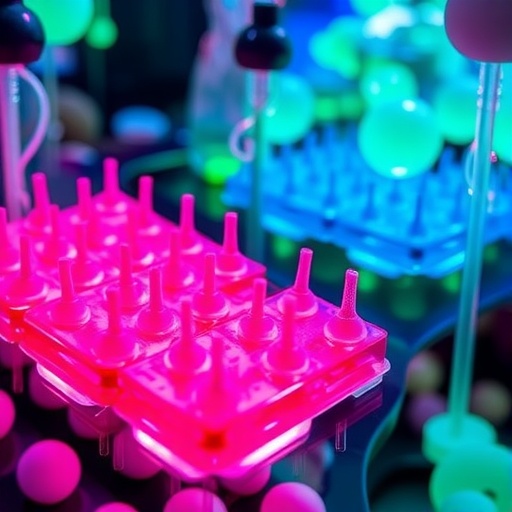
Complementing this biological innovation is the development of a portable, user-friendly electronic interface that dramatically simplifies signal acquisition. The team engineered a centimeter-scale bioelectronic device that enables direct electrical readout with widely available household tools such as digital multimeters. This breakthrough eliminates the need for expensive, specialized instruments conventionally required for bioelectronic sensor operation and opens the path toward decentralized monitoring and point-of-care diagnostics in resource-limited settings. Such accessibility stands to democratize detection technologies and augment real-time surveillance capabilities on a global scale.
The modular e⁻COSENS framework exemplifies the power of synthetic biology and microbial engineering in constructing living devices that transcend traditional biochemical sensing paradigms. By programming distinct bacterial strains for complementary functions—recognition, electron mediator production, and extracellular electron transfer—the system seamlessly integrates molecular specificity with bioelectronic transduction. This plug-and-play design not only streamlines sensor customization but also accelerates iterative optimization and scaling for diverse analytical challenges.
Moreover, the strategic use of electron mediators as diffusible signal carriers represents a pivotal advance in maintaining independence between sensing and transduction domains. Electron mediators are small redox-active molecules capable of shuttling electrons efficiently, thereby facilitating communication between species that otherwise might not interact electrically. By capitalizing on this natural phenomenon within an engineered synthetic ecosystem, the researchers constructed a robust electron flow pathway that converts biochemical recognition into quantitative electrical currents with high fidelity.
The ability of e⁻COSENS to detect analytes in urban waterways, milk, saliva, and microbial communities underscores its versatility and potential for real-world applications spanning environmental monitoring, food safety, and clinical diagnostics. Urban water systems often suffer from contamination by heavy metals and pollutants, while dairy products and oral fluids harbor bioactive molecules and indicators of health status. The sensor’s modularity allows rapid tailoring to these varied niches, facilitating proactive monitoring and timely intervention strategies with minimal technical overhead.
Beyond the immediate practical benefits, the e⁻COSENS platform exemplifies how harnessing interspecies microbial interactions can expand functional capabilities of biosensors. Synthetic co-cultures emulate natural consortia more closely than monocultures, endowing devices with resilience, adaptability, and emergent properties that are difficult to achieve otherwise. This systems-level perspective paves the way for future biotechnological innovations integrating multiple microbes engineered for complementary tasks within living sensing and remediation networks.
From a technological standpoint, the translation of microbial sensing circuits into deployable electronic signals marks a critical step toward scalable biosensor networks. The co-culture’s extracellular electron transfer exploits well-characterized respiratory pathways adapted for bioelectrochemical interfaces, aligning biological electron flow with conventional electronic circuitry. This bioelectronic convergence facilitates integration into Internet-of-Things (IoT) frameworks, enabling real-time data telemetry, remote monitoring, and automated feedback systems essential for modern environmental and health surveillance.
The researchers also underscore the modular simplicity of the system, where tuning sensitivity and specificity results from swapping genetic elements within the sender strain or selecting alternative electron mediators, rather than extensive receptor engineering or bioelectrode redesign. This flexibility greatly lowers the barrier for developers to create bespoke sensors targeting emerging threats without reinventing the entire sensor platform, which is particularly advantageous in rapidly changing contexts such as pandemic outbreaks or environmental disasters.
Importantly, e⁻COSENS reduces dependency on resource-intensive laboratory protocols and bulky analytical equipment, thereby enhancing field adaptability and user-friendliness. The small, portable device footprint, coupled with minimal training requirements due to straightforward electrical readouts, transforms biosensing from a niche research tool into an actionable technology poised for widespread adoption by environmental agencies, clinicians, and citizen scientists alike.
Looking forward, this pioneering work signals a paradigm shift in biosensor development. Integrating synthetic microbial consortia engineered for modular biochemical sensing and efficient bioelectronic transduction presents an adaptable template for a broad spectrum of applications. As synthetic biology continues to mature, incorporating more sophisticated genetic circuits, communication channels, and metabolic pathways will further expand the sensor repertoire and improve performance metrics such as dynamic range, response time, and environmental robustness.
In conclusion, the e⁻COSENS technology provides a powerful, flexible, and accessible platform that leverages synthetic microbial co-cultures to achieve modular bioelectronic sensing across diverse environments. By embodying the principles of modularity, portability, and operational simplicity, this system addresses longstanding challenges in whole-cell biosensor design. It lays the groundwork for next-generation living devices capable of transforming how we monitor and respond to chemical signals in our surroundings, with profound implications for environmental stewardship, public health, and biotechnology at large.
Cite Scienmag News
Morgan Morrow. (April 17, 2026). Modular Microbial Co-Cultures Revolutionize Bioelectronic Sensing. Scienmag. https://scienmag.com/modular-microbial-co-cultures-revolutionize-bioelectronic-sensing/
Morgan Morrow. "Modular Microbial Co-Cultures Revolutionize Bioelectronic Sensing." Scienmag, 17 April 2026, https://scienmag.com/modular-microbial-co-cultures-revolutionize-bioelectronic-sensing/. Accessed 4 September 2026.
Morgan Morrow. "Modular Microbial Co-Cultures Revolutionize Bioelectronic Sensing." Scienmag. April 17, 2026. https://scienmag.com/modular-microbial-co-cultures-revolutionize-bioelectronic-sensing/


