


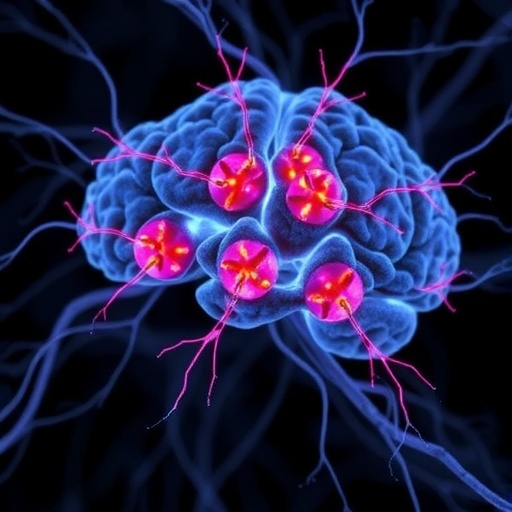
A groundbreaking new study shines a spotlight on the elusive molecular pathways underpinning Alzheimer’s disease (AD), uncovering a neuron-specific mechanism that orchestrates the formation of tau protein aggregates – a hallmark of neurodegeneration. For decades, researchers have sought to understand how soluble tau proteins transition into the pathogenic paired helical filaments (PHFs) characteristic of AD, but the cellular triggers remained undefined. Now, a team led by Paradise et al. reveals the critical role of a specialized plasma membrane proteasome, termed the “neuroproteasome,” in regulating this pathological tau transformation. Their findings not only demystify a vital cellular process but also link genetic and aging factors to disease progression, with profound implications for future therapeutic strategies.
At the center of this discovery is the neuroproteasome, a variant of the proteasome complex uniquely localized to the neuronal plasma membrane. Unlike the canonical proteasomes distributed throughout the cytoplasm and nucleus, neuroproteasomes are specifically embedded in the cell’s outer membrane, positioning them to regulate protein homeostasis at a crucial interface between the neuron and its environment. The study reveals that neuroproteasomes act as gatekeepers, maintaining tau protein solubility and preventing its abnormal aggregation under physiological conditions. When neuroproteasome function is selectively inhibited, the researchers observed a rapid and spontaneous conversion of endogenous tau into sarkosyl-insoluble PHFs in primary neuronal cultures and mouse brain tissue. Remarkably, these induced tau aggregates share essential biochemical signatures and ultrastructural features with PHFs extracted from human Alzheimer’s brain samples, affirming the pathological relevance of this mechanism.
This is the first time a direct connection has been drawn between proteasome activity on the neuronal plasma membrane and tau pathology, highlighting a previously unappreciated layer of regulation in tau proteostasis. The implications are far-reaching: targeting neuroproteasome function could represent a novel intervention point to halt or slow the tau aggregation cascade before irreversible neurodegeneration ensues. The authors employed sophisticated biochemical assays and electron microscopy to meticulously characterize the tau filamentation process, ensuring that the observed PHFs match the molecular complexity found in AD pathology.
Adding critical nuance to these findings, the study explores the influence of apolipoprotein E (APOE) isoforms on neuroproteasome abundance and tau aggregation susceptibility. APOE, encoded by a gene with three major alleles—E2, E3, and E4—is established as a genetic risk factor for AD, with APOE4 carriers showing significantly higher vulnerability. Paradise et al. demonstrate that neuroproteasome presence at the plasma membrane is modulated in an isoform-dependent manner, with APOE2 associated with the most robust neuroproteasome levels, followed by APOE3, and then APOE4 exhibiting the least. This gradient mirrors disease risk and suggests that APOE4 neurons are inherently predisposed to impaired proteostasis, especially under conditions of neuroproteasome disruption.
Moreover, this proteostatic deficit becomes exacerbated with aging, as neuroproteasome abundance naturally declines over time. The convergence of age-related neuroproteasome reduction and the presence of the high-risk APOE4 genotype create a perfect storm for tau aggregation and subsequent neuronal damage. The researchers meticulously quantified neuroproteasome density and correlated it with tau aggregation propensity across different age cohorts and APOE genotypes, providing compelling evidence that these factors interplay to modulate AD onset and severity. This pioneering insight offers an elegant explanation for the well-documented yet mechanistically obscure age and genotype influence on Alzheimer’s progression.
By employing both in vitro neuronal cultures and in vivo mouse models, the team ensured the robustness and translational relevance of their findings. They induced modest neuroproteasome inhibition pharmacologically and genetically, showing that even slight compromises in neuroproteasome function could trigger tau PHF formation, predominantly in APOE4 background neurons. Conversely, APOE2 genotype neurons exhibited remarkable resilience, maintaining tau in its soluble, nonpathogenic state despite similar insults. This genotype-specific vulnerability provides not only mechanistic clarity but also a potential biomarker stratification paradigm to identify individuals who might benefit most from neuroproteasome-targeted therapies.
At the ultrastructural level, electron microscopy revealed that the newly formed tau filaments mimic the canonical paired helical filaments seen in AD brain tissue. These filamentous aggregates possess the hallmark periodicity and morphology, ruling out the possibility that the neuroproteasome inhibition induced nonphysiological or off-target tau aggregates. This affirmation is crucial, as it confirms that neuroproteasome dysfunction could be a primary driver in actual human disease pathology rather than a mere cellular artifact. The comprehensive biochemical analyses further pinpointed the tau isoforms and post-translational modifications involved, adding a deeper layer of molecular definition to the pathological process.
Importantly, the findings position the neuroproteasome as a therapeutic target of immense potential. While traditional strategies in AD focus on extracellular amyloid plaques or general proteostasis enhancers, targeting the neuron-specific plasma membrane proteasome offers spatial and mechanistic selectivity. Modulating neuroproteasome activity could restore tau homeostasis preemptively, preventing the initial seeding and spread of tau aggregates across synaptically connected neurons. Given the difficulty in treating established tau pathology, such preventive strategies are critically needed, especially for at-risk individuals identified via APOE genotyping.
These discoveries also raise intriguing questions for future research. For instance, what molecular signals regulate neuroproteasome abundance and activity at the plasma membrane? Are there modulators or interactors specific to the neuroproteasome that can be exploited pharmacologically? How does neuroproteasome dysfunction affect other neurodegenerative diseases characterized by protein aggregation? Paradise et al. lay the groundwork to explore these avenues, potentially broadening the implication of neuroproteasomes beyond Alzheimer’s disease.
From a clinical perspective, this study supports the integration of neuroproteasome status and APOE genotype as biomarkers for early detection and personalized therapeutic regimens. Neuroproteasome decline could serve as a measurable endpoint in longitudinal monitoring of at-risk populations, enabling timely interventions before significant neurodegeneration takes hold. Furthermore, pharmaceutical development focusing on enhancing or stabilizing plasma membrane proteasome function may yield a novel class of neuroprotective agents.
The intersection of ageing, genetics, and proteostasis illuminated by this research epitomizes the complexity of Alzheimer’s disease and underscores the importance of neuron-specific mechanisms in neurodegeneration. By elucidating how differential modulation of neuroproteasomes by APOE isoforms and ageing fosters tau aggregation, this work advances our fundamental understanding of AD pathogenesis and opens innovative therapeutic pathways. It highlights the need to consider subcompartmentalized protein quality control systems within neurons in designing effective interventions to combat this devastating disease.
In summary, Paradise and colleagues deliver a transformative insight into the cellular triggers of tau pathology in Alzheimer’s disease, centering on the neuroproteasome’s crucial role. The work elegantly integrates biochemical, genetic, and age-related dimensions to explain the formation of paired helical filaments from endogenous tau in a genotype- and age-dependent manner. These findings redefine the landscape of AD research, emphasizing neuron-specific plasma membrane proteasomes as pivotal regulators of proteostasis and promising therapeutic targets. As neurodegenerative diseases continue to challenge healthcare systems globally, such novel mechanistic revelations provide hope for the development of precision treatments that could significantly alter disease trajectories.
This seminal study not only deepens the molecular narrative of Alzheimer’s disease but also crucially informs the broader field of neurobiology regarding how neurons maintain protein homeostasis in an age- and genotype-contextualized manner. It is a quintessential example of how detailed cellular biology intertwined with genetic insights can unravel the complexities of human disease, guiding the next generation of diagnostic and therapeutic innovations. Ultimately, the intersection of neuroproteasome function, APOE genotype, and ageing processes pinpoints critical vulnerabilities that could be exploited to preserve neuronal integrity and cognitive function in Alzheimer’s disease.
Cite Scienmag News
Cassandra Pierce. (May 29, 2026). Neuroproteasomes Control Tau Filaments by APOE, Age. Scienmag. https://scienmag.com/neuroproteasomes-control-tau-filaments-by-apoe-age/
Cassandra Pierce. "Neuroproteasomes Control Tau Filaments by APOE, Age." Scienmag, 29 May 2026, https://scienmag.com/neuroproteasomes-control-tau-filaments-by-apoe-age/. Accessed 5 September 2026.
Cassandra Pierce. "Neuroproteasomes Control Tau Filaments by APOE, Age." Scienmag. May 29, 2026. https://scienmag.com/neuroproteasomes-control-tau-filaments-by-apoe-age/


