


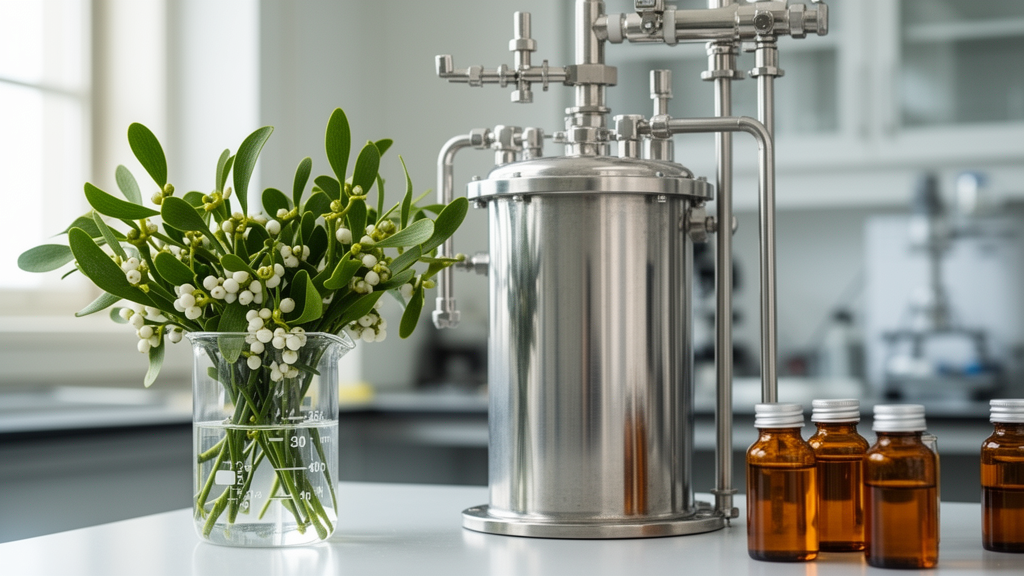
Mistletoe has hung over doorways and threaded through folklore for centuries, but in Mexico it has also hung over something far more serious: the treatment of disease. Phoradendron leucarpum, the American mistletoe that drapes itself over oaks and walnut trees across the country and the southern United States, has long been used in folk medicine as a remedy for cancer, diabetes, and cardiovascular conditions. Now a team of researchers at Tecnológico de Monterrey and CINVESTAV in Monterrey has brought modern green chemistry to this ancient remedy, using supercritical carbon dioxide to extract its bioactive compounds and, in the process, exposing a surprising weakness in the way science measures antioxidant power.
The study, published in Frontiers in Natural Products, tackled a problem that has shadowed natural product research for years: most studies of mistletoe have focused on European and Asian species, leaving the chemistry of the abundant American variety largely unexplored. Because P. leucarpum is a hemiparasite that never touches soil and feeds directly on the sap of its host tree, its phytochemical makeup shifts with the host and the climate, making it a chemically unpredictable but tantalizing candidate for drug discovery. The researchers collected the plant from a ranch in Nuevo León, dried its stems, and set out to coax out two particularly valuable classes of molecules: oleanolic acid, a triterpene with documented activity against multiple tumor cell lines, and polyphenols, the aromatic compounds linked to antioxidant, anti-inflammatory, and antitumor effects.
Their tool of choice was supercritical CO2 extraction, a technique that exploits carbon dioxide held at a temperature and pressure above its critical point, where it takes on properties of both a gas and a liquid. Because CO2 reaches this state at just 31 degrees Celsius, the method can pull delicate biological molecules out of plant tissue without cooking them. Even better, by dialing the pressure up to around 200 bar, the fluid’s density approaches that of hexane, allowing it to dissolve lipophilic compounds such as triterpenes without harsh organic solvents. Small tweaks in temperature and pressure reshape the solvent’s density and polarity, meaning chemists can, in principle, tune the extraction like a radio dial to favor one family of compounds over another.
To map that dial, the team used a Box-Behnken statistical design that generated 15 extraction conditions spanning temperatures of 40 to 70 degrees Celsius, pressures of 100 to 400 bar, and ethanol co-solvent flow rates of 2 to 6 grams per minute. Twenty grams of dried stems went into the extraction vessel for each run, and the resulting extracts were concentrated, freeze-dried, and analyzed. Response surface methodology then linked each combination of settings to three outcomes: total extract yield, oleanolic acid content measured by high-performance liquid chromatography, and total polyphenol content measured with the classic Folin-Ciocalteu assay. The models fit the data remarkably well, with prediction coefficients near 0.99 for the polyphenol analysis.
The results revealed a counterintuitive landscape in which more was not always better. The highest total extract yield, 3.08 grams per 20 grams of plant material, came from the gentlest condition tested, at 40 degrees Celsius and 100 bar. But the purest haul of oleanolic acid emerged from a different corner of the parameter space: treatment 10, run at 40 degrees Celsius and 250 bar with a low 2 grams per minute of co-solvent, delivered up to about 117 milligrams of the triterpene per gram of dried extract. The explanation lies in the molecule’s dual personality. Its bulky pentacyclic hydrocarbon core is strongly nonpolar, yet a hydroxyl group and a carboxylic acid lend it partial polarity, so a modest whisper of ethanol co-solvent bridges the gap between the compound and the carbon dioxide fluid. In two treatments where the fluid density or polarity drifted out of that sweet spot, oleanolic acid was not detected at all.
Polyphenols told a different story. The richest phenolic extracts clustered at the center of the design, around 55 degrees Celsius, 250 bar, and 4 grams per minute of co-solvent, averaging nearly 197 milligrams of gallic acid equivalents per gram of extract. Temperature proved to be the dominant driver, with its influence highly significant in the statistical model, while pressure contributed mainly through its quadratic and interaction effects. Moderate co-solvent flow, it seems, nudges the fluid’s polarity into the range that dissolves phenolics best, whereas pushing the flow rate too high dilutes the solvent’s contact time with the plant matrix and leaves the extraction vessel unsaturated.
The most provocative part of the study came when the team measured antioxidant activity. Conventionally, researchers rely on assays such as ABTS and DPPH, which track how well a compound quenches synthetic radicals in a test tube. These assays are fast and reproducible, but their radicals bear little resemblance to the reactive oxygen species actually generated inside living cells. So the group applied a novel method, developed within their own labs and reported previously, that generates four physiologically relevant reactive oxygen species, singlet oxygen, hydroxyl radical, hydrogen peroxide, and superoxide anion, by irradiating specific photosensitizers, then detects how effectively each extract neutralizes them using fluorescent probe molecules at physiological pH.
What emerged was a fundamental disconnect. Some extracts that scored impressively against the synthetic radicals, such as treatment 5 and the central-point extracts, showed strong ABTS and DPPH responses, yet the ROS-specific profiles told a fragmented tale. Treatment 7 led against singlet oxygen with roughly 40 percent neutralization despite containing only moderate levels of oleanolic acid and polyphenols, hinting that specific mixtures of compounds can act synergistically where individual molecules cannot. Nearly all extracts neutralized superoxide anion robustly, between 70 and 95 percent, while performance against hydroxyl radical and hydrogen peroxide ranged widely and did not track with oleanolic acid or polyphenol content at all. Most strikingly, extracts that looked nearly inert in the traditional assays, such as treatments 10 and 12, proved moderately to highly effective against several physiological ROS. The synthetic radical tests, in other words, had been painting a misleading portrait.
Principal component analysis added mechanistic texture to these patterns. Oleanolic acid content correlated most closely with hydroxyl radical neutralization, consistent with the compound’s known ability to chelate transition metals such as iron and copper and thereby block the Fenton reactions that spawn this, the most destructive of all ROS. Total polyphenol content, by contrast, tracked positively with superoxide and singlet oxygen scavenging but, unexpectedly, correlated negatively with hydrogen peroxide neutralization, suggesting that the specific identity of the phenolic compounds, and their interactions with triterpenes, matters far more than the bulk total. Earlier work on hop extracts has shown similarly that individual phenolics can excel against one ROS while faltering against another, underscoring just how compound-specific these activities are.
The team ultimately selected treatment 8, run at 40 degrees Celsius and 100 bar with 4 grams per minute of co-solvent, as the optimal condition for future work: it produced the highest extract yield, respectable levels of both target compound classes, strong activity against key ROS, and, because it operates at the lowest temperature and pressure tested, an energy profile suited to industrial scale-up. Beyond the practical recipe, the study lands a broader punch. Since individual ROS species are implicated in distinct diseases, from singlet oxygen in glaucoma to hydroxyl radical in atherosclerosis and superoxide in cancer, a genuine broad-spectrum antioxidant will likely require either a carefully chosen blend of bioactive molecules or a purified compound with multi-target activity. For a hemiparasitic plant long dismissed as a Christmas curiosity, American mistletoe has just delivered a pointed message about how the field hunts for its next generation of natural medicines.
Subject of Research: Supercritical CO2 extraction of bioactive compounds from American mistletoe and ROS-specific antioxidant evaluation
Article Title: Supercritical CO2 extraction of Phoradendron leucarpum (American mistletoe): optimizing oleanolic acid and polyphenol yields, monitoring ROS-specific neutralization
Article References: Ijadi, F., Buenfil-Chi, T. J., Serna Guerrero, D. A., Mercado-Uribe, H., Guajardo-Flores, D., & Sierra-Valdez, F. J. (2026). Supercritical CO2 extraction of Phoradendron leucarpum (American mistletoe): optimizing oleanolic acid and polyphenol yields, monitoring ROS-specific neutralization. Frontiers in Natural Products, 5, Article 1931234. https://doi.org/10.3389/fntpr.2026.1931234
Image Credits: AI Generated
DOI: 10.3389/fntpr.2026.1931234
Keywords: Phoradendron leucarpum, American mistletoe, supercritical CO2 extraction, oleanolic acid, polyphenols, reactive oxygen species, antioxidant capacity, Box-Behnken design, response surface methodology, green chemistry, natural products, HPLC
Cite Scienmag News
Roy Phillips. (October 17, 2026). Mistletoe Meets Green Chemistry: Supercritical CO2 Unlocks a Mexican Folk Remedy’s Antioxidant Secrets. Scienmag. https://scienmag.com/mistletoe-meets-green-chemistry-supercritical-co2-unlocks-a-mexican-folk-remedys-antioxidant-secrets/
Roy Phillips. "Mistletoe Meets Green Chemistry: Supercritical CO2 Unlocks a Mexican Folk Remedy’s Antioxidant Secrets." Scienmag, 17 October 2026, https://scienmag.com/mistletoe-meets-green-chemistry-supercritical-co2-unlocks-a-mexican-folk-remedys-antioxidant-secrets/. Accessed 17 October 2026.
Roy Phillips. "Mistletoe Meets Green Chemistry: Supercritical CO2 Unlocks a Mexican Folk Remedy’s Antioxidant Secrets." Scienmag. October 17, 2026. https://scienmag.com/mistletoe-meets-green-chemistry-supercritical-co2-unlocks-a-mexican-folk-remedys-antioxidant-secrets/


