


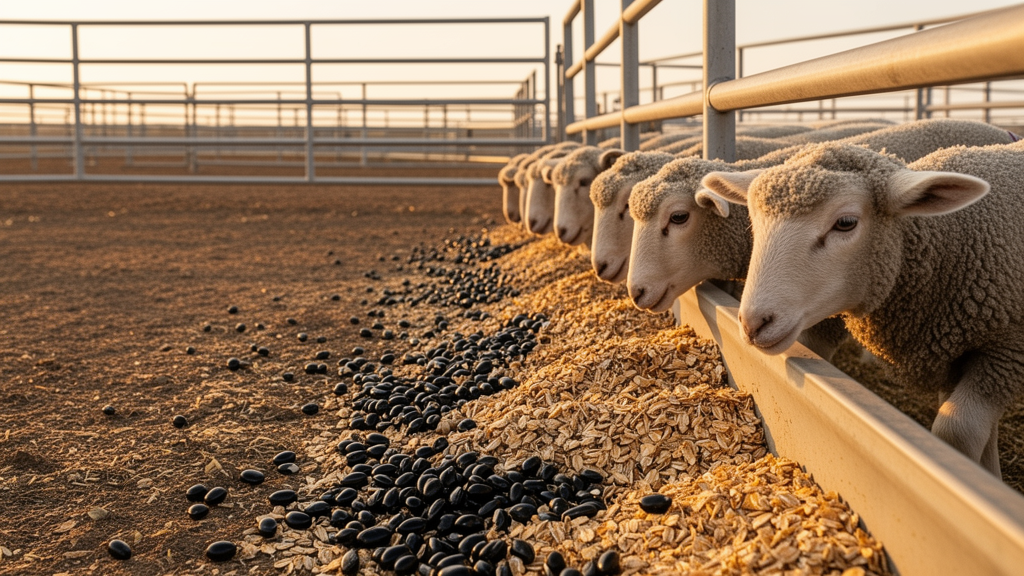
Something as simple as whether a sunflower seed passes through a hammer mill before reaching a feed bunk can reshape the entire digestive economy of a growing lamb. In a feedlot experiment conducted at the Universidade Estadual de Santa Cruz in Ilhéus, Bahia, Brazil, researchers found that ewe lambs fed intact, whole sunflower seeds gained substantially more weight, digested more of their diet, and supported a larger ruminal microbial population than lambs given the same seeds ground into smaller particles. The finding, published in Frontiers in Animal Science, challenges the long-standing assumption in animal nutrition that mechanical processing of oilseeds is inherently beneficial, and it suggests that the physical architecture of a seed can act as a form of ruminal protection that no additive can replicate.
The study was designed around a deceptively straightforward question: does the physical form of an oilseed alter how its lipids interact with the ruminal microbial ecosystem, and does that interaction change the response to a fermentation-modulating additive? Thirty-two growing ewe lambs, averaging just over 15 kilograms in body weight and roughly 75 days old, were randomly assigned to one of four dietary treatments in a completely randomized 2 × 2 factorial arrangement. The two factors were sunflower seed processing, either whole or ground, and chitosan supplementation at either 0 or 4 grams per kilogram of dry matter. All diets contained 25 percent sorghum silage and 75 percent concentrate, formulated to be isonitrogenous and to meet the nutritional requirements of growing ewe lambs targeting an average daily gain of 300 grams per day. The trial ran for 59 days, comprising 17 days of dietary adaptation followed by 42 days of data collection, with each animal housed in an individual suspended pen equipped with slatted floors, individual feeders, and automatic drinkers to allow precise measurement of feed and water intake.
The biological rationale for the experiment rests on a fundamental tension in high-concentrate feeding. Dietary lipids are an efficient way to raise the energy density of ruminant diets, but unsaturated fatty acids, particularly oleic and linoleic acids, are directly toxic to cellulolytic bacteria in the rumen. Landmark work by Maia and colleagues demonstrated that polyunsaturated fatty acids inhibit the very microorganisms responsible for fiber digestion. In oilseeds, however, lipids are not free-floating; they are stored within intracellular compartments and associated with structural components of the plant cell. Preserving seed integrity delays the immediate exposure of these lipids to ruminal microbes, effectively modulating the kinetics of lipid availability during fermentation. Grinding, by contrast, disrupts cellular structures and increases the accessibility of intracellular contents, potentially intensifying lipid–microbe interactions precisely when the ruminal ecosystem is already under stress from rapid carbohydrate fermentation, reduced pH, and a microbial community dominated by acid-tolerant amylolytic populations.
Chitosan entered the picture as a potential counterweight. This cationic biopolymer, derived from chitin, exerts antimicrobial activity through electrostatic interactions between its positively charged amino groups and the negatively charged surfaces of microbial cells, altering membrane permeability and metabolism. Previous studies in lambs and buffaloes had reported improvements in nitrogen utilization, estimated microbial protein supply, and ruminal fermentation at doses comparable to the 4 grams per kilogram of dry matter used here, which corresponded to an estimated intake of approximately 155 to 160 milligrams per kilogram of body weight per day. The researchers hypothesized that the response to chitosan would depend on how the sunflower seeds were processed, since both unsaturated fatty acids and chitosan exert overlapping antimicrobial effects on ruminal microorganisms, and the prevailing lipid environment might determine whether additional modulation by the additive produces any marginal benefit.
The results on nutrient utilization were unambiguous. Sunflower seed processing did not affect nutrient intake, and no interactions were detected for intake or digestibility variables. Yet lambs fed whole seeds showed greater apparent digestibility of dry matter, organic matter, non-fiber carbohydrates, and total digestible nutrients than those fed ground seeds, with statistical significance at P ≤ 0.007. The digestibility of non-fiber carbohydrates, the primary fermentable substrate in these high-concentrate diets, reached 830.4 grams per kilogram in whole-seed diets versus 780.4 grams per kilogram in ground-seed diets, a difference of roughly 6.4 percent. Ether extract digestibility did not differ significantly between the two processing methods, indicating that total-tract lipid disappearance was not the driver of the performance differences. Instead, the pattern points toward altered interactions between intracellular seed components and digestive processes, with the intact seed matrix moderating lipid exposure and preserving the fermentable carbohydrate supply for microbial degradation.
The nitrogen metabolism data reinforced this interpretation with striking magnitude. Whole sunflower seeds increased nitrogen absorption by 8 percent, nitrogen retention by 15 percent, estimated microbial nitrogen production by 41 percent, and estimated microbial efficiency by 31 percent, all at P < 0.05, despite similar nitrogen intake across treatments. Estimated microbial nitrogen production rose from 2.01 to 2.84 grams per day, and microbial efficiency climbed from 23.22 to 30.35 grams of microbial crude protein per kilogram of total digestible nutrients. Plasma urea nitrogen concentrations were also higher in lambs fed whole seeds, reflecting a greater flux of nitrogen through the urea pool. Because microbial protein synthesis typically accounts for 50 to 80 percent of the total amino acids absorbed in ruminants, these estimates suggest that the intact seed created conditions more favorable for the growth of the ruminal microbial biomass, possibly by reducing the antimicrobial pressure of accessible unsaturated fatty acids on the microbial community.
The behavioral observations added a layer of physiological texture to the story. Without chitosan, lambs fed whole seeds spent 24 percent less time ruminating, 339 versus 421 minutes per day, and showed greater rumination efficiency for both dry matter and neutral detergent fiber. When chitosan was supplemented, these differences between whole and ground seeds were eliminated, an interaction pattern that suggests the additive may have exerted secondary effects on chewing dynamics, particularly with ground seeds, though these did not translate into measurable improvements in nutrient utilization or performance. Water intake also differed: lambs fed ground seeds drank more water per unit of dry matter intake, 2.87 versus 2.50 liters per kilogram, and required more water per unit of body weight gain, 10.0 versus 8.2 liters per kilogram. Chewing activity, bolus characteristics, and idle time were otherwise unaffected by either factor.
Growth performance followed directly from the nutrient utilization pattern. Lambs fed whole sunflower seeds reached a final body weight of 25.8 kilograms versus 24.2 kilograms for those fed ground seeds, with average daily gain of 254.1 versus 215.2 grams per day and feed efficiency of 313.2 versus 290.1 grams of gain per kilogram of dry matter intake, all significant at P ≤ 0.028. Critically, dry matter intake was similar across treatments, meaning the performance advantage came from greater nutrient utilization rather than greater consumption. Chitosan supplementation produced no measurable effect on any performance variable, and the bioeconomic assessment confirmed the practical consequence: under the price assumptions used, whole sunflower seeds without chitosan yielded the highest descriptive net margin at US$ 7.87 per animal, while ground seeds with chitosan yielded the lowest at US$ 4.57 per animal. The cost-to-revenue ratio ranged from 48.43 percent for the best treatment to 64.91 percent for the worst.
The authors are careful to frame their mechanistic explanation as biologically supported inference rather than direct proof. Ruminal pH, volatile fatty acid profiles, ammonia concentrations, fatty acid flow, and microbial community composition were not measured, and the particle-size distribution of the sunflower seed fraction itself, as opposed to the complete diets, was not directly quantified. Alternative contributions from digesta passage rate, site of digestion, energy–nitrogen synchronization, and post-ruminal nitrogen utilization cannot be excluded. Chitosan was evaluated at a single inclusion level with one product of specific physicochemical characteristics, so a dose-dependent response cannot be ruled out. The economic indicators were deterministic, scenario-specific estimates based on fixed ingredient and live-animal prices, and the ranking could shift under different market conditions.
What emerges from this work is a principle with implications well beyond a single feedstuff. The physical presentation of lipids within the feed matrix is a first-order determinant of ruminal function in high-concentrate systems, and structural integrity of oilseeds can serve as a practical, low-cost form of ruminal protection. Future studies using ruminal fermentation measurements and microbial community profiling through 16S rRNA sequencing would help confirm whether seed processing alters lipid–microbe interactions directly, and whether the physical form of oilseeds affects methane emissions, hydrogen partitioning, and the response to rumen-modulating additives. For now, the message to feedlot producers is clear: before reaching for an additive, consider whether the simplest intervention, leaving the seed whole, might do the work better.
Subject of Research: Sunflower seed processing affects nutrient utilization and performance in feedlot ewe lambs fed high-concentrate diets with or without chitosan
Article Title: Sunflower seed processing affects nutrient utilization and performance in feedlot ewe lambs fed high-concentrate diets with or without chitosan
Article References: Nunes, F. D. S., Dias, B. B. P. D. A., Júnior, J. E. D. F., Rodrigues, H. P., Ferreira, J. M. D. S., da Silva, A. V., Santana, J. P. S., Souza, L. L., Santos, S. A., de Carvalho, G. G. P., & Azevêdo, J. A. G. (2026). Sunflower seed processing affects nutrient utilization and performance in feedlot ewe lambs fed high-concentrate diets with or without chitosan. Frontiers in Animal Science, 7, Article 1903800. https://doi.org/10.3389/fanim.2026.1903800
Image Credits: AI Generated
DOI: 10.3389/fanim.2026.1903800
Keywords: Sunflower, seed, processing, affects, nutrient, utilization, performance, feedlot, lambs, high-concentrate, diets, without
Cite Scienmag News
Drew Townsend. (October 17, 2026). Whole Sunflower Seeds Outperform Ground Seeds in Feedlot Ewe Lambs. Scienmag. https://scienmag.com/whole-sunflower-seeds-outperform-ground-seeds-in-feedlot-ewe-lambs/
Drew Townsend. "Whole Sunflower Seeds Outperform Ground Seeds in Feedlot Ewe Lambs." Scienmag, 17 October 2026, https://scienmag.com/whole-sunflower-seeds-outperform-ground-seeds-in-feedlot-ewe-lambs/. Accessed 17 October 2026.
Drew Townsend. "Whole Sunflower Seeds Outperform Ground Seeds in Feedlot Ewe Lambs." Scienmag. October 17, 2026. https://scienmag.com/whole-sunflower-seeds-outperform-ground-seeds-in-feedlot-ewe-lambs/


