


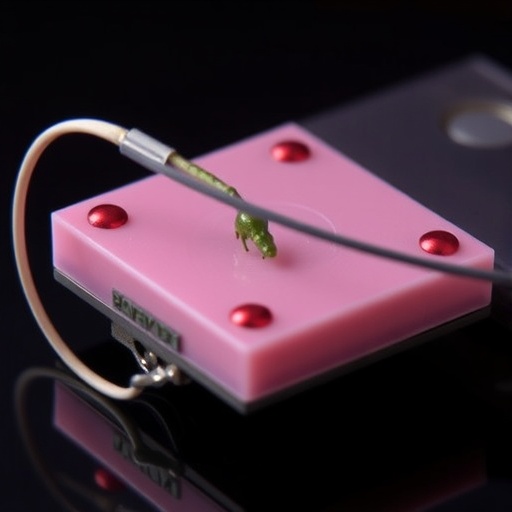
Under the lens of a microscope, a collection of diminutive lollipop-shaped structures, each smaller than a grain of sand, delicately undulates in a fluid-filled Petri dish. With the mere wave of a small external magnet, these lifeless passive formations instantly snap together, mimicking the rapid closing mechanism of a Venus flytrap’s jaws. This transformation from static assemblies to an active robotic gripper exemplifies a groundbreaking innovation in the field of microscopic soft robotics. The team behind this discovery, composed of engineers from the Massachusetts Institute of Technology (MIT), the École Polytechnique Fédérale de Lausanne (EPFL), and the University of Cincinnati, has developed a novel magnetically responsive soft hydrogel. This material offers an unprecedented method for fabricating complex, magnetically activated three-dimensional microstructures, heralding a new era in micro-robotics and programmable materials technology.
The research, published in the journal Matter, describes a sophisticated fabrication approach that blends advanced 3D microprinting with a chemical doping process. Employing two-photon lithography—a cutting-edge technique that uses a tightly focused laser beam to polymerize resin with micron precision—the scientists first print intricate polymer gel architectures devoid of magnetic particles. Subsequently, these microstructures undergo a ‘double-dip’ chemical treatment, whereby immersion in an iron ion solution allows the gel to absorb these ions, followed by exposure to a hydroxide ion solution, triggering the in situ formation of iron-oxide nanoparticles. These nanoparticles endow the once inert microstructures with magnetic properties, while preserving the integrity and fine detail of the original prints.
This innovative double-dip methodology circumvents a long-standing challenge in the field of magnetically actuated microfabrication: the adverse effects of magnetic nanoparticle integration on the photopolymerization process. Typically, embedding magnetic particles directly into photopolymer resins results in light scattering and sedimentation, undermining the resolution and mechanical strength of the printed objects. By contrast, this post-printing incorporation of magnetism enables the precise spatial control of magnetic properties on a micron scale without compromising structural fidelity. Altering the laser exposure power during printing modulates the cross-link density of the polymer network, which in turn governs nanoparticle formation density during doping, allowing tunable magnetic responses within different regions of a single microstructure.
The potential applications of such tunable magnetic microarchitectures are vast and multifaceted. The lollipop-like grippers demonstrated in the study serve as proof-of-concept soft robots capable of remotely controlled motion and manipulation within microscopic environments. Under the influence of an external magnetic field, individual components respond with varying magnetic intensities, allowing coordinated actuation that resembles miniature, magnetically operated fingers. This precision manipulation holds tantalizing promise for biomedical interventions, such as navigating confined bodily passages or executing minimally invasive tasks like targeted drug delivery or biopsy extraction, all governed by non-contact magnetic steering.
Beyond grippers, the team showcased a bistable magnetic switch, engineered by anchoring tiny, oar-shaped magnetic elements to a flexible polymer rectangle. Measuring mere microns in thickness—comparable to the size of a red blood cell—these paddles flip orientation in synchrony with an external magnet’s position, snapping the rectangle into one of two stable states. Such mechanisms could revolutionize microfluidic devices by acting as remotely actuated valves, modulating fluid pathways without the need for embedded electronic controls or external physical connections, significantly simplifying device complexity and enhancing reliability.
The underlying material, a programmable magneto-responsive hydrogel, represents a leap forward in the design and manufacture of metamaterials—engineered composites whose exotic mechanical and electromagnetic behaviors arise from their precisely architected microstructures rather than their chemical composition alone. Unlike previous efforts that emphasized static properties, this dynamic system leverages the immediate responsiveness of magnetism to achieve real-time actuation, thus encoding mechanical intelligence into its architecture. This capability could pave the way for future smart materials that adapt actively to their environments, enabling innovations ranging from self-healing surfaces to reconfigurable optical devices.
One of the most profound aspects of this study is the fusion of multiple disciplines—materials science, mechanical engineering, polymer chemistry, and applied physics—opening new frontiers in soft robotics and nanorobotics. The combination of two-photon lithography’s precision with postsynthetic magnetic doping imparts a versatility previously unattainable in microfabrication. This synthesis not only enables the realization of microscale devices with complex, multifunctional behavior but also introduces the ability to spatially program these behaviors within a single construct, a feat unattainable with conventional approaches.
Moreover, the use of external magnetic fields as stimuli offers significant advantages over other forms of actuation such as chemical, thermal, or electrical triggers. Magnetic fields can penetrate biological tissues and enclosed environments without degradation or attenuation and do so instantly and noninvasively. This rapid and remote-control capability unlocks the potential for therapies and diagnostics that operate deep within the human body or in otherwise inaccessible microenvironments, controlled wirelessly by clinicians or autonomous systems.
This paradigm-shifting technology is poised to influence the future of additive manufacturing at the microscale. The ability to selectively tune magnetic nanoparticle loading post-printing offers designers unprecedented freedom to create soft multifunctional components with hierarchical control over shape and function. Given the rich landscape of emerging applications for microscale soft robotics—from precision medicine to environmental sensing—the impact of this work is bound to ripple across multiple sectors, fueling innovations that demand adaptable, remotely operated microdevices.
The implications also extend into the realm of fundamental science, where elucidating the physics of soft magnetic systems at the micron scale can inform the design of new metamaterials and soft actuation strategies. Understanding how heterogeneous magnetic domains interact within deformable matrices deepens insight into responsive matter, potentially guiding the development of artificial muscles, self-assembling devices, and intelligent materials capable of complex, multi-modal responses to their surroundings.
Supported by grants from the U.S. National Science Foundation and the MathWorks seed grant program, this research exemplifies the synergy between academic institutions and funding agencies in driving pioneering advancements. Spearheaded by Professor Carlos Portela, whose prior work in metamaterials laid the foundation for this leap, the study draws upon an international team of collaborators spanning MIT, EPFL, and the University of Cincinnati. Together, they have not only unveiled a new class of magnetically active soft nanocomposites but also laid the groundwork for a transformative platform in micro-robotic technology.
In summation, this novel magnetically responsive soft hydrogel—fabricated through a marriage of high-resolution two-photon lithography and innovative postprinting doping—ushers in a new era of micro-scale robotics capable of sophisticated, remotely controlled deformations and mechanical operations. The ability to spatially tune magnetic nanoparticle concentration within intricate 3D geometries promises remarkable flexibility in design and application. As research progresses, these magneto-active metamaterials may become critical enablers for next-generation biomedical devices, miniature actuators, and intelligent materials that bridge the gap between artificial constructs and natural biological systems.
News Publication Date: 28-April-2026
Web References: DOI link
References: Article published in the journal Matter
Keywords
Soft robotics, two-photon lithography, magnetically responsive materials, hydrogels, nanocomposites, microfabrication, programmable metamaterials, iron-oxide nanoparticles, additive manufacturing, micro-actuation, magnetic microbots, microfluidic valves
Cite Scienmag News
Bethany Barker. (April 28, 2026). Microscopic “Magno-Bots” Execute Complex Maneuvers with a Simple Magnet Swipe. Scienmag. https://scienmag.com/microscopic-magno-bots-execute-complex-maneuvers-with-a-simple-magnet-swipe/
Bethany Barker. "Microscopic “Magno-Bots” Execute Complex Maneuvers with a Simple Magnet Swipe." Scienmag, 28 April 2026, https://scienmag.com/microscopic-magno-bots-execute-complex-maneuvers-with-a-simple-magnet-swipe/. Accessed 5 September 2026.
Bethany Barker. "Microscopic “Magno-Bots” Execute Complex Maneuvers with a Simple Magnet Swipe." Scienmag. April 28, 2026. https://scienmag.com/microscopic-magno-bots-execute-complex-maneuvers-with-a-simple-magnet-swipe/


