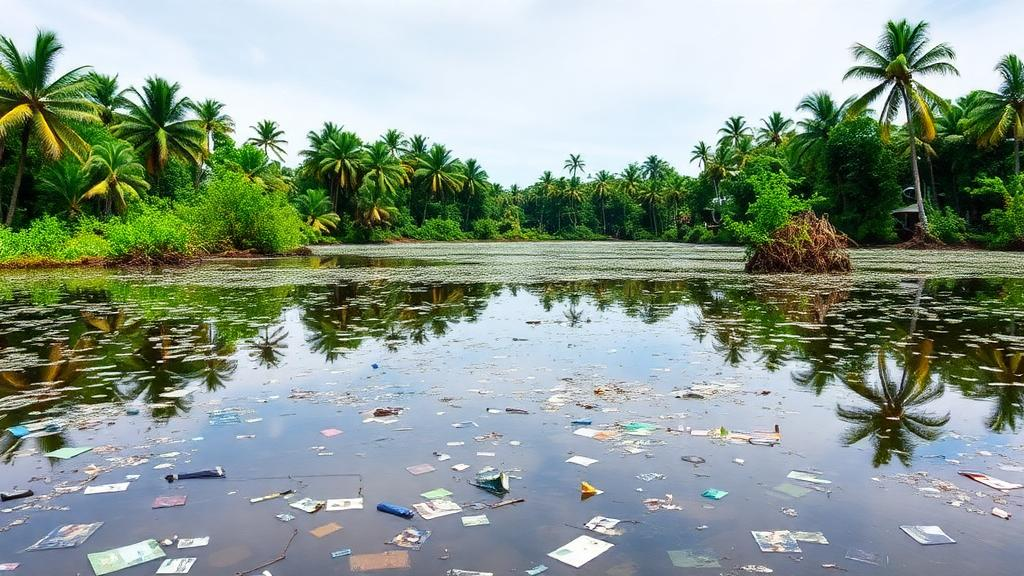
The heart of the Amazon is often imagined as pristine wilderness, but a new study has found that even a remote floodplain lake on the world’s largest river carries a visible load of plastic pollution. Researchers from the Universidade Federal do Amazonas and partner institutions surveyed Lake Canaçari, a floodplain lake on the left bank of the Amazon River near Itacoatiara, and detected microplastics in every sampled area, both in the surface water and in the lake bed sediments. The findings, published in Environmental Monitoring and Assessment, offer one of the most detailed chemical portraits yet of plastic contamination in an Amazonian floodplain system, and they suggest that these seasonal lakes may act as way stations where plastic particles are transported, redistributed, and stored.
The team collected samples in October 2022, during the Amazonian dry season, when falling water levels cut the hydrological connections between the lake, adjacent channels, and the main river. This low-water phase matters because reduced connectivity tends to trap particles within the lake rather than flushing them out. The researchers chose two contrasting areas: one dominated by artisanal fishing activity, with boats, nets, and lines in regular use, and another marked by riverside dwellings, visible solid waste, and direct domestic use of the water. At seven points in each area, spaced ten meters apart along the margins, they drew six liters of near-surface water from the top thirty centimeters and scraped 150 grams of sediment from the upper five centimeters of the lake bed.
The laboratory work followed rigorous contamination-control protocols. Water samples were vacuum-filtered through paper filters with a five-micrometer pore size, while sediments were dried, subjected to density separation in saturated salt solution to float plastic particles away from mineral grains, and then treated with hydrogen peroxide to digest organic matter. The researchers wore only cotton clothing in the field, rinsed glass containers with filtered water, and ran sixteen blank controls, fourteen in the field and two in the laboratory. Just three particles appeared in those blanks, roughly 1.5 percent of the count in the environmental samples, indicating that background contamination was minimal and that the particles they counted were genuinely present in the lake.
The numbers were striking. Surface water concentrations ranged from zero, in a single sample where no particles were found, to 1,000 microplastics per cubic meter, with a mean of 405 plus or minus 298. Sediments held between 7 and 307 particles per kilogram of dry sediment, averaging 77 plus or minus 104. Perhaps the most telling result was what the researchers did not find: no statistically significant difference in concentrations between the fishing area and the settlement area. Both human activities, it seems, are feeding plastic into the lake at comparable rates, whether through worn fishing gear and boat materials on one side or inadequate waste disposal and untreated effluents on the other.
The physical character of the particles told its own story. In surface water, the particles were overwhelmingly fibers, predominantly blue and red, with sizes spanning 115 to 3,615 micrometers. In sediments, the picture split by land use: fragments dominated near the human settlements, consistent with the breakdown of domestic plastic waste, while fibers were more abundant in the fishing zone, where synthetic nets, lines, and ropes shed filaments as they wear. Sediment particle sizes also differed significantly between the two areas, with smaller to intermediate particles concentrated near the settlements and larger ones near the fishing grounds. The authors caution that because source-specific morphology was not statistically tested, these attributions remain plausible interpretations rather than proven links.
To identify what the particles were actually made of, the team turned to Fourier-transform infrared and Raman spectroscopy, analyzing roughly eight percent of the visually identified particles. Polyethylene emerged as the most frequently identified polymer, a finding that points to everyday sources such as packaging, bags, and household items. The spectra also revealed something less expected: copper phthalocyanine pigments, specifically Pigment Blue 15 and Pigment Green 7, the same organic colorants used in paints, coatings, and dyed plastics. One Raman spectrum showed the characteristic polyethylene bands, including carbon-carbon stretching signals near 1063 and 1130 inverse centimeters, alongside the fingerprint of Pigment Blue 15. The researchers note that such pigments can accelerate photodegradation under ultraviolet light, potentially speeding the fragmentation of plastic debris and the release of degradation products.
The ecological implications are significant. Blue fibers are a known hazard in aquatic food webs because fish and invertebrates can mistake them for prey, and previous work by some of the same team has already documented microplastics in catfish species sold in local markets near Lake Canaçari. Smaller particles, with their high surface-to-volume ratios, tend to stay suspended longer and interact readily with clays and organic matter, forming aggregates that settle into the sediment. In a low-energy floodplain lake during the dry season, when water exchange with the river is minimal, these particles may accumulate where fish feed and where riverside communities harvest their food. The Amazon’s limited sanitation infrastructure, particularly the absence of wastewater treatment and organized solid waste collection, ensures a continuous supply of new material.
The study also carries a broader geographic message. Model-based estimates suggest the Amazon River discharges somewhere between 38,000 and 182,000 tons of plastic to the ocean each year, though the wide range reflects sparse data. Floodplain lakes like Canaçari sit squarely within this conveyor belt. The authors propose that the lake functions simultaneously as a transport pathway, a redistribution zone, and a retention compartment for microplastics, storing particles during low water and potentially releasing them when the flood pulse reconnects the system. If that hypothesis holds, floodplain lakes could modulate the timing and magnitude of plastic delivery from the Andes to the Atlantic, a dynamic that global plastic transport models have largely ignored.
The researchers are careful about the limits of their work. Sampling covered a single dry-season campaign with modest spatial coverage, land-use categories were defined from qualitative field observations, and the salt-based density separation used for sediments may have under-recovered denser polymers such as PVC or PET. Only a subset of particles received spectroscopic confirmation, and degraded, pigment-coated particles sometimes resisted identification. They call for future studies spanning multiple hydrological seasons, deeper sediment cores, quantitative measures of human pressure, and denser separation solutions to capture the full polymer spectrum. Even so, the baseline is now established: an Amazonian floodplain lake, far from any city, carries microplastics in its water and its bed, and the particles bear the chemical signatures of both fishing livelihoods and everyday domestic life. Managing the Amazon’s plastic problem, the study suggests, will require monitoring strategies that follow the region’s dramatic seasonal pulse of water rather than treating the river system as a static environment.
Subject of Research: Microplastic contamination in the surface water and sediments of an Amazonian floodplain lake
Article Title: Microplastic contamination in surface water and sediments of Lake Canaçari, Central Amazon, during the dry season
Article References: Guimarães, G. D. A., da Fonseca, R. V., de Moraes, B. R., Ando, R. A., de Azevedo Rodrigues, I. J., Perotti, G. F., Sant’Anna, B. S., & Hattori, G. Y. (2026). Microplastic contamination in surface water and sediments of Lake Canaçari, Central Amazon, during the dry season. Environmental Monitoring and Assessment, 198(11), Article 1221. https://doi.org/10.1007/s10661-026-16079-2
Image Credits: AI Generated
DOI: 10.1007/s10661-026-16079-2
Keywords: microplastics, Amazon, Lake Canaçari, floodplain lake, polyethylene, Raman spectroscopy, FTIR, sediments, fishing activity, water pollution, Pigment Blue 15, dry season
Cite Scienmag News
Violet Maxwell. (October 19, 2026). Microplastics Found Throughout an Amazon Floodplain Lake, Even Far From Villages. Scienmag. https://scienmag.com/microplastics-found-throughout-an-amazon-floodplain-lake-even-far-from-villages/
Violet Maxwell. "Microplastics Found Throughout an Amazon Floodplain Lake, Even Far From Villages." Scienmag, 19 October 2026, https://scienmag.com/microplastics-found-throughout-an-amazon-floodplain-lake-even-far-from-villages/. Accessed 19 October 2026.
Violet Maxwell. "Microplastics Found Throughout an Amazon Floodplain Lake, Even Far From Villages." Scienmag. October 19, 2026. https://scienmag.com/microplastics-found-throughout-an-amazon-floodplain-lake-even-far-from-villages/