


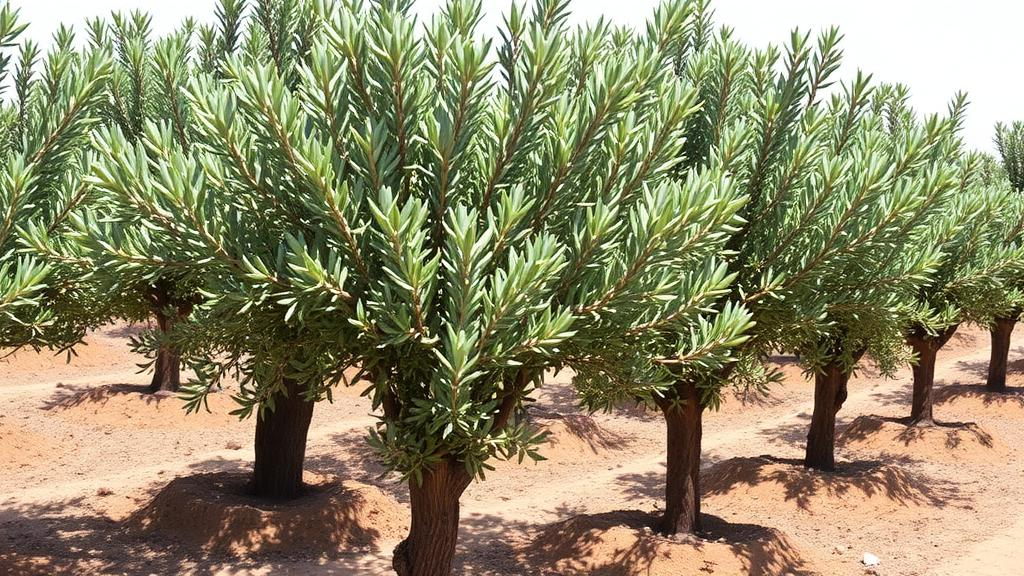
Soil salinization has quietly become one of the most damaging forces in modern agriculture, and a new study suggests that the fertilizer a farmer chooses may determine whether an olive orchard survives it. Researchers in Tunisia, working with colleagues at the African Plant Nutrition Institute, tested how young Arbequina olive trees responded to salt stress when fed with different nitrogen fertilizers and an amino-acid-based biostimulant. Their findings, published in BMC Plant Biology, point to a surprisingly practical conclusion: the chemistry of the nitrogen source matters as much as the amount applied.
The experiment focused on one-year-old olive trees of the Arbequina variety, a cultivar prized for high oil content and widely planted across the Mediterranean basin and beyond. The trees were grown in 20-liter pots and subjected to a salt stress regime of 100 millimolar sodium chloride, delivered through irrigation with half-strength Hoagland’s nutrient solution. This concentration is high enough to impose genuine physiological stress while still allowing researchers to observe graded differences between treatments over time.
The team compared four mineral fertilizer formulations: ammonium nitrate, urea, calcium nitrate, and potassium nitrate, alongside a foliar-applied amino-acid biostimulant. Each nitrogen treatment was standardized at 30 grams of nitrogen per plant, applied in 28 to 32 separate doses throughout the experiment. This careful dosing strategy ensured that any differences observed between treatments could be attributed to the chemical form of the nitrogen and its associated ions, rather than to unequal nutrient supply.
The baseline effect of salinity was stark. Salt stress significantly reduced vegetative growth across the board and depleted potassium content in the leaves, a critical loss because potassium plays a central role in stomatal regulation, enzyme activation, and osmotic adjustment. At the same time, the stressed trees accumulated sodium in their foliage and suffered increased electrolyte leakage, a classic marker of membrane damage. When cell membranes are compromised by excess sodium, electrolytes escape from cells, and the plant’s internal chemistry begins to unravel.
Against this backdrop, the differences between fertilizer treatments became striking. Ammonium nitrate and potassium nitrate actually made things worse: trees receiving these formulations produced less dry vegetative biomass than salt-stressed trees that received no additional fertilizer at all. In other words, two of the most common nitrogen fertilizers in global agriculture compounded the damage that salt was already inflicting on the young trees. This finding challenges the assumption that simply feeding stressed crops more nitrogen will help them recover.
Urea occupied an intermediate position. Trees treated with urea showed lower sodium accumulation in their leaves and reduced electrolyte leakage compared with some other treatments, suggesting a partial protective effect at the cellular level. However, this biochemical relief did not translate into improved growth, as urea-treated plants failed to produce more biomass than their unfertilized, salt-stressed counterparts. The disconnect between membrane protection and biomass production illustrates how complex plant stress responses can be: a treatment can alleviate one symptom without solving the underlying growth penalty.
The real winners were calcium nitrate and the foliar amino-acid treatment. Both were associated with improved vegetative growth, higher biomass production, reduced sodium accumulation in aerial tissues, and lower leaf-to-root sodium concentration ratios. That last metric is particularly important. A low leaf-to-root sodium ratio indicates that the plant is successfully retaining sodium in its roots and limiting its transport to the shoots, where it would otherwise interfere with photosynthesis and potassium-dependent processes. In effect, these treatments helped the trees keep the salt where it does the least harm.
The mechanism behind calcium nitrate’s benefit is biologically plausible. Calcium is well known for its role in stabilizing cell membranes and maintaining cell wall structure, and adequate calcium supply can help plants maintain selective ion uptake even under saline conditions. By supplying calcium alongside nitrogen, calcium nitrate may simultaneously nourish the tree and reinforce its physical defenses against sodium invasion. The amino-acid biostimulant, applied directly to the foliage, likely works through different pathways, potentially including osmoprotection and chelation, though the study’s reported outcomes focus on the growth and ion-distribution benefits rather than a single molecular explanation.
The implications extend well beyond potted saplings. Olive cultivation is a cornerstone of Mediterranean agriculture, and rising temperatures, shifting rainfall patterns, and intensive irrigation are steadily pushing salts into soils across the region. Because fertilization is one of the few inputs farmers adjust every season, identifying which formulations aggravate salt stress and which mitigate it offers an immediately actionable lever. The study, part of a project on optimizing olive fertilization in Tunisia funded by the African Plant Nutrition Institute, suggests that switching from ammonium nitrate or potassium nitrate toward calcium nitrate, or supplementing with foliar amino acids, could meaningfully protect young trees in salt-affected orchards.
There are, of course, caveats. The trees were one-year-old saplings in containers, and field-grown mature olives interact with a far larger and more heterogeneous soil volume. The 100 millimolar NaCl regime, while realistic for severely affected soils, represents a specific stress intensity, and results may differ under milder or fluctuating salinity. Nonetheless, the study provides a clear, quantified comparison of five common nutritional interventions under controlled conditions, and its central message is hard to ignore: when salt is in the soil, the form of nitrogen a grower applies is not a neutral choice. Choosing calcium nitrate or amino-acid biostimulants may help olive trees not just survive salinity, but keep growing through it.
Subject of Research: Effects of fertilizer formulations on salt stress tolerance in young olive trees
Article Title: Optimizing fertilizer applications to mitigate salt stress in olive trees (Olea europaea L. var. Arbequina)
Article References: Zaier, H., Boulal, H., & Larbi, A. (2026). Optimizing fertilizer applications to mitigate salt stress in olive trees (Olea europaea L. var. Arbequina). BMC Plant Biology. https://doi.org/10.1186/s12870-026-10213-5
Image Credits: AI Generated
DOI: 10.1186/s12870-026-10213-5
Keywords: olive trees, salt stress, soil salinization, calcium nitrate, amino-acid biostimulants, sodium accumulation, electrolyte leakage, nitrogen fertilizers, Arbequina, plant physiology, BMC Plant Biology, Tunisia
Cite Scienmag News
Alan Morgan. (October 19, 2026). Calcium Nitrate and Amino Acids Help Olive Trees Cope with Salty Soils. Scienmag. https://scienmag.com/calcium-nitrate-and-amino-acids-help-olive-trees-cope-with-salty-soils/
Alan Morgan. "Calcium Nitrate and Amino Acids Help Olive Trees Cope with Salty Soils." Scienmag, 19 October 2026, https://scienmag.com/calcium-nitrate-and-amino-acids-help-olive-trees-cope-with-salty-soils/. Accessed 19 October 2026.
Alan Morgan. "Calcium Nitrate and Amino Acids Help Olive Trees Cope with Salty Soils." Scienmag. October 19, 2026. https://scienmag.com/calcium-nitrate-and-amino-acids-help-olive-trees-cope-with-salty-soils/


