


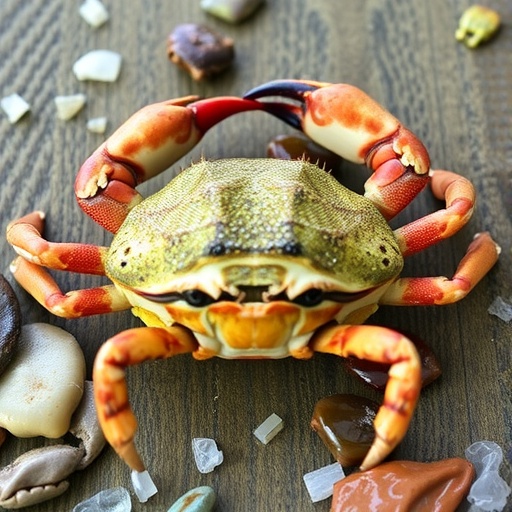
A new scientific review is drawing attention to an overlooked consequence of the plastic age: the growing exposure of horseshoe crabs to microscopic plastic particles that can enter their bodies through sediment, seawater and food. Published in npj Emerging Contaminants, the study examines how microplastics accumulate in these ancient marine animals and explains the biological mechanisms through which the particles may damage their tissues, disrupt immunity and intensify the effects of other pollutants. The findings arrive at a moment when horseshoe crabs are already under pressure from coastal development, overharvesting, climate change and declining water quality.
Microplastics are generally defined as plastic fragments, fibers or beads smaller than five millimeters, although many environmental particles are far smaller and can approach the micrometer scale. They are produced when larger objects such as fishing gear, packaging and synthetic textiles fragment, but they can also be manufactured directly for industrial or consumer applications. Because plastic does not readily biodegrade, particles can persist in estuaries and tidal flats, where they are transported by currents and repeatedly buried and resuspended in the sediment. These environments are especially important for horseshoe crabs, which spend much of their lives on the seafloor and forage by disturbing sediment with their legs.
That feeding behavior creates a direct route of exposure. Horseshoe crabs consume worms, mollusks and other small invertebrates living in or on the sediment, and microplastics can be swallowed alongside those prey items. Particles may also adhere to food, become suspended in the water during tidal movement or enter the animal through contact with contaminated surfaces. Fibers from clothing and fishing materials are particularly mobile, while irregular fragments can become trapped in sediment and remain available to bottom-feeding species for long periods. Once inside the digestive tract, particles may pass through the animal, remain temporarily in the gut or interact with tissues and digestive fluids.
The review emphasizes that accumulation is not determined only by the amount of plastic in the surrounding water. Particle size, shape, density, chemical composition and surface properties all influence whether microplastics are ingested, retained or expelled. Smaller particles are more likely to move through biological barriers than larger fragments, while long fibers may become physically entangled in digestive structures. Jagged particles can irritate tissues, and dense materials may settle in the gut or sediment more readily. Weathering also changes plastic surfaces, creating cracks and chemically active sites that can bind metals, petroleum compounds and persistent organic pollutants from the surrounding environment.
This ability to transport other contaminants is one of the most concerning features of microplastic pollution. Plastic particles can act as mobile surfaces for chemicals that are already present in coastal ecosystems, including hydrocarbons, pesticides and industrial compounds. Additives used to make plastic flexible, durable or resistant to heat may also leach from the material after ingestion. In the digestive tract, changes in acidity, enzymes and physical abrasion can increase the release of these substances. A horseshoe crab therefore may not be exposed only to an inert particle; it may encounter a mixture of plastic, absorbed pollutants and chemical additives whose combined effects are difficult to predict.
At the cellular level, the principal concern is oxidative stress. When microplastics or the chemicals associated with them disturb normal cell function, they can increase the production of reactive oxygen species—highly reactive molecules that damage proteins, membranes and genetic material when antioxidant defenses are overwhelmed. Such stress may trigger inflammation and alter the activity of enzymes involved in energy production and detoxification. In fish and invertebrates, similar processes have been linked to tissue injury, reduced growth and impaired physiological performance. For horseshoe crabs, the consequences could include damage to digestive tissues, altered metabolism and a reduced ability to cope with additional environmental stressors.
The immune system may be another important target. Horseshoe crabs possess a distinctive circulating blood system in which immune cells respond rapidly to microbial threats and foreign materials. Their hemolymph contains amebocytes that participate in clotting and defense, a biological system widely used in the limulus amebocyte lysate test for detecting bacterial endotoxins in medicines and medical devices. Microplastic exposure could stimulate these cells, exhaust defensive resources or interfere with normal clotting and inflammatory responses. The review presents this as a mechanistic concern rather than a single isolated effect: persistent particle exposure may produce chronic immune activation, leaving animals less capable of responding to pathogens or injury.
The ecological consequences may extend beyond individual crabs. Horseshoe crabs are important components of coastal food webs, and their eggs support migratory shorebirds during seasonal journeys. Juveniles and adults also contribute to the movement of sediment and serve as prey for other marine animals. If microplastics reduce feeding efficiency, growth, reproduction or survival, the effects could spread through estuarine ecosystems. Even subtle physiological changes may matter when populations are already exposed to habitat loss and extreme temperatures. A crab that must spend additional energy processing particles or repairing cellular damage may have less energy available for molting, reproduction and recovery from physical disturbance.
The review also highlights major scientific challenges. Detecting microplastics in marine animals is technically difficult because contamination can occur during sampling, laboratory handling and chemical digestion of tissues. Researchers must distinguish plastic particles from natural materials and identify their polymer composition using techniques such as Fourier-transform infrared spectroscopy or Raman spectroscopy. Measuring biological effects is equally complex because exposure varies with particle size, concentration, shape, weathering and the presence of co-contaminants. Laboratory experiments may use uniform plastic spheres at concentrations that do not fully represent natural conditions, while field studies capture realistic mixtures but make it harder to establish cause and effect.
For that reason, the authors call for research that connects environmental measurements with biological outcomes in wild horseshoe crab populations. Future studies will need to examine how particles move through different life stages, whether they cross from the digestive system into other tissues and how long they remain in the body. Investigations should also consider seasonal changes, sediment chemistry, temperature and the combined effects of microplastics with pathogens, metals and organic pollutants. Standardized sampling protocols would allow results from different coastlines to be compared. Reducing plastic leakage at its source, improving wastewater and stormwater filtration and limiting the loss of fishing gear could provide immediate benefits while scientists continue to determine the full scale of the threat.
The significance of the study lies in its focus on a species that is both ecologically valuable and biologically unusual. Horseshoe crabs have survived for hundreds of millions of years, but their evolutionary resilience does not make them immune to a modern pollutant that is persistent, mobile and chemically complex. Microplastics may not produce a dramatic, easily visible die-off; their danger could instead emerge through cumulative effects on digestion, immunity, metabolism and reproduction. By bringing these mechanisms together, the review turns attention toward a hidden form of stress in coastal ecosystems—and reinforces the message that protecting horseshoe crabs requires controlling pollution at the microscopic scale as well as the visible one.
Cite Scienmag News
Violet Maxwell. (August 13, 2026). Microplastics Accumulate in Horseshoe Crabs, Revealing New Toxicity Threats. Scienmag. https://scienmag.com/microplastics-accumulate-in-horseshoe-crabs-revealing-new-toxicity-threats/
Violet Maxwell. "Microplastics Accumulate in Horseshoe Crabs, Revealing New Toxicity Threats." Scienmag, 13 August 2026, https://scienmag.com/microplastics-accumulate-in-horseshoe-crabs-revealing-new-toxicity-threats/. Accessed 4 September 2026.
Violet Maxwell. "Microplastics Accumulate in Horseshoe Crabs, Revealing New Toxicity Threats." Scienmag. August 13, 2026. https://scienmag.com/microplastics-accumulate-in-horseshoe-crabs-revealing-new-toxicity-threats/


