


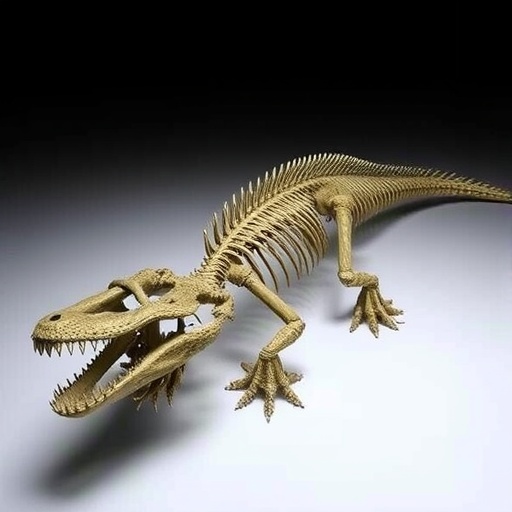
In the world of paleontology, the preservation of ancient bones often tells a tale buried within millions of years of geological history. Recently, a groundbreaking study published in Communications Earth & Environment has unveiled an extraordinary insight into the preservation of ichthyosaur bones—a discovery that not only challenges traditional notions but highlights the intricate interplay between microbial activity and mineral cementation. The research shows how microbial oxidation processes, combined with carbonate cementation, have led to an unparalleled three-dimensional preservation of ichthyosaur fossils, providing a new perspective on fossilization mechanisms.
Ichthyosaurs, marine reptiles that thrived during the Mesozoic era, have long fascinated scientists for their remarkable adaptation to aquatic life and their diverse forms. However, preserving the delicate structures of their bones over tens of millions of years remains a significant challenge. This recent study uncovers a novel preservation pathway involving microbial oxidation that initiates a cascade of chemical reactions ultimately resulting in the solidification of bone through carbonate cementation. This mechanism prevents the typical collapse or deformation of bone material that often accompanies fossilization.
By conducting an interdisciplinary investigation involving detailed geochemical analyses and scanning electron microscopy, the researchers revealed microscopic evidence of microbial oxidation within the ichthyosaur bones. These microbes engaged in the oxidation of organic compounds, producing localized chemical environments conducive to carbonate mineral precipitation. This mineralization then cemented the bone structure in three dimensions, creating an exceptional fossil preservation scenario where even microscopic features remain undistorted.
The concept of microbial mediation in fossil preservation is not new, but what sets this study apart is the direct evidence linking microbial oxidation processes to the mineralogical changes responsible for three-dimensional cementation. The study’s findings are supported by an array of sophisticated techniques including X-ray diffraction, stable isotope analysis, and detailed petrographic studies. These methods collectively affirmed the presence of microbial activity as a primary driver in the fossilization process, a mechanism that ensures both preservation of bone microstructure and resistance to diagenetic alteration.
The implications of this research are profound, extending beyond ichthyosaurs to broader aspects of fossil preservation across various marine vertebrates. By understanding microbial oxidation as a fundamental step in the fossilization sequence, paleontologists can refine their models of how ancient organisms are preserved within their sedimentary environments. This insight aids in reconstructing past ecological conditions and improves the accuracy of interpreting fossil records critical for evolutionary studies.
More fascinating is how this microbial-driven oxidation alters the geochemical milieu surrounding the bones. The oxidation promotes the release of ions such as calcium and carbonate from the surrounding sediments or bone matrix. These ions subsequently precipitate as carbonate minerals, primarily calcite or aragonite, which act as a natural cementing agent. This mineral cementation effectively encapsulates the bone particles, preserving their spatial relationships and preventing compaction or distortion during burial and lithification.
Furthermore, the study elucidates the temporal dimension of this preservation process. It demonstrates that microbial oxidation and carbonate cementation occurred rapidly after the bones were deposited, a factor crucial to maintaining three-dimensionality. Rapid cementation acts as a protective shield, limiting exposure to mechanical pressures and chemical dissolution that often degrade fossil quality. This insight underscores the delicate timing and environmental conditions necessary for exceptional fossil preservation.
From a broader perspective, these findings highlight the complex feedback loops between biological and geological systems. Microbial communities not only play a role in mediating decomposition but can also contribute to the construction of mineral frameworks that preserve biological materials. This dual functionality reveals a nuanced relationship where life and mineral processes interlock to secure ancient biological heritage for millions of years.
In addition to its paleontological significance, this research also offers analogies that may benefit fields such as biomineralization and geobiology. Understanding microbial mediation in mineral precipitation can inform biomimetic approaches in materials science, where the controlled formation of mineral phases is desirable. Moreover, it opens avenues for exploring ancient microbial ecosystems and their metabolic pathways preserved within fossilized remains.
One striking feature of the study is its interdisciplinary approach, combining expertise in microbiology, geochemistry, and sedimentology. This synergy allowed for the comprehensive characterization of both the biological agents and mineralogical outcomes involved in preservation. It demonstrates the increasing importance of cross-disciplinary methods in unraveling complex Earth system processes that shape fossil records.
Additionally, the researchers found that the carbonate cementation associated with microbial oxidation creates microenvironments of enhanced chemical stability. These microenvironments impede the infiltration of external fluids that often carry altering agents, effectively isolating the fossil within a protective mineral shell. This protective effect supports the long-term durability of the fossil and explains how delicate bone structures remain intact despite harsh post-depositional conditions.
Importantly, the fossils analyzed in the study were recovered from marine sedimentary strata known for their dynamic depositional environments. This context suggests that microbial oxidation-driven mineral preservation can operate effectively even in settings characterized by fluctuating redox conditions and sedimentation rates. Such adaptability broadens the relevance of this preservation pathway to a variety of paleoenvironments.
The discovery underscores the critical role of microbial communities in shaping not only modern ecosystems but also the fossil archives that inform our understanding of Earth’s biological past. By mediating key geochemical processes, these microorganisms facilitate fossilization in ways that blur the line between biological decay and mineral preservation. This revelation introduces a paradigm shift in how scientists view microbial contributions to the fossil record.
Looking ahead, the study invites further exploration of microbial mineralization across different fossil types and depositional settings. Future research may focus on identifying specific microbial taxa involved in oxidation and cementation or elucidating the precise biochemical pathways enabling mineral precipitation. Such endeavors promise to refine our grasp of fossil preservation and enhance the fidelity of paleobiological reconstructions.
In conclusion, this innovative research profoundly advances our understanding of fossilization, particularly the three-dimensional preservation of ichthyosaur bones. By illuminating the critical role of microbial oxidation coupled with carbonate cementation, it not only redefines the preservation narrative but also enriches the scientific discourse on the intricate interactions between life, minerals, and Earth’s geological processes. This breakthrough paves the way for new discoveries and applications rooted in the ancient dance of microbes and minerals that immortalize the past.
Cite Scienmag News
Morgan Morrow. (March 25, 2026). Microbial Oxidation Preserves Ichthyosaur Bones in 3D. Scienmag. https://scienmag.com/microbial-oxidation-preserves-ichthyosaur-bones-in-3d/
Morgan Morrow. "Microbial Oxidation Preserves Ichthyosaur Bones in 3D." Scienmag, 25 March 2026, https://scienmag.com/microbial-oxidation-preserves-ichthyosaur-bones-in-3d/. Accessed 7 September 2026.
Morgan Morrow. "Microbial Oxidation Preserves Ichthyosaur Bones in 3D." Scienmag. March 25, 2026. https://scienmag.com/microbial-oxidation-preserves-ichthyosaur-bones-in-3d/


