


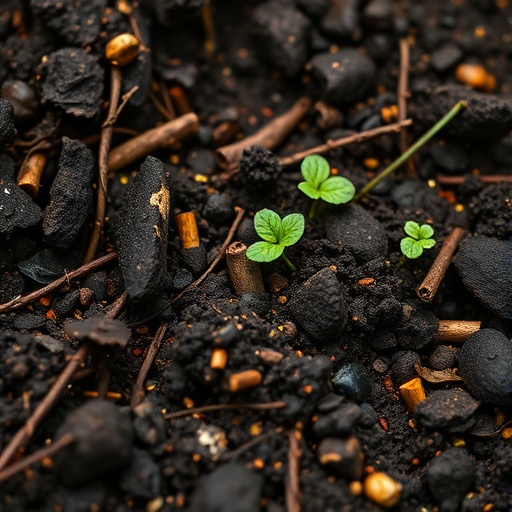
A groundbreaking global synthesis study has unveiled the pivotal role of soil microbial communities in mediating the effectiveness of biochar application for soil organic carbon (SOC) sequestration. Revealing the complex biological mechanisms at play, this research adds a crucial piece to the puzzle of how biochar can be leveraged as a reliable climate mitigation tool. With climate change threats escalating worldwide, these insights offer a fresh roadmap for enhancing the carbon storage potential of soils on a global scale.
Biochar, a highly porous, carbon-rich material derived from pyrolyzed biomass, has emerged as a promising negative emission technology due to its ability to augment SOC levels and curb greenhouse gas emissions. However, despite significant interest and investment, the response of soils to biochar amendments has been notably inconsistent across studies and environments, complicating efforts to standardize its use. Until now, the underlying biological mechanisms that influence this variability remained insufficiently understood.
The new study, authored by Gehao Zhang and colleagues and published in the journal Biochar, addresses this critical knowledge gap through an extensive meta-analysis encompassing 76 peer-reviewed studies and over 220 experimental comparisons from across the planet. This expansive dataset allowed the researchers to quantify the average impact of biochar on SOC and, importantly, to dissect how the composition of microbial communities governs the magnitude and persistence of carbon gains in amended soils.
Their analysis unequivocally confirmed that biochar application elevates soil organic carbon by an average of 52.4%, underscoring its substantial sequestration potential. Yet, this enhancement is far from uniform. The researchers demonstrated that microbial community structure is a decisive factor driving these differential outcomes. Certain bacterial taxa, particularly those classified as broad-niche generalists like Proteobacteria and Actinobacteria, were found to be strongly correlated with pronounced carbon increases. These microbes possess the metabolic versatility to rapidly metabolize soil nutrients and biochemically stabilize organic carbon within soil matrices.
Conversely, microbial communities dominated by oligotrophic bacteria such as Acidobacteria and Chloroflexi exhibited restrained carbon gains or even accelerated SOC loss. These taxa are adapted to low-nutrient environments and tend to utilize carbon less efficiently, potentially destabilizing sequestered carbon pools. The study highlights that microbial community composition not only reflects prevailing soil conditions but also fundamentally influences biochar’s efficacy as a carbon sink.
Beyond microbiology, environmental parameters modulated the observed effects as well. The analysis revealed that biochar’s carbon-sequestering benefits were most pronounced under arid to semi-arid climates characterized by low precipitation. In these dry conditions, oxygen availability in the soil is higher, favoring microbial populations adept at carbon stabilization. Additionally, higher soil pH levels synergistically enhanced biochar’s performance, likely by promoting favorable microbial activity and chemical interactions that protect SOC from decomposition.
In contrast, in wetter climates, the increased soil moisture reduced oxygen diffusion, selectively shifting microbial ecology toward communities less capable of efficient carbon use. Moreover, excess water facilitated carbon leaching and other losses, undermining biochar’s intended benefits. These findings provide crucial context for tailoring biochar implementation strategies according to regional climatic and edaphic characteristics, potentially improving the predictability and reliability of its carbon sequestration outcomes.
Temporal dynamics were also a key focus of the investigation. The researchers observed that biochar’s benefits on SOC stocks were most robust shortly following application but tended to diminish over time. This temporal decline underscores the importance of long-term management approaches and repeated applications to sustain carbon storage and maximize climate mitigation returns. The study suggests that biochar’s integration into integrated soil management could be optimized by concurrent monitoring of microbial indicators and environmental factors.
These revelations reposition soil microbiome analysis at the frontline of biochar research, encouraging a shift from solely physicochemical evaluations of soil amendments to a more holistic, biology-centered paradigm. By leveraging microbial community data, agricultural scientists and land managers can better predict where biochar additions will yield meaningful carbon sequestration and avoid ineffective deployments that squander resources.
The authors emphasize that biochar is no universal panacea. Instead, its success hinges upon complex interactions between biochar properties, soil chemistry, microbial consortia, and climatic variables. Hence, adopting site-specific strategies that integrate detailed microbial and environmental profiling will be essential to harnessing biochar’s true potential as a scalable climate solution.
This study fundamentally advances our understanding of soil carbon dynamics and provides actionable insights to improve biochar’s role in global carbon management. As the urgency to mitigate greenhouse gas emissions intensifies, such interdisciplinary approaches that unite soil science, microbiology, and climate strategy offer a promising path toward achieving agriculture-based carbon sequestration goals.
Looking ahead, research efforts aimed at manipulating microbial communities alongside biochar amendments could generate even greater SOC stabilization effects. Biotechnological innovations, such as targeted microbial inoculants or engineered biochars optimized for microbial interactions, may unlock new horizons for carbon-negative agriculture. Such strategies will support the growing imperative to find durable and economically viable solutions in the fight against climate change.
In summary, the study by Zhang et al. uncovers the invisible but decisive role of soil microbes in determining biochar’s capacity to lock carbon into the terrestrial biosphere. By recognizing that beneath every gram of sequestered carbon lies a bustling microbial ecosystem, this research injects fresh optimism and analytical rigor into the ongoing quest to transform soil management into a cornerstone of global climate mitigation.
News Publication Date: 17-Feb-2026
References: Zhang, G., Deng, L., Liao, Y. et al. Microbial regulation mechanisms of soil organic carbon sequestration by biochar application. Biochar 8, 57 (2026). DOI: 10.1007/s42773-026-00575-2
Cite Scienmag News
Morgan Morrow. (March 27, 2026). Microbes Unlock Biochar’s Potential for Carbon Storage in Soils. Scienmag. https://scienmag.com/microbes-unlock-biochars-potential-for-carbon-storage-in-soils/
Morgan Morrow. "Microbes Unlock Biochar’s Potential for Carbon Storage in Soils." Scienmag, 27 March 2026, https://scienmag.com/microbes-unlock-biochars-potential-for-carbon-storage-in-soils/. Accessed 3 September 2026.
Morgan Morrow. "Microbes Unlock Biochar’s Potential for Carbon Storage in Soils." Scienmag. March 27, 2026. https://scienmag.com/microbes-unlock-biochars-potential-for-carbon-storage-in-soils/


