

Tuesday, October 20, 2026
Science
No Result
View All Result
  • Login
  • HOME
  • SCIENCE NEWS
  • CONTACT US
  • HOME
  • SCIENCE NEWS
  • CONTACT US
No Result
View All Result
Scienmag
No Result
View All Result
Home Science News Biology

MICA variants may tune microRNA control of immune surveillance

October 20, 2026
in Biology
Juliet Wilcox
By Juliet Wilcox Scienmag Editorial Profile - Human Genetics
Reading Time: 3 mins read
0
MICA variants may tune microRNA control of immune surveillance

MICA variants may tune microRNA control of immune surveillance

65
SHARES
587
VIEWS
Share on FacebookShare on Twitter
ADVERTISEMENT

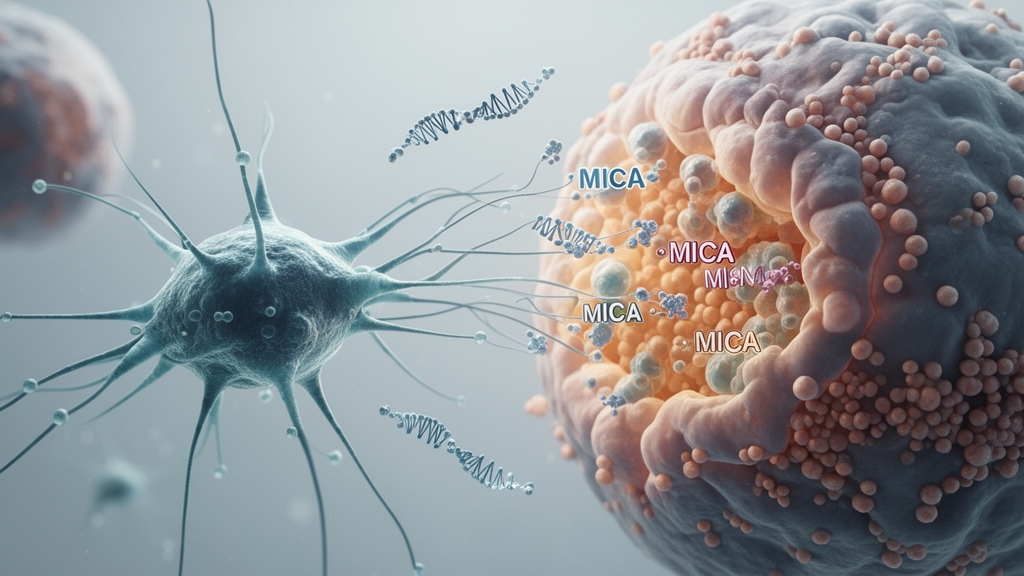
A mini review concludes that microRNAs can regulate MICA, a protein involved in immune surveillance, while naturally occurring variation in the gene’s 3′ untranslated region may alter that regulation. The review separates experimentally established control of MICA from computational predictions about how particular MICA alleles might interact with microRNAs. It also identifies a central gap: no direct evidence yet links a naturally occurring 3′ untranslated region variant to altered microRNA binding, allele-specific MICA expression, and a measurable change in immune function.

MICA, or major histocompatibility complex class I chain-related chain A, acts as a ligand for the activating receptor NKG2D, which is expressed by natural killer cells and cytotoxic T lymphocytes. Its expression is therefore positioned to influence immune recognition. The review describes microRNAs as small non-coding RNAs that regulate messenger RNAs after transcription, principally through sequences in the 3′ untranslated regions of target transcripts. By affecting messenger-RNA stability and translation, these molecules can fine-tune processes including immune activation, inflammatory signaling, and responses to cellular stress.

Experimental studies summarized in the review have shown that several microRNAs directly regulate MICA through its 3′ untranslated region. Manipulating microRNA-responsive sequences in this regulatory region can change the degree of repression, with consequences for MICA expression and natural killer-cell responses. This provides a mechanism by which post-transcriptional control could modify the availability of a ligand important to NKG2D-mediated immune surveillance. The reported findings concern regulatory mechanisms and experimental assays; they do not establish that microRNA targeting of MICA prevents or cures a human disease.

Genetic studies have also established that the MICA 3′ untranslated region contains naturally occurring polymorphisms and haplotypes, meaning that the sequence targeted by microRNAs varies among individuals. MICA itself is highly polymorphic, and its allelic variants can differ in sequence composition, structural organization, and expression patterns. Computational analyses suggest that some 3′ untranslated region variants could create, disrupt, or modify microRNA target sites, alter predicted interaction energies, or change which microRNAs might target particular alleles. Such results offer a plausible explanation for differences in regulation, but they remain predictions rather than demonstrations of natural functional effects.

The review emphasizes an important distinction between editing a target site experimentally and testing a naturally occurring variant in its biological context. A naturally occurring polymorphism may not completely prevent a microRNA from recognizing MICA. It could instead modify binding affinity, target-site accessibility, or the relative contribution of individual microRNAs to regulation. Closing this gap would require integrated experiments using natural MICA sequences or haplotypes, targeted microRNA perturbation, direct measurement of microRNA–MICA interactions, analysis of messenger RNA and protein expression, and functional testing of NKG2D-mediated immune responses. The evidence currently supports a model in which genetic variation, microRNA regulation, and MICA-dependent immune surveillance are connected, but the causal chain from a natural MICA variant to a change in human immune function has not been established.

Subject of Research: MicroRNA-mediated regulation of MICA and the effects of MICA 3′ untranslated-region polymorphisms

Article Title: MicroRNAs and polymorphisms influencing MICA immune modulation

Article References: Nicoletti, M. B., Ferraz, I. M., Moço, A. C., da Cruz Castelli, E., & Castro, C. F. B. (2026). MicroRNAs and polymorphisms influencing MICA immune modulation. Molecular Biology Reports, 53(1), Article 1760. https://doi.org/10.1007/s11033-026-12959-5

Image Credits: AI Generated

DOI: 10.1007/s11033-026-12959-5

Keywords: MICA, microRNAs, NKG2D, natural killer cells, cytotoxic T lymphocytes, gene regulation, 3′ untranslated region, single-nucleotide polymorphisms, immune surveillance, post-transcriptional regulation, polymorphisms, influencing

Cite Scienmag News

Juliet Wilcox. (October 20, 2026). MICA variants may tune microRNA control of immune surveillance. Scienmag. https://scienmag.com/mica-variants-may-tune-microrna-control-of-immune-surveillance/

Juliet Wilcox. "MICA variants may tune microRNA control of immune surveillance." Scienmag, 20 October 2026, https://scienmag.com/mica-variants-may-tune-microrna-control-of-immune-surveillance/. Accessed 20 October 2026.

Juliet Wilcox. "MICA variants may tune microRNA control of immune surveillance." Scienmag. October 20, 2026. https://scienmag.com/mica-variants-may-tune-microrna-control-of-immune-surveillance/


Tags: 3′ untranslated regionallele-specific MICA expressioncomputational predictioncytotoxic T lymphocytesexperimental evidence of microRNA-MICA regulationGene regulationgenetic variation in immune gene expressionimmune surveillanceimpact of 3′ UTR polymorphisms on immune functioninfluencingMiCAMICA gene variants and immune responsemicroRNA binding to 3' untranslated regionsmicroRNA regulation of immune surveillancemicroRNA-mediated control of immune ligandsmicroRNAsnatural killer cell activation and MICAnatural killer cellsNKG2DNKG2D receptor and MICA interactionpolymorphismspost-transcriptional regulationrole of microRNAs in inflammation and cellular stresssingle-nucleotide polymorphisms
Share26Tweet16
Previous Post

Verified Paeony Bulleye Record Extends Distribution to Malaysia

Next Post

Stable U.S. vote shares conceal the independents deciding Congress

Related Posts

Laboratory study finds electron beams inactivate three human viruses with preserved antigens
Biology

Laboratory study finds electron beams inactivate three human viruses with preserved antigens

October 20, 2026
Morphology and DNA identify tiny highland dragon in western Thailand
Biology

Morphology and DNA identify tiny highland dragon in western Thailand

October 20, 2026
Camera-trap study documents white-tailed deer chewing sea turtle bones in Costa Rica
Biology

Camera-trap study documents white-tailed deer chewing sea turtle bones in Costa Rica

October 20, 2026
Research report: From epidemiology to molecular pathology: current research status and future prospects on the role of toxic metal exposure in the development and progression of bladder cancer
Biology

Research report: From epidemiology to molecular pathology: current research status and future prospects on the role of toxic metal exposure in the development and progression of bladder cancer

October 20, 2026
Lysosomal pH emerges as a context-dependent amplifier in septic lung injury
Biology

Lysosomal pH emerges as a context-dependent amplifier in septic lung injury

October 20, 2026
ClinGen framework reveals recurrent CNV burden in diagnostic microarray series
Biology

ClinGen framework reveals recurrent CNV burden in diagnostic microarray series

October 20, 2026
Next Post
Stable U.S. vote shares conceal the independents deciding Congress

Stable U.S. vote shares conceal the independents deciding Congress

  • Mothers who receive childcare support from maternal grandparents show more optimized

    Mothers who receive childcare support from maternal grandparents show more parental warmth, finds NTU Singapore study

    27656 shares
    Share 11059 Tweet 6912
  • University of Seville Breaks 120-Year-Old Mystery, Revises a Key Einstein Concept

    1061 shares
    Share 424 Tweet 265
  • Bee body mass, pathogens and local climate influence heat tolerance

    682 shares
    Share 273 Tweet 171
  • Researchers record first-ever images and data of a shark experiencing a boat strike

    546 shares
    Share 218 Tweet 137
  • Groundbreaking Clinical Trial Reveals Lubiprostone Enhances Kidney Function

    531 shares
    Share 212 Tweet 133
Science

Embark on a thrilling journey of discovery with Scienmag.com—your ultimate source for cutting-edge breakthroughs. Immerse yourself in a world where curiosity knows no limits and tomorrow’s possibilities become today’s reality!

RECENT NEWS

  • Observational study links Chinese police tactics to shorter weaponless encounters
  • Laboratory study finds electron beams inactivate three human viruses with preserved antigens
  • Cross-sectional study sets South Punjab plank endurance benchmarks for adolescents
  • Stable U.S. vote shares conceal the independents deciding Congress

Categories

  • Agriculture
  • Anthropology
  • Archaeology
  • Athmospheric
  • Biology
  • Biotechnology
  • Blog
  • Bussines
  • Cancer
  • Chemistry
  • Climate
  • Earth Science
  • Editorial Policy
  • Marine
  • Mathematics
  • Medicine
  • Pediatry
  • Policy
  • Psychology & Psychiatry
  • Science Education
  • Science News
  • Social Science
  • Space
  • Technology and Engineering

Subscribe to Blog via Email

Enter your email address to subscribe to this blog and receive notifications of new posts by email.

Join 5,150 other subscribers

© 2025 Scienmag - Science Magazine

Welcome Back!

Login to your account below

Forgotten Password?

Retrieve your password

Please enter your username or email address to reset your password.

Log In
No Result
View All Result
  • HOME
  • SCIENCE NEWS
  • CONTACT US

© 2025 Scienmag - Science Magazine

Discover more from Science

Subscribe now to keep reading and get access to the full archive.

Continue reading