


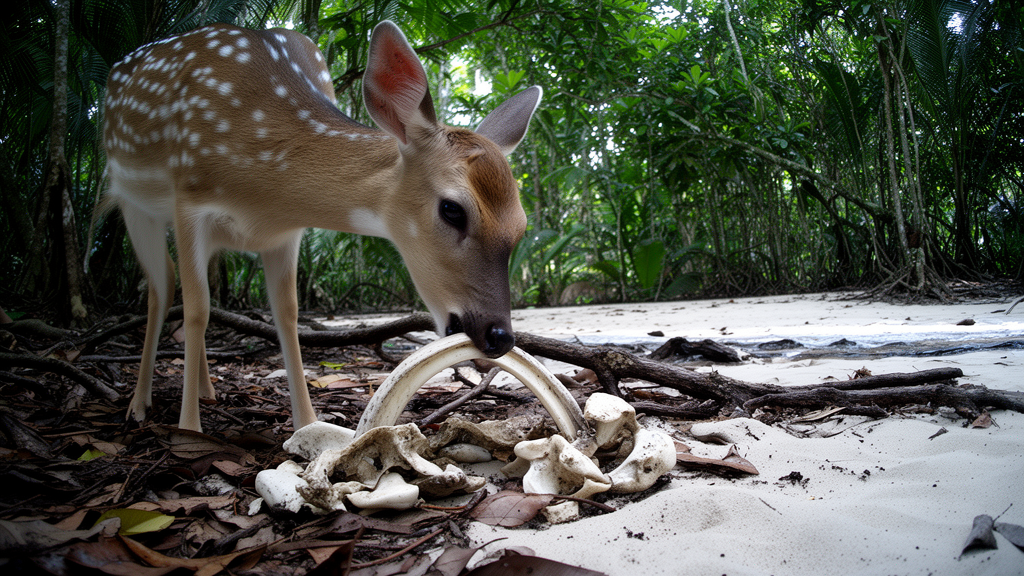
Camera-trap observations showed that white-tailed deer repeatedly chewed bones from olive ridley and green sea turtles killed by jaguars at a nesting beach in northwestern Costa Rica. During 237 trap nights, researchers recorded 183 independent events of deer chewing sea turtle bones, representing 39% of 463 independent white-tailed deer photo events. The study was conducted with one camera at Tule Beach in Santa Rosa National Park from January through September 2017, so its results describe a localized interaction rather than deer behavior across the wider region. The records nevertheless show that feeding on these carcasses was repeated rather than an isolated event at the monitored site.
The observations form part of a broader ecological setting in which jaguars prey on sea turtles near nesting beaches and leave carcasses that other animals can exploit. Santa Rosa National Park lies within the Área de Conservación Guanacaste in northwestern Costa Rica. The surrounding landscape is a recovering lowland seasonal dry forest with highly seasonal rainfall: monthly averages range from almost no rain to 1,040 millimeters, with the wet season generally extending from May through November. The dry season runs from December through April and can include temperatures above 37 degrees Celsius. White-tailed deer are common in the park, and nearby Naranjo and Nancite beaches are regularly used by jaguars to kill olive ridley and green sea turtles that nest locally on a year-round but seasonal basis.
The camera used for this analysis was positioned near a mangrove zone at Tule Beach, 1.1 kilometers northwest of Nancite Beach, in an area known for concentrations of sea turtle carcasses that were the remains of jaguar kills. It was one of an array of cameras designed to maximize photo captures of jaguars and their prey across an area of approximately 100 square kilometers. To quantify osteophagia, the researchers defined separate photo events as those recorded at least 30 minutes apart. This procedure yielded 463 independent records involving white-tailed deer, of which 183 showed the animals chewing sea turtle bones. The total comprised 81 records of females, 77 of males and 25 of fawns.
The researchers used visible physical characteristics and comparisons of body size to divide the deer into sex and age categories. A full-sized animal was classified as an adult male when genitalia or antlers were visible. Male antlers were divided into three stages: nubs with visible pedicels, velvet antlers that were growing and had rounded tine ends, and hard antlers that were fully formed. Adults without observable antlers or genitalia were classified as females and separated into those recorded alone and those accompanied by fawns. Fawns were distinguished by body size and grouped as spotted or non-spotted. These classifications allowed the analysis to compare monthly frequencies among animals at different reproductive and developmental stages.
Monthly variation was assessed with a chi-square test. The frequency of bone-chewing records did not differ significantly by month for adult males with antler nubs, for which the reported p value was 0.53, or for spotted fawns, for which it was 0.64. Adult females showed clearer peaks. Solitary females had their highest monthly frequency in July, with a p value of 0.02, while females accompanied by fawns also reached their maximum in July, when 12 independent records were recorded; the latter group had a p value below 0.01. These results describe the distribution of photographed events in the camera dataset rather than direct measures of feeding by a marked population of deer.
Stronger seasonal patterns appeared among males in stages of antler development associated with greater mineral demands. Males with hard antlers recorded six bone-chewing events in June, five in July and seven in August, with a p value below 0.01. Males with velvet antlers recorded nine events in each of June, July and August, also with a p value below 0.01. Non-spotted fawns showed a comparable concentration, with six records in July and seven in August and a p value below 0.01. By contrast, the absence of significant monthly variation among males with nubs and spotted fawns indicates that their photographed feeding did not follow the same June-to-August pattern detected in the other categories.
Osteophagia is the chewing of antlers or bones by ungulates. Previous reports have associated this behavior with mineral-deficient environments, particularly where available food supplies limited calcium or phosphorus. The study interprets the seasonal pattern among females with fawns as consistent with the nutritional demands of lactation at the beginning of the park’s wet season and as a possible means of recovering condition after gestation. The timing among non-spotted fawns may likewise be associated with their growth after weaning. For males with velvet antlers, the increase in bone chewing coincided with the growth stage before antler mineralization, when physiological requirements for calcium and phosphorus rise. These are interpretations of the observed timing; the camera records did not directly measure the diets, mineral status or physiological responses of individual deer.
The wider dry-forest environment provides a plausible seasonal context for these patterns. During long rainless periods, vegetation changes and the availability of foods varies, requiring animals to cope with shifts in resources. White-tailed deer in northwestern Costa Rica are thought to gain nutritional condition during the wet season and to produce fawns near the beginning of the dry season, when some new leaf production occurs. Fallen fruit is also available during the dry season, while evergreen vegetation remains present throughout the year. The combination of reproductive stage and the changing mineral composition of vegetation may therefore contribute to seasonal osteophagy in both sexes, although the study did not measure vegetation chemistry or directly test that relationship.
Mineral acquisition through bone consumption may matter because calcium, sodium and phosphorus are involved in bone construction, nerve impulses, the contraction and relaxation of blood vessels, and the control of enzymes associated with blood clotting. Deficiencies of minerals in ungulates can be associated with weight loss, reduced growth, malformed bones, reduced appetite and decreased plasma volume. Earlier studies have linked bone chewing in cervids with lactation, the later growth of fawns, the end of gestation, seasonal changes in plant minerals and successful antler development. The new observations do not demonstrate that the turtles’ bones improved deer health, but they provide a detailed account of when particular categories of deer fed on the carcasses and are consistent with these established nutritional and reproductive associations.
Beyond deer nutrition, the findings illustrate how a top predator can make marine biomass available to terrestrial consumers. Jaguars killed the turtles and left their remains on beaches, where white-tailed deer and other organisms could feed on them. The authors describe this pathway as a cascade effect in which jaguar predation creates a resource used by multiple terrestrial species. The evidence comes from a single camera at one beach over January through September 2017, however, and does not establish how many individual deer participated, how much bone each animal consumed, or whether comparable behavior occurs at other beaches or in other seasons. Within those limits, 183 independent records document a repeated feeding relationship between white-tailed deer and jaguar-killed sea turtles at a nesting site in Santa Rosa National Park.
Subject of Research: Camera-trap documentation of sea turtle bone consumption by white-tailed deer at a Costa Rican nesting beach
Article Title: Osteophagia of sea turtle bones by white-tailed deer ( Odocoileus virginianus ) in Santa Rosa National Park, northwestern Costa Rica
Article References: Morera, B., Montalvo, V., Sáenz-Bolaños, C., Cruz-Díaz, J. C., Fuller, T. K., & Carrillo, E. (2022). Osteophagia of sea turtle bones by white-tailed deer (Odocoileus virginianus) in Santa Rosa National Park, northwestern Costa Rica. Neotropical Biology and Conservation, 17(2), 143-149. https://doi.org/10.3897/neotropical.17.e87274
Image Credits: AI Generated
DOI: 10.3897/neotropical.17.e87274
Keywords: white-tailed deer, osteophagia, sea turtles, jaguars, camera traps, Costa Rica, Santa Rosa National Park, bone chewing, animal nutrition, turtle nesting beaches, seasonal behavior, ecological cascades
Cite Scienmag News
Margaret Porter. (October 20, 2026). Camera-trap study documents white-tailed deer chewing sea turtle bones in Costa Rica. Scienmag. https://scienmag.com/camera-trap-study-documents-white-tailed-deer-chewing-sea-turtle-bones-in-costa-rica/
Margaret Porter. "Camera-trap study documents white-tailed deer chewing sea turtle bones in Costa Rica." Scienmag, 20 October 2026, https://scienmag.com/camera-trap-study-documents-white-tailed-deer-chewing-sea-turtle-bones-in-costa-rica/. Accessed 20 October 2026.
Margaret Porter. "Camera-trap study documents white-tailed deer chewing sea turtle bones in Costa Rica." Scienmag. October 20, 2026. https://scienmag.com/camera-trap-study-documents-white-tailed-deer-chewing-sea-turtle-bones-in-costa-rica/


