


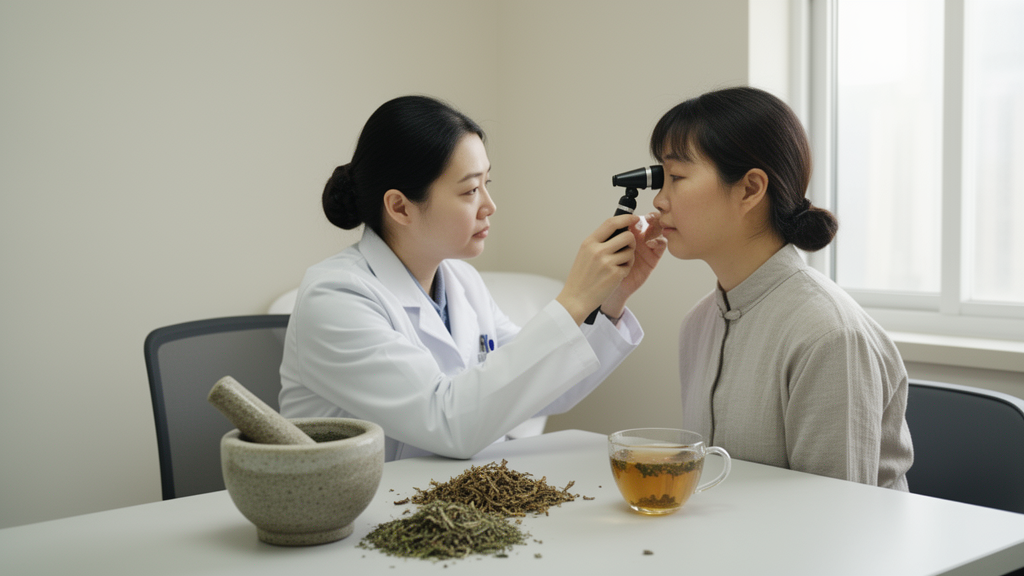
A 2026 review concludes that acupuncture and selected herbal formulations may help manage Ménière’s disease, a disabling inner-ear disorder marked by recurrent vertigo, fluctuating sensorineural hearing loss, tinnitus and aural fullness. Acupuncture has a relatively extensive clinical literature, with pooled results suggesting improvements in dizziness, tinnitus, ear fullness and some hearing measures, while most findings for herbal medicines come from laboratory and animal studies. The authors emphasize that the evidence remains insufficient to position traditional Chinese medicine, or TCM, as a primary treatment. They describe it instead as an investigational adjunct that may help selected patients and needs testing in larger, controlled trials with objective outcomes and longer follow-up.
Ménière’s disease has no single established cause. Genetic susceptibility, viral infections, autoimmune activity and autonomic dysregulation may converge on several interconnected processes, including abnormal accumulation of endolymph in the membranous labyrinth, inflammation, impaired inner-ear circulation, oxidative stress and injury to auditory and vestibular neurons. This biological complexity helps explain why interventions aimed at a single pathway can produce inconsistent results in a condition whose severity and course vary considerably among patients. Current management is correspondingly staged, beginning with lifestyle modification, dietary sodium restriction, diuretics and betahistine, followed by intratympanic corticosteroids or gentamicin and, in severe cases, surgery. The review notes that the evidence for some conservative measures remains equivocal, while intratympanic gentamicin can control vertigo while carrying a risk of permanent ototoxicity.
The pathological feature drawing the most mechanistic attention is endolymphatic hydrops, an abnormal accumulation of endolymph that is associated with Ménière’s disease but neither unique to it nor sufficient on its own for diagnosis. Endolymph is produced mainly by the cochlear stria vascularis and normally removed through the endolymphatic sac, a specialized structure involved in fluid regulation and metabolic-waste clearance. Aquaporin 2, a membrane protein that transports water, is expressed in the sac and vestibular end organs and helps regulate endolymph volume. Pathological studies have reported congenital malformation, inflammation-related fibrosis and age-related degeneration in the endolymphatic sac, all of which could impair reabsorption. In rodent models in which the endolymphatic duct was surgically obstructed, aquaporin 2 expression fell, consistent with reduced water clearance and hydrops. Whether changing this protein can prevent or reverse human disease remains unknown, but it provides a measurable target for mechanistic research.
Herbal experiments reviewed by the authors connect TCM interventions with several processes implicated in Ménière’s disease. In guinea pigs with surgically induced hydrops, the herbal formula Wendan decoction improved neurovestibular function, reduced labyrinthine swelling and preserved outer hair cells compared with untreated animals. Assays also found reduced aquaporin 2 expression in inner-ear tissue. Because the intervention lowered rather than raised a protein associated with water transport, the authors interpret the result as consistent with the formula supporting endolymph absorption and fluid balance. This provides a possible biological interpretation of the traditional category “phlegm-dampness,” but the review stresses that an animal experiment does not directly validate a classical theory or demonstrate clinical benefit in people. The study also used surgical induction of hydrops, so its findings may not reproduce the heterogeneous biological triggers of human disease.
The same preclinical work points to an anti-inflammatory pathway. Wendan decoction reduced activation of the mitogen-activated protein kinase, or MAPK, pathway and lowered the release of proinflammatory cytokines in experimental inner-ear models. Other botanical preparations, including Ginkgo biloba extract, have suppressed tumor necrosis factor alpha and interleukin-1 beta in laboratory studies. These mediators can activate NF-κB signaling, recruit immune cells and damage the blood-labyrinth barrier, which helps isolate inner-ear tissues from systemic immune activity. Persistent inflammation can also promote reactive oxygen species, mitochondrial dysfunction and programmed cell death in sensory hair cells and neurons. Experimental reports of an anti-inflammatory action by acupuncture add another possible mechanism, possibly involving vagal and cholinergic pathways, although these explanations remain hypotheses requiring direct confirmation in humans. The review also proposes a longer-term neuroprotective role for interventions that reduce oxidative stress and apoptosis, but that possibility is based principally on experimental pathways rather than demonstrated protection of human hearing or vestibular function.
Human evidence is more developed, though still methodologically uneven, for acupuncture. A 2024 meta-analysis of six randomized controlled trials reported that acupuncture alone or combined with conventional therapy performed better than conventional therapy alone for overall efficacy. Other pooled analyses found reductions in Dizziness Handicap Inventory scores, improvements in Tinnitus Handicap Inventory scores, less ear fullness on visual analogue scales and better pure-tone audiometry thresholds. These findings point to effects on both perceived disability and measured hearing, but the review does not establish a reliable treatment effect or a consistent clinical benefit across patients. Trials tend to be small, acupuncture protocols vary and sham controls are inconsistent. Ménière’s disease also has a fluctuating course, and the substantial placebo response described in the review makes it difficult to distinguish specific effects from nonspecific improvement and natural variation.
That placebo problem is unusually important for interpreting results. Reviews cited in the article report reductions in vertigo-attack frequency of roughly 50 percent or more in placebo groups of some studies. An uncontrolled observation or a trial without credible blinding can therefore appear favorable even when the intervention’s specific effect is small. Herbal trials face similar problems: small samples, subjective endpoints, short follow-up, inadequate controls and inconsistent preparation or dosing. One reported study of modified Banxia Baizhu Tianma decoction recorded a 94.74 percent overall response rate, but the review says that the numerical result cannot be separated from bias, natural symptom fluctuation and placebo or other nonspecific effects without a properly controlled comparison. The response rate therefore should not be read as proof that the formula prevents attacks, protects hearing or changes the long-term course of disease. A substantial placebo response is a property of the evidence context, not evidence that an intervention is ineffective, but it raises the threshold needed to demonstrate a specific therapeutic effect.
Several other TCM ingredients have biological effects relevant to the disorder, although most have not been tested adequately in patients with Ménière’s disease. Gastrodia elata contains gastrodin, which has shown anticonvulsant, sedative, neuroprotective and microcirculation-related effects in experimental research. Pinellia ternata supplies alkaloids with antiemetic activity, while Alisma species contain triterpenoids with diuretic effects. Ginkgo biloba extracts have been investigated for blood flow, oxidative stress and tinnitus, and preclinical work reports effects on cochlear microcirculation through platelet aggregation and endothelial nitric oxide production. These properties are compatible with the pathways proposed in the review, including improved cochleovestibular circulation and reduced oxidative injury. Compatibility is not proof that isolated effects translate into meaningful changes in vertigo frequency, hearing loss or disease progression in humans. The clinical evidence for these individual constituents remains more limited than the mechanistic literature.
The review’s proposed research program calls for multicentre, adequately powered randomized controlled trials with standardized herbal preparations or clearly specified acupuncture protocols. For herbal studies, researchers should control batch variability, report preparation methods, use appropriate placebos and assess blinding where feasible. Acupuncture trials should employ carefully designed sham procedures, measure the success of blinding and standardize acupoint selection, stimulation parameters and treatment duration. Objective measures—including delayed gadolinium-enhanced inner-ear magnetic resonance imaging for hydrops, comprehensive audiometry, the video head impulse test and vestibular evoked myogenic potentials—should be combined with symptom scales. The authors also argue that molecular, immunological and imaging data may eventually help distinguish biological subgroups, while cautioning that MRI-detected hydrops is a structural feature rather than an etiological category. Proposed inflammatory, vascular or genetic profiles remain research concepts, and the review does not establish that they can yet guide the selection of a specific TCM regimen.
Overall, the review positions acupuncture and herbal medicine as testable components of an integrative model rather than replacements for established care. Acupuncture has the larger body of clinical studies and shows preliminary associations with symptom relief and some audiometric improvement. Herbal prescriptions have more detailed laboratory and animal findings involving aquaporin expression, MAPK and NF-κB signaling, microcirculation, oxidative stress and apoptosis, but those results do not establish efficacy in people. The review’s proposed multi-tiered sequence—an immediate anti-inflammatory and fluid-regulatory effect, medium-term vestibular compensation and long-term neuroprotection—is a mechanistic framework for testing, not a demonstrated treatment trajectory. Until adequately powered, standardized and long-term trials confirm both clinical effects and relevant mechanisms, firm clinical recommendations would go beyond the available evidence.
Subject of Research: Evaluation of acupuncture and herbal medicine as adjunctive treatments for Ménière’s disease
Article Title: Bridging mechanistic evidence and clinical perspectives: traditional Chinese medicine in Menière's disease
Article References: Ye, S., & Zhu, Z. (2026). Bridging mechanistic evidence and clinical perspectives: traditional Chinese medicine in Menière's disease. Frontiers in Neurology, 17, Article 1915230. https://doi.org/10.3389/fneur.2026.1915230
Image Credits: AI Generated
DOI: 10.3389/fneur.2026.1915230
Keywords: Ménière’s disease, traditional Chinese medicine, acupuncture, herbal medicine, endolymphatic hydrops, aquaporins, vertigo, hearing loss, tinnitus, clinical evidence, Bridging, mechanistic
Cite Scienmag News
Ophelia Keating. (October 20, 2026). Traditional Chinese Medicine Shows Preliminary Promise for Ménière’s Disease. Scienmag. https://scienmag.com/traditional-chinese-medicine-shows-preliminary-promise-for-menieres-disease/
Ophelia Keating. "Traditional Chinese Medicine Shows Preliminary Promise for Ménière’s Disease." Scienmag, 20 October 2026, https://scienmag.com/traditional-chinese-medicine-shows-preliminary-promise-for-menieres-disease/. Accessed 20 October 2026.
Ophelia Keating. "Traditional Chinese Medicine Shows Preliminary Promise for Ménière’s Disease." Scienmag. October 20, 2026. https://scienmag.com/traditional-chinese-medicine-shows-preliminary-promise-for-menieres-disease/


