


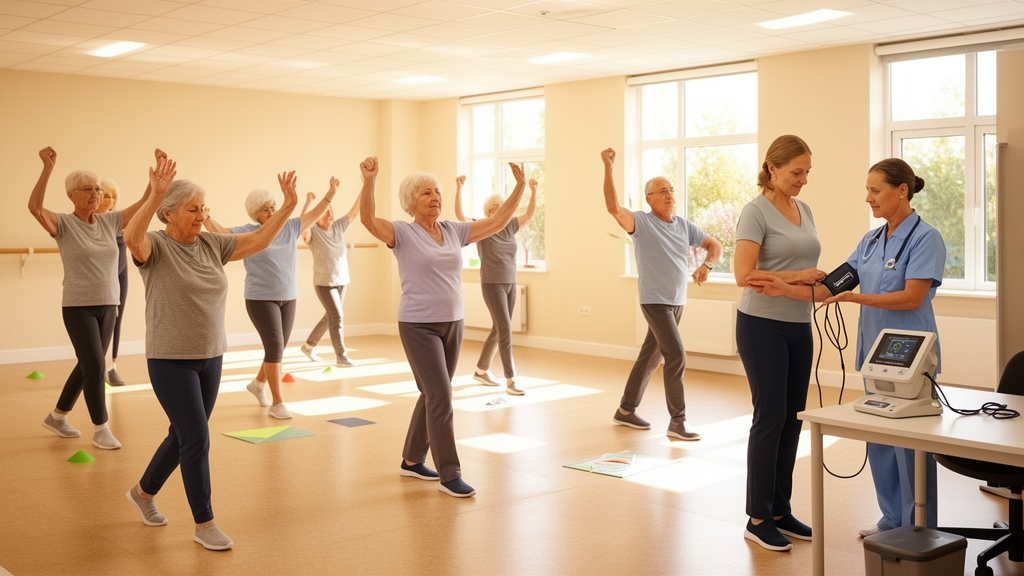
An eight-week physical literacy program was associated with lower systolic blood pressure, reduced body weight, greater physical activity and improved psychosocial measures in a small mixed-methods pilot study of young and middle-aged adults with Grade 1 hypertension. Researchers assigned 40 adults aged 18 to 59 at a community healthcare center in Hefei, China, to the program or usual care between August and October 2024. Thirty-five participants completed all three assessments—before the intervention, immediately afterward and one month later—and 10 intervention participants also took part in semi-structured interviews.
The findings provide a preliminary signal for community-based hypertension care, but non-random allocation, short follow-up, a small sample and complete-case analysis limit how broadly the results can be applied. The intervention was designed to strengthen the motivation, confidence, knowledge and physical competence needed to engage in meaningful physical activity. It combined cognitive workshops, physical training, psychological support and digital tools rather than prescribing exercise alone.
SMART goal-setting was used to help participants plan personal activity, while strength, flexibility, balance and aerobic exercises were intended to build toward 150 to 300 minutes of moderate-intensity activity per week. The program also included Tai Chi, Baduanjin and aerobic dance. Mindfulness-based stress reduction and reflective journaling were used to support self-efficacy and a sense of coherence, while WeChat-based peer support and artificial-intelligence health assistants provided monitoring and feedback.
A multidisciplinary team of nursing experts, a sports science teacher, a psychological counselor and community health workers delivered the sessions after completing a standardized two-day training workshop. An intervention manual, attendance records and weekly implementation meetings were used to support consistency and monitor adherence. Three of the 20 intervention participants withdrew: two because of work commitments and one after medical advice related to a foot injury.
Two control-group participants also withdrew, leaving 17 intervention participants and 18 control participants in the complete-case quantitative analysis. Mean participation across the eight intervention sessions was 79.4%, and no adverse events were reported. Overall study completion was 87.5%, with completion rates of 85% in the intervention group and 90% in the control group.
Among intervention participants, 88.2% expressed general satisfaction and 76.5% rated the course content clear. Satisfaction with delivery methods was lower: 52.9% were satisfied, 35.3% were neutral and 5.9% were dissatisfied. These findings indicate that the program was generally feasible in the studied setting, although the format of content delivery was not equally well received as its content.
The clearest physiological result concerned systolic blood pressure. In the intervention group, mean systolic pressure declined from 150.24 ± 5.85 mmHg at baseline to 144.00 ± 6.26 mmHg after the program and 142.88 ± 5.73 mmHg one month later. The control-group means changed little, moving from 149.78 ± 4.11 to 150.39 ± 4.63 and then 151.28 ± 3.53 mmHg.
The group-by-time interaction was significant at P less than 0.001. At follow-up, the estimated between-group difference was 8.395 mmHg, with a 95% confidence interval of 5.067 to 11.724 mmHg. Diastolic pressure showed a group-by-time interaction in the repeated-measures analysis, but pairwise post-intervention and follow-up differences between the groups were not statistically significant.
Because allocation depended on enrollment order rather than randomization, these differences are observed associations in the pilot and do not establish that the program caused the blood-pressure changes in each participant. Body weight and body mass index also differed over time. Intervention participants weighed an average of 69.76 kg at baseline, 67.01 kg after the program and 65.56 kg at follow-up, while control-group means were 72.38, 72.45 and 73.32 kg.
Their average BMI fell from 25.16 to 24.16 and then 23.63 kg/m²; the control group moved from 24.61 to 24.70 and 25.03 kg/m². Both group-by-time interactions were significant at P less than 0.001. The complete-case analysis included only participants who attended all three assessments, and the authors acknowledged the possibility that missing data from the five withdrawals were not completely at random.
Physical-literacy scores were higher in the intervention group after the program and at follow-up. The total mean score rose from 60.65 ± 5.16 at baseline to 75.00 ± 3.26 immediately after the intervention and 73.59 ± 4.39 one month later, compared with control-group means of 62.33 ± 7.90, 63.11 ± 4.85 and 62.44 ± 5.14. Significant group-by-time effects occurred for the total score and each of its four domains: cognition, emotion, physical competence and behavior.
The follow-up difference in total score was 11.144 points, with a 95% confidence interval of 7.849 to 14.438. The 18-item scale covered cognitive, affective, physical-competence and behavioral dimensions, using scores from 18 to 90, with higher values indicating greater physical literacy. Changes in psychosocial measures accompanied the physical and behavioral findings.
Mean total perceived social support in the intervention group rose from 60.88 ± 12.94 at baseline to 74.35 ± 4.46 after the program and 67.59 ± 5.62 at follow-up, while the control group moved from 60.78 ± 10.74 to 61.72 ± 9.20 and 58.72 ± 8.61. Family and “other” support showed significant between-group differences, but friend support did not. Total sense-of-coherence scores in the intervention group were a baseline median of 60.00, followed by means of 72.59 ± 5.27 after treatment and 69.82 ± 4.41 at follow-up.
The corresponding control-group values were a median of 55.00, a mean of 58.72 ± 6.49 and a mean of 57.00 ± 5.90. Comprehensibility and meaningfulness showed differential change, whereas manageability did not. General self-efficacy in the intervention group had a baseline median of 27.00, followed by means of 36.65 ± 2.69 after treatment and 35.06 ± 2.49 at follow-up.
The control-group values were a median of 28.50, a mean of 32.06 ± 5.64 and a mean of 31.78 ± 4.07, with a significant group-by-time effect for self-efficacy. Activity questionnaires likewise suggested greater activity among intervention participants. Weekly total energy expenditure in that group increased from 1,161.74 ± 280.73 minutes at baseline to 1,622.12 ± 272.13 minutes after treatment, with a follow-up median of 1,584.00 minutes.
The corresponding control-group values were a mean of 1,132.64 ± 270.48, a mean of 1,261.86 ± 208.23 and a follow-up median of 1,213.50 minutes. Moderate-intensity exercise and walking also showed significant group-by-time interactions. At follow-up, the intervention group reported a median of 125 minutes of moderate-intensity exercise per week, compared with 85 minutes in the control group, and a mean of 140.29 ± 35.33 minutes of walking, compared with 92.78 ± 29.32 minutes.
No significant interaction was found for high-intensity exercise, while the difference in sedentary time did not reach conventional statistical significance. Activity was measured with the International Physical Activity Questionnaire short form rather than an objective monitor such as a wearable device. Interviews with 10 program completers, aged 32 to 55, offered possible explanations for the quantitative results.
Participants described learning more about hypertension, reducing salt and fat, exercising more regularly, monitoring blood pressure with mobile applications and feeling better able to manage their condition. They also reported greater vitality, steadier blood pressure, improved emotional regulation and less stress, which participants associated with mindfulness exercises, reflective journaling and peer interaction. These accounts are subjective experiences and do not independently establish effectiveness.
Participants also identified practical barriers. Materials were distributed across chat groups and public accounts, activity logs required effort in several formats, reminders did not always suit individual schedules, and real-time peer interaction was limited. They suggested a centralized application, simpler progress tracking, customizable reminders and interactive features for sharing progress.
Ten interviews were purposively selected across age, sex and adherence, and the researchers reported that no new codes emerged from three consecutive interviews after the tenth interview. Overall, the pilot provides preliminary evidence that a theory-based physical literacy program may be feasible and acceptable for some young and middle-aged adults with Grade 1 hypertension, with favorable changes in systolic blood pressure, weight, activity, physical literacy, social support, sense of coherence and self-efficacy. Its mixed-methods design adds detail about what participants considered helpful and burdensome, while the absence of adverse events and the 87.5% overall completion rate support short-term feasibility in the studied setting.
The results should nevertheless be treated as preliminary. Recruitment came from one center through convenience sampling, allocation was based on enrollment order rather than randomization, five dropouts were excluded under an assumption that missing data were completely at random, and participants aged 18 to 59 were analyzed as one cohort without age-stratified comparisons. Only one month of post-program follow-up was available.
Larger randomized or otherwise robust multicenter trials with longer follow-up, objective behavioral measures and age-stratified analyses are needed to determine whether the program can produce durable clinical benefits in broader populations.
Subject of Research: Pilot evaluation of an eight-week physical literacy intervention for adults with Grade 1 hypertension
Article Title: Effectiveness of a physical literacy intervention program for young and middle-aged adults with hypertension: a mixed-methods quasi-experimental study
Article References: Ma, G. (2026). Effectiveness of a physical literacy intervention program for young and middle-aged adults with hypertension: a mixed-methods quasi-experimental study. Frontiers in Endocrinology, 17, Article 1944805. https://doi.org/10.3389/fendo.2026.1944805
Image Credits: AI Generated
DOI: 10.3389/fendo.2026.1944805
Keywords: hypertension, physical literacy, physical activity, systolic blood pressure, community health, behavior change, self-efficacy, social support, quasi-experimental study, mixed-methods research, Effectiveness, physical
Cite Scienmag News
Phoebe Ingram. (October 20, 2026). Eight-week physical literacy program linked with lower blood pressure in hypertension pilot. Scienmag. https://scienmag.com/eight-week-physical-literacy-program-linked-with-lower-blood-pressure-in-hypertension-pilot/
Phoebe Ingram. "Eight-week physical literacy program linked with lower blood pressure in hypertension pilot." Scienmag, 20 October 2026, https://scienmag.com/eight-week-physical-literacy-program-linked-with-lower-blood-pressure-in-hypertension-pilot/. Accessed 20 October 2026.
Phoebe Ingram. "Eight-week physical literacy program linked with lower blood pressure in hypertension pilot." Scienmag. October 20, 2026. https://scienmag.com/eight-week-physical-literacy-program-linked-with-lower-blood-pressure-in-hypertension-pilot/


