


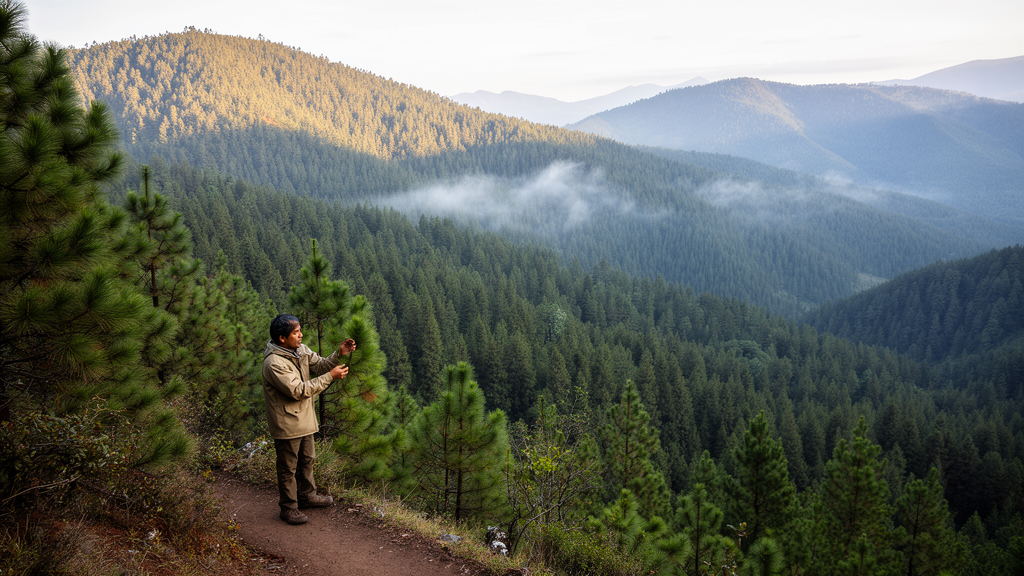
Deep in the mountains of Mexico, where pines and oaks converge in combinations found nowhere else on Earth, scientists have spent more than seven decades struggling to agree on what to call the forests they study. Now a comprehensive review published in the journal Vegetation Classification and Survey has traced the tangled history of temperate forest classification in Mexico, from pre-Hispanic plant knowledge to a new eight-level national system designed to end the confusion once and for all.
The review, led by researchers analyzing vegetation classification proposals from 1950 to the present, examined how the country’s sub-humid temperate forests have been named, divided, and cataloged across a sweeping body of literature. Using documentary analysis, frequency counts of terms in academic titles, and co-occurrence mapping of keywords, the team identified eighteen different terms used to designate these plant communities, with temperate forest, oak forest, and pine-oak forest together accounting for sixty-three percent of all uses found in the ninety-two documents analyzed.
Temperate forests in Mexico are far more than a botanical curiosity. They cover the four great mountain systems that define the country’s physiography: the Sierra Madre Occidental, the Trans-Mexican Volcanic Belt, the Sierra Madre Oriental, and the Sierra Madre del Sur. These ranges cover roughly a quarter of the national territory, and it is precisely in these mountains, at altitudes above eight hundred to one thousand meters, where the sub-humid temperate climate with summer rains occupies about twenty-four percent of Mexico. The combination of Nearctic and Neotropical biotic components, layered onto this topographic and climatic mosaic, has produced one of the planet’s great centers of plant diversification.
The numbers behind that diversity are staggering. Mexico harbors a little over twenty-three thousand species of vascular plants, of which around fifty percent are endemic, found nowhere else. The conifers alone, the group that dominates much of the temperate forest canopy, are represented by four families, ninety-four species, and ten genera. It is a megadiverse country considered a center of origin and diversification for a wide range of plant taxa, and that diversification is expressed at every level of vegetation classification, from associations up to biomes.
Classifying such vegetation is not a new enterprise. Long before European botanists arrived, the inhabitants of the Americas had developed extensive knowledge about plants, including their uses, properties, habitats, and classification, organizing vegetation by life forms and differentiating communities such as forests, grasslands, and pine forests. During the sixteenth and nineteenth centuries, botanical attention focused largely on medicinal properties, although broader works emerged, including those of Martin Sesse and the expeditions of Humboldt. In 1842, Martens and Galeotti proposed a classification of Mexico’s vegetation grouped by climatic, topographic, and latitudinal conditions, and by 1872 Grisebach was discussing the country’s mountainous regions and floristic diversity, even differentiating oak from pine forests.
The twentieth century brought the conceptual and methodological advances that still anchor the field. Leopold proposed twelve vegetation types in 1950, placing the boreal forest and the pine-oak forest within the temperate zone, and his inclusion of distribution maps, altitudinal ranges, and estimated areas made the contribution one of the most relevant of its era, even as he acknowledged arbitrary decisions and left the critical definition of plant communities to specialists. A decade later, Miranda and Hernández proposed a physiognomic system of thirty-two vegetation types based on life forms and the Köppen climate framework, four of them grouped within temperate forests: juniper forest, pine forest, holm oak forest, and fir or oyamel forest, complete with a dichotomous key for identification. Then in 1978, Rzedowski presented ten vegetation types with descriptive, ecological, and distributional considerations for each category, a work so influential that it remains in use and commonly cited today, underpinning forest inventories and surface area estimates across the country.
The twenty-first century has pushed classification toward hierarchical integration and international compatibility. González-Medrano proposed a system built on five criteria: life form, foliage function and phenology, size of the life form, texture and consistency of leaves and stems, and coverage, organized into zonal and azonal climatic zones. Palacio-Prieto and colleagues grouped vegetation hierarchically with phenological, floristic, and dasometric criteria, from stands at the minimum level to biomes at the highest, a practical framework adopted by INEGI for land use and vegetation mapping and by CONAFOR for national forest inventories in 2004 to 2009 and again in 2017. Villaseñor and Ortiz, working from Rzedowski’s foundation, grouped vegetation into five major biomes and estimated the number of Magnoliophyta species, endemism included, in each vegetation type.
The culmination of this trajectory is the Mexican Vegetation Classification System, known as SECLAVEMEX, proposed by Velázquez and colleagues in 2016. The system is hierarchically structured in eight nested levels. Levels one to three rest on physiognomic and environmental criteria: the biome, defined by the dominant life form; the major formation, defined by climate following García’s modified Köppen system and Holdridge’s life zones; and the formation, defined by foliage phenology, whether leaves are evergreen, sub-evergreen, deciduous, or sub-deciduous. Levels four to six are botanical and floristic in nature: the subformation, based on leaf morphology such as linear, needle, or scale leaves; the series of associations, based on dominance at the family or genus level; and the association, referenced by one to three or more dominant species. The final two levels, subassociation and facies, are established by edaphic and substrate characteristics, considering the degree of disturbance or ecological succession. For temperate forests, the system integrates communities up to the association level, with series defined by genera such as Abies, Pinus, Cupressus, Juniperus, Quercus, and Alnus.
What makes SECLAVEMEX notable is its deliberate harmonization of the classic Mexican proposals of Miranda and Hernández, Rzedowski, and González-Medrano with global systems, including the European phytosociological approach and the North American EcoVeg approach. It seeks to satisfy both academic and practical needs, from field data collectors to the institutions responsible for natural resource management, while anticipating adaptations as vegetation shifts from natural to cultural states and accommodating exceptions born of Mexico’s evolutionary and biogeographic history. The review’s keyword co-occurrence analysis, built from seventy-eight items in VosViewer, showed that Quercus, temperate forest, coniferous forest, and Abies religiosa are the terms with the highest co-occurrence and the greatest number of interactions, suggesting that Quercus functions as a widely used alternative indicating oak or mixed pine-oak communities in academic titles.
Beneath the terminology lies a rich architecture of plant associations. The conifer group forms series such as Pinus-Pinus, Pinus-Abies, and Cupressus-Pseudotsuga, with associations like Pinus hartwegii or Abies religiosa dominating alone, or combinations such as Pinus durangensis with Abies durangensis, and even three-genus mixtures like Pinus durangensis, Abies durangensis, and Pseudotsuga menziesii. Mixed conifer and broadleaf forests produce the familiar Pinus-Quercus and Quercus-Pinus series, alongside rarer combinations such as Abies-Quercus, Quercus-Cupressus, and Pseudotsuga-Quercus-Cupressus. In the broadleaf subformation, Quercus species dominate, often associated with Alnus or Arctostaphylos, with associations frequently defined by single species such as Quercus rugosa or Quercus deserticola, or by two or more Quercus species together. Environmental factors shape these patterns: Rzedowski suggested that oak forests predominate over pines in the Sierra Madre Oriental because oaks tolerate soils approaching neutrality, whereas the acidic volcanic soils of the Sierra Madre Occidental and the Trans-Mexican Volcanic Belt favor pines.
Despite the growing sophistication of these systems, the review concludes that a fundamental task remains unfinished. Given the high diversity of conifer and broadleaf species in Mexico, combined with the diversity of associations the two groups form, an outstanding challenge involves identifying and creating an inventory of the associations that compose these temperate forests, as well as establishing criteria for the maximum number of dominant species used to designate an association. The International Code of Phytosociological Nomenclature specifies a maximum of two species to indicate an association, yet the literature reveals cases with up to four, prompting the review’s authors to adopt an arbitrary maximum of three for compiling their list. Classification, the authors emphasize, is a continuous process of construction, evolution, and refinement, one that reduces the confusion and ambiguities of earlier eras while opening the door to a complete inventory of one of the world’s great forest biomes.
Subject of Research: Classification and nomenclature of temperate forest types in Mexico
Article Title: Classification and nomenclature of temperate forest types in Mexico
Article References: Ávila-Akerberg, V., Rosaliano-Evaristo, R., González-Martínez, T., Pichardo-García, B., & Serrano-González, D. (2023). Classification and nomenclature of temperate forest types in Mexico. Vegetation Classification and Survey, 4, 329-341. https://doi.org/10.3897/vcs.100796
Image Credits: AI Generated
DOI: 10.3897/VCS.100796
Keywords: temperate forests, Mexico, vegetation classification, SECLAVEMEX, phytosociology, plant associations, biodiversity, conifers, Quercus, Pinus, biomes, forest inventory
Cite Scienmag News
Margaret Porter. (October 18, 2026). Mexico’s temperate forests finally get a unified classification system. Scienmag. https://scienmag.com/mexicos-temperate-forests-finally-get-a-unified-classification-system/
Margaret Porter. "Mexico’s temperate forests finally get a unified classification system." Scienmag, 18 October 2026, https://scienmag.com/mexicos-temperate-forests-finally-get-a-unified-classification-system/. Accessed 18 October 2026.
Margaret Porter. "Mexico’s temperate forests finally get a unified classification system." Scienmag. October 18, 2026. https://scienmag.com/mexicos-temperate-forests-finally-get-a-unified-classification-system/


