


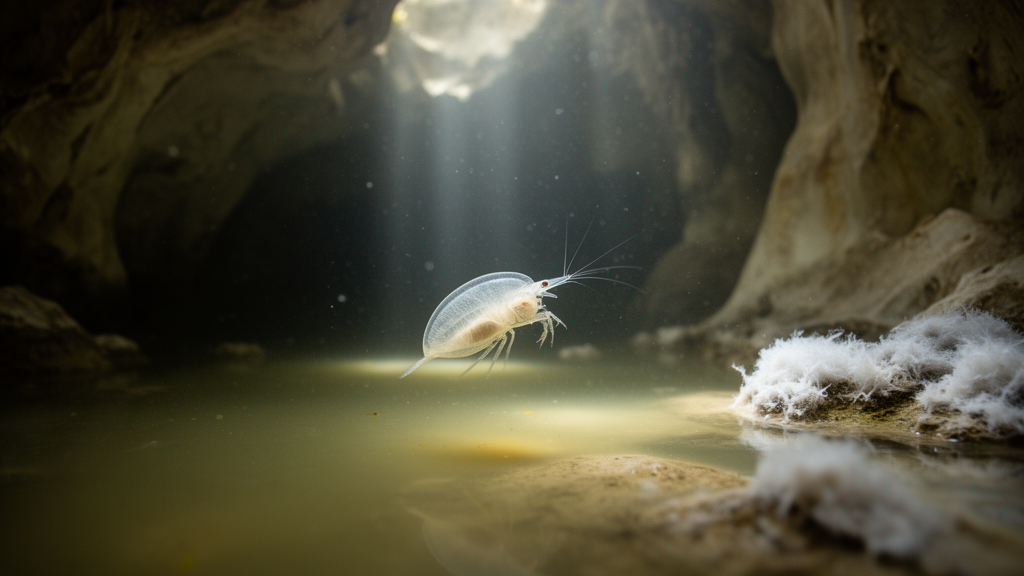
Deep inside a hypogenic cave near Elassona in central Greece, in a lake whose water carries concentrations of hydrogen sulfide that would kill most aquatic animals, a tiny bivalve crustacean has been quietly building a life. A team of Italian researchers has now formally described it as Mixtacandona thessalica, a new species of ostracod, and its address alone makes it remarkable: it is the only cave-dwelling ostracod species currently known from the entire country, and it belongs to a lineage of crustaceans that have made the permanent darkness of groundwater their exclusive home. The discovery, published in the journal Subterranean Biology, adds a striking entry to the short list of animals capable of thriving on the chemistry of rotten eggs.
Ostracods, sometimes called seed shrimp, are a class of small crustaceans enclosed in a hinged, clam-like carapace that typically measures well under a millimetre. They are ancient and extraordinarily successful: the class appeared in the seas during the late Cambrian and has left an almost continuous fossil record, while the living non-marine representatives, all belonging to the order Podocopida, comprise more than 2,300 species in roughly 270 genera. Many of these have colonized caves, aquifers and hyporheic zones, and a disproportionate share of those subterranean species fall within the subfamily Candoninae. Within that group, ecologists distinguish stygoxenes that merely visit groundwater, eurytopic genera that straddle surface and subsurface waters, and true stygobites that live nowhere else. The genus Mixtacandona, which now counts 22 recognized living species including the newcomer, belongs firmly to the third category: every one of its species is exclusively subterranean and confined to the western Palearctic.
The new species was not found by accident. Melissotrypa Cave, located at 299 metres altitude at coordinates 39°52’40″N, 22°02’57″E, had already signalled its biological riches in a 2019 survey that reported a rich community of subterranean invertebrates sustained by chemosynthesis. Unlike most caves, where food rains down from the surface, Melissotrypa’s energy base is generated in place: sulfur-oxidizing microorganisms use the hydrogen sulfide dissolved in the cave water together with oxygen from the cave atmosphere to build biomass, effectively running a microbial food web that replaces photosynthesis. The cave holds a five-metre-deep sulfidic lake plus two non-sulfidic lakes in its southern and eastern maze areas, with air and water temperatures of 16 to 19 degrees Celsius. Four endemic stygobitic species had already been described from its waters, two gastropods, an isopod and an amphipod, and further oligochaetes, a planarian and another amphipod await formal description. Specimens of Mixtacandona had been observed in both the Sulfidic Lake and the Gallery Lake, initially suspected to be close to M. idrisi, a species described from a cave near Palermo in Sicily.
Collecting the animals demanded delicacy. Specimens were gathered during two surveys, on 5 May 2023 and 29 June 2024, using a 180-micrometre hand net and preserved in 70 percent ethanol. Under a stereomicroscope the researchers sorted and dissected them, and the extreme fragility of the valves meant that intact shells often could not be saved; damaged valves and fragments were stored dry in micropalaeontological slides. Scanning electron microscopy with a ZEISS EVO MA10 captured the architecture of the carapaces, while dissected soft parts were mounted in glycerine on sealed slides and drawn with a camera lucida, following the chaetotactic conventions of the standard reference work on freshwater ostracods. The holotype, an adult male, and the paratypes are deposited in the crustacean collection of the La Specola Museum of Natural History in Florence.
The morphology alone marks the species out. Males range from 520 to 558 micrometres in carapace length, averaging 546 micrometres, while females are slightly larger at 543 to 585 micrometres, averaging 569.5, a modest size difference with some overlap. The carapace is elongated and subtrapezoidal in side view, with a height-to-length ratio of about 0.45, and narrow in dorsal view with the width under a third of the length. The valve surface is smooth and covered with sparse setae, and the left valve slightly overlaps the right on all sides, most markedly at the postero-dorsal corner. Here the species shows a striking sexual dimorphism: the posterior margin is rounded in females but straight in males, and males carry a subtle posterior dorsal protuberance on the left valve that forms an obtuse angle with the dorsal margin. Under the SEM, the surface reveals a delicate vascular-like pattern and simple pore canals each topped with a lip and a sensory seta. The appendages add further diagnostics: on the male antenna the second endopodal segment is subdivided and two of its setae are transformed into bristles, the cleaning leg carries a distinctive setal arrangement, and the hemipenis shows a thin pointed outer lobe, a triangular folded inner lobe and a thumb-shaped medial lobe. The eye pigment is absent, as expected for a blind cave dweller.
To test whether the morphology told the whole story, the team turned to genetics. Seven specimens of the new species and five of M. idrisi were processed for DNA extraction, and a 663-base-pair fragment of the mitochondrial cytochrome c oxidase subunit I gene, the workhorse COI barcode, was amplified with zooplankton primers, alongside a fragment of the nuclear 28S rDNA. Sequencing was carried out commercially after gel confirmation of the amplifications, and the curated sequences were checked against GenBank with BLASTn before alignment on the MAFFT server and Maximum Likelihood reconstruction on IQ-TREE. Species delimitation was run with two complementary methods, the distance-based ASAP and the tree-based PTP, and diagnostic nucleotide combinations in the COI alignment were identified with the MOLD tool to provide a formal molecular diagnosis.
The molecular results were unambiguous. The seven COI sequences of the new species resolved into four haplotypes, while all four sequenced individuals of M. idrisi shared a single haplotype, and both ASAP and PTP separated the two species cleanly. On the COI tree, with p-distances of 0.178, the closest relative of M. thessalica is not the Sicilian M. idrisi but an unnamed Mixtacandona species from the Frasassi cave system in central Italy, another sulfidic environment, hinting that sulfidic caves across the Mediterranean may host a radiation of related extremophiles. The 28S tree, built from a shorter 279-base-pair overlap, points instead to M. idrisi as the nearest relative, with a p-distance of 0.065. The new species carries three diagnostic nucleotides in its COI barcode, at sites 32, 40 and 171 of the trimmed alignment, and six of its 28S sequences all shared one haplotype. A curious wrinkle emerged at higher taxonomic level: two Australian genera, Notacandona and Meridiescandona, nest within the clade of Mixtacandona species, an unusual result suggesting the genus may be polyphyletic, echoing similar problems in other freshwater candonid genera such as Candona and Fabaeformiscandona.
The Greek ostracod fauna remains one of the least documented in the Mediterranean, a gap the authors attribute to the scarcity of studies rather than a poverty of species. With the new addition, ten hypogeal species of living ostracods are known from Greece, six of them endemic, and three of the endemics, including M. thessalica, belong to Mixtacandona, all within the laisi-chappuisi species group characterized by rectangular or trapezoidal carapace outlines and smooth valve surfaces. Until now, all of these had been recorded from wells; the new species is the first found in a cave. The authors speculate that this region may have acted as a speciation hotspot for the group, whose representatives have existed in Europe since at least the Miocene. The contrast with the country’s geology is stark: the Hellenic Speleological Society has recorded more than 10,000 caves, yet almost nothing is known of their microscopic fauna.
Ecologically, the new ostracod qualifies as a genuine extremophile, tolerating water laden with sulfide and other reduced chemical compounds, and the authors assume its presence reflects adaptive processes accumulated over long timescales. Its ecology has not yet been studied directly, but a plausible model comes from the Frasassi cave system, where a Mixtacandona species occupies the oxygenated water layers close to the sulfidic chemocline, grazing on the abundant sulfur-oxidizing bacteria that crowd that boundary. Notably, the sex ratio in the sampled population was close to 1:1, a balanced figure that in other stygobitic crustaceans has been linked to a reproductive advantage in thermally stable environments where females mate asynchronously. The species is known only from its type locality, the sulfidic lake of Melissotrypa Cave, which makes its conservation inseparable from that of the cave’s fragile chemosynthetic ecosystem.
The broader lesson of the discovery is methodological. The authors stress that a comprehensive review of Mixtacandona, combining thorough morphological work on valves and soft parts with molecular techniques, is urgently needed to settle the phylogenetic relationships within the family Candonidae, because the almost complete absence of publicly available sequences for the genus currently makes such assessments impossible. The 28S marker, for instance, was entirely absent from sequence databases for Mixtacandona before this study. Molecular methods have already revealed numerous cryptic species among non-marine ostracods that no amount of morphological scrutiny could separate, and DNA-based approaches hold particular promise for habitats as difficult to sample as caves. At the same time, detailed knowledge of valve morphology, intraspecific variability and sexual dimorphism remains essential, because those same shells are the primary tools of palaeontological research. A crustacean half a millimetre long, living on sulfur in the dark, thus sits at the junction of ecology, evolution and deep time, and it is very likely not the last of its kind to be pulled from a Greek cave lake.
Subject of Research: Description of a new stygobitic ostracod species, Mixtacandona thessalica sp. nov., from a sulfidic cave lake in central Greece, with morphological and molecular characterization
Article Title: Mixtacandona thessalica , a new species of ostracod ( Crustacea , Ostracoda ) from a sulfidic cave in central Greece
Article References: Rossetti, G., Sarbu, S. M., Ștefan, A., Motoc, R., & Mazzini, I. (2025). Mixtacandona thessalica, a new species of ostracod (Crustacea, Ostracoda) from a sulfidic cave in central Greece. Subterranean Biology, 52, 111-133. https://doi.org/10.3897/subtbiol.52.142113
Image Credits: AI Generated
DOI: 10.3897/subtbiol.52.142113
Keywords: ostracoda, Mixtacandona thessalica, stygobite, sulfidic cave, Melissotrypa Cave, extremophile, Candonidae, COI barcoding, 28S rDNA, subterranean biodiversity, Greece, new species
Cite Scienmag News
Drew Townsend. (October 18, 2026). New Ostracod Species Found Thriving in Sulfidic Greek Cave Lake. Scienmag. https://scienmag.com/new-ostracod-species-found-thriving-in-sulfidic-greek-cave-lake/
Drew Townsend. "New Ostracod Species Found Thriving in Sulfidic Greek Cave Lake." Scienmag, 18 October 2026, https://scienmag.com/new-ostracod-species-found-thriving-in-sulfidic-greek-cave-lake/. Accessed 18 October 2026.
Drew Townsend. "New Ostracod Species Found Thriving in Sulfidic Greek Cave Lake." Scienmag. October 18, 2026. https://scienmag.com/new-ostracod-species-found-thriving-in-sulfidic-greek-cave-lake/


