


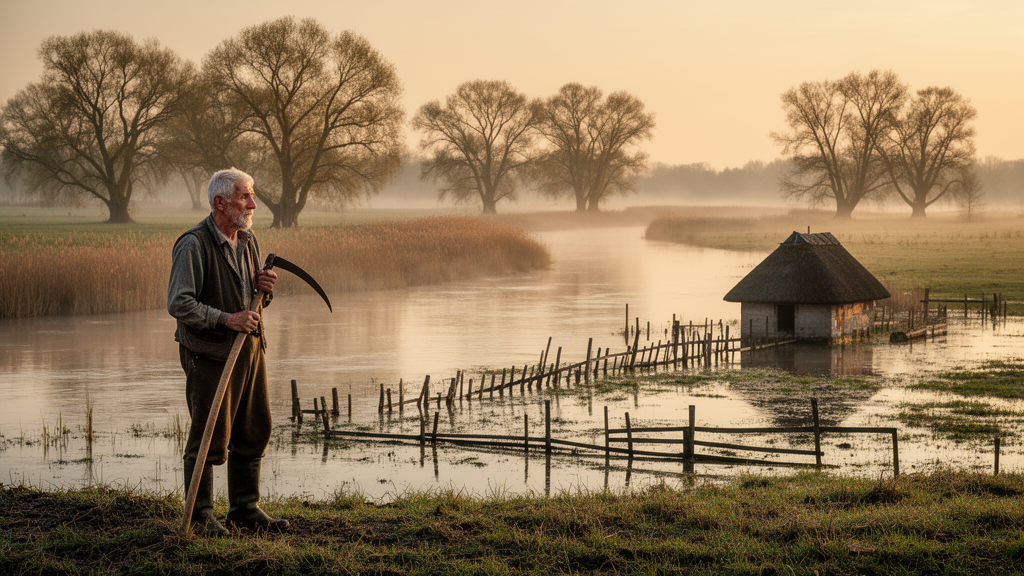
Europe’s river floodplains are among the most biodiverse landscapes on the continent, and according to a sweeping new review published in Nature Conservation, they are also among its most culturally rich. The study, led by Karl Matthias Wantzen and colleagues, delivers the first systematic catalogue of cultural practices tied to the pulsing hydrology of European rivers, from Neolithic pile dwellings around Lake Constance to the Olympic swimmers who competed in the Seine in 2024. Its central finding is as sobering as it is actionable: biological and cultural diversity in floodplains are declining together, driven by the same forces, and cultural practices may hold the key to restoring both.
The flood pulse concept, first articulated by Junk and colleagues in 1989, explains why floodplains teem with life. Rhythmic wet-dry cycles restructure physical habitat, reset ecological successions, and open what researchers call windows of opportunity, periods of abundant resources, alternating with windows of susceptibility, when survival risks spike. Organisms whose life cycles synchronize with these hydrological phases gain a selective advantage, a phenomenon termed the flood pulse advantage. Inter-annual variability in flood patterns promotes coexistence of diverse life-history strategies, producing what Wantzen describes as sequential biodiversity, an exceptional richness that makes floodplains continental hotspots for species.
Crucially, the review argues that the same hydrological rhythms that structure biological diversity also structure cultural diversity. Culture, in this framework, is understood as learned behavior expressed in patterns handed down between generations or social groups, and there is increasing evidence that collective behavior among animal groups can also qualify. Like biological adaptations, cultural adaptations to the natural flow regime combine use strategies, such as profiting from seasonally migrating fish, with risk avoidance strategies, such as cattle transhumance, seasonal migration, or flood-adapted architecture. Archaeological evidence indicates human utilization of riverine resources dating back 500,000 years, with floodplains serving as primary settlement locations and rivers facilitating cultural dispersal across continents.
The historical examples are vivid. Precisely timed spring tree-harvesting for flood-adapted stilt-houses around Lake Constance dates back 7,000 years. Roman producers fermented fish sauce, garum, seasonally in the Loire floodplains. Fishing traditions followed the May migrations of the allis shad, the Mai-Fisch of German rivers, while monastic fishing rights on the Rhine reach back to the tenth century. Intangible heritage runs just as deep: harvest and fishery festivals on the Seine and Rhine, Celtic cults venerating the deity Rhenos, and beliefs about a mythical worm-like creature causing bank erosion in the Dordogne catchment. Even linguistic elements migrated up- and downstream along the Rhine via towboats and steamboats, while logs rafted from the Black Forest built Dutch cities.
To bring order to this richness, the team adapted a taxonomy originally devised under the auspices of the Ramsar Convention on Wetlands, expanding it with new riverine categories. The resulting typology spans five broad domains: habitation and transport, from UNESCO World Heritage sites like the Loire Valley to floating neighborhoods in Amsterdam and Rotterdam; primary uses, including rice cultivation in the Ebro Delta, cattle grazing on Loire meadows, and sand and gravel extraction that has incised the Loire riverbed by an average of 1.5 meters; secondary uses such as food processing, craftsmanship, and the Roses & Castles canal boat painting that emerged in nineteenth-century Britain; knowledge, belief systems and social practices, from the Loreley legend, which in reality encodes the dangerous hydrology of the Middle Rhine, to van Gogh’s Starry Night Over the Rhône and Smetana’s The Moldau; and a newly added fifth category on human wellbeing, covering local identity, temporal rhythm, riverine soundscapes, and the cooling effect rivers exert on urban climates.
The co-decline of biological and cultural diversity is now well documented. Since 1970, freshwater biodiversity populations have declined by 85 percent globally, a rate exceeding all other species groups, and nearly one-third of freshwater species face extinction. Europe’s riverscapes are the most fragmented on Earth, disrupted by over 1.2 million instream barriers. The review characterizes the cultural erosion in four systematic phases: first, loss of direct relationships, as traditional fishing methods and handicraft techniques like wattling disappear; second, loss of indirect relationships, as poetry, music, and spiritual connections to rivers fade; third, disconnection and replacement, as rivers lose their significance in community identity, accelerated by polluted water and physical distancing; and fourth, complete oblivion, when waterbodies have been buried in underground culverts and removed from public memory entirely.
The review also exposes a paradox in conservation policy itself. Regulatory bans on fisheries targeting the allis shad and the European eel in the Loire River, imposed to protect imperiled species, have inadvertently disrupted longstanding traditional fishing and jeopardized the cultural continuation of the practice. The interruption of professional fishermen’s long-term datasets on eel and shad migrations, once modestly funded by watershed agencies, now forces reliance on far more expensive sampling methods. Meanwhile, inland fishing has transitioned from an essential subsistence activity to a predominantly leisure pursuit, with most captured fish returned to the river, a shift that strips the practice of its original ecological and social function.
Yet the paper’s most constructive contribution is its four-category framework for reviving cultural practices as conservation tools. Inactive practices can be adapted for modern use, as with the Grande remontée, a biennial event featuring up to 100 traditional Loire boats that now advocates for granting juridical personhood to the river, or the renovated ship mill in Minden, Germany, which showcases renewable energy, though the authors caution that restoring historic mills with weirs creates new barriers to fish migration. Discontinued practices incompatible with conservation, such as wood rafting on the Rhine, survive as living history in open-air museums. The European dam removal movement, which dismantled 487 barriers across 15 countries in 2023 alone and reconnected over 4,300 kilometers of rivers, exemplifies the deliberate retirement of obsolete practices, reinforced by the EU Nature Restoration Law’s target of restoring 25,000 kilometers of free-flowing rivers by 2030.
Diminished but revivable practices offer perhaps the most dramatic success stories. River bathing, banned in the Seine since 1925, returned to global attention when Paris invested over €1.4 billion since 2015 to restore water quality, and the river successfully hosted six Olympic swimming events in 2024, with public bathing scheduled to resume in 2025. By 2023, 85 percent of Europe’s 22,081 monitored bathing sites achieved excellent quality standards. Grassroots movements such as the Swimmable Cities Alliance and Drinkable Rivers are working to make urban rivers accessible public spaces again. The authors stress, however, that new cultural activities can also harm biodiversity: kayak landings on Loire sandbanks disrupt ground-nesting birds, and recreational bathing in Munich’s Isar River has reduced habitat for the nase, a key restoration target. Geneva’s compensatory reedbed habitats upstream of new bathing sites on Lake Geneva show how careful planning can balance both.
The review concludes with a call for standardized, publicly accessible databases documenting successful biocultural conservation practices across European riverscapes, knowledge repositories the authors say are currently missing. Among emerging models, the Eurometropole of Strasbourg is planning an intra-urban park along an ancient Rhine floodplain channel combining human-river encounter sites with stream restoration, flood-retention zoning, and a thermal refuge for residents during heat waves. The underlying message is that cultural practices, far from being relics to red-list, are living tools to rediscover, evolve, and create new linkages with rivers and their floodplains, helping societies better respect, protect, restore, and newly create the pulsing wetlands on which both biodiversity and human culture depend.
Subject of Research: Biocultural diversity and cultural practices in European riverine floodplains
Article Title: Cultural practices in European riverine floodplains: formation, typology, co-decline of biocultural diversity, and emerging drivers of conservation and sustainable management
Article References: Wantzen, K. M., & Cao, Y. (2026). Cultural practices in European riverine floodplains: formation, typology, co-decline of biocultural diversity, and emerging drivers of conservation and sustainable management. Nature Conservation, 62, 195-215. https://doi.org/10.3897/natureconservation.62.156771
Image Credits: AI Generated
DOI: 10.3897/natureconservation.62.156771
Keywords: floodplains, biocultural diversity, river restoration, flood pulse, cultural heritage, Europe, conservation, wetlands, Cultural, practices, European, riverine
Cite Scienmag News
Margaret Porter. (October 18, 2026). Europe’s Floodplain Cultures Are Vanishing Alongside Their Rivers. Scienmag. https://scienmag.com/europes-floodplain-cultures-are-vanishing-alongside-their-rivers/
Margaret Porter. "Europe’s Floodplain Cultures Are Vanishing Alongside Their Rivers." Scienmag, 18 October 2026, https://scienmag.com/europes-floodplain-cultures-are-vanishing-alongside-their-rivers/. Accessed 18 October 2026.
Margaret Porter. "Europe’s Floodplain Cultures Are Vanishing Alongside Their Rivers." Scienmag. October 18, 2026. https://scienmag.com/europes-floodplain-cultures-are-vanishing-alongside-their-rivers/


