


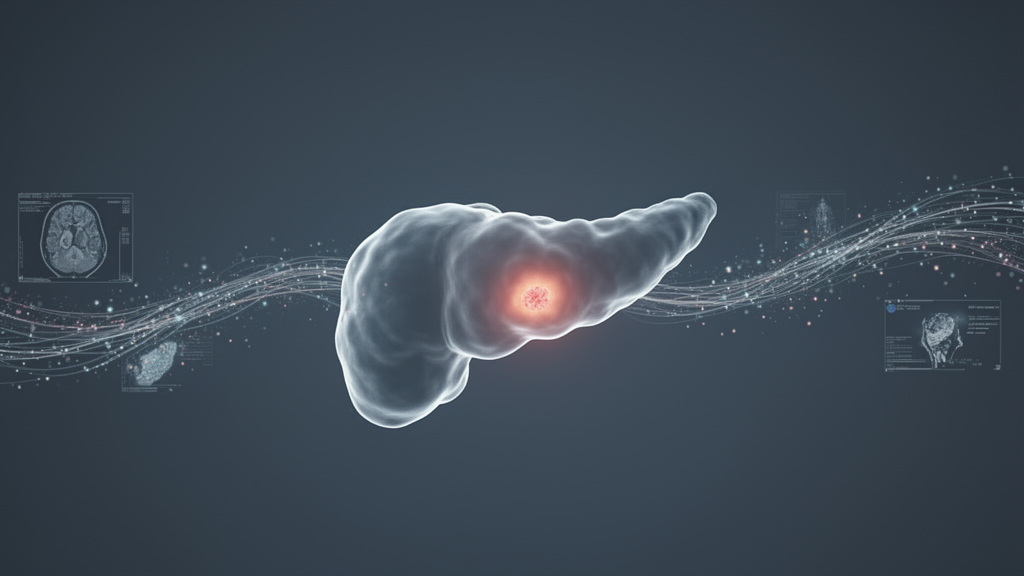
Pancreatic cancer has long been the most elusive of common malignancies, a disease that typically announces itself only after it has spread beyond the pancreas and when curative treatment is no longer possible. Now researchers at Mayo Clinic report that an artificial intelligence model, trained on the ordinary details of patients’ electronic health records, can flag individuals at high risk of developing pancreatic cancer up to three years before clinicians make the diagnosis. The findings, scheduled for presentation at the American College of Surgeons Clinical Congress 2026 in Washington from September 26 to 29, suggest that the data hospitals already collect every day may hold early warnings that no single laboratory value or symptom can reveal on its own.
The stakes are unusually high for a cancer that is statistically uncommon. According to the American Cancer Society, roughly 67,000 people in the United States will receive a new diagnosis of pancreatic cancer in 2026, and about 52,000 will die of the disease. Although pancreatic cancer accounts for only about 3 percent of all new cancer cases, it is responsible for approximately 8 percent of all cancer deaths, a disproportion that reflects how late the disease is usually caught. Fewer than one in five patients is diagnosed at a stage when the tumor can still be removed surgically, the only treatment with a realistic chance of cure.
“Pancreatic cancer can be curable, but only when we catch it early — and fewer than one in five patients is diagnosed in time,” said study co-author Cornelius Thiels, DO, MBA, FACS, a surgical oncologist at Mayo Clinic in Rochester, Minnesota. “As a result, survival for many patients is still measured in months, not years.” Because the disease is rare at the population level, screening everyone with imaging scans is neither practical nor affordable, which is why universal screening for pancreatic cancer is not currently feasible. Thiels and his colleagues instead set out to build a tool that could concentrate screening resources on the small fraction of patients whose everyday medical data already hints at trouble ahead.
The central insight behind the project is temporal. Pancreatic cancer, Thiels noted, forms over a period of roughly five to seven years, but the signs that a clinician or patient can perceive typically appear only when it is too late to change the outcome. The Mayo team reasoned that the disease’s long silent development might leave a statistical fingerprint in the longitudinal record of a patient’s health — subtle shifts in laboratory values, patterns of symptoms, and the trajectory of chronic conditions that individually look innocuous but collectively trace the early arc of a growing tumor.
To capture that fingerprint, lead study author Chris Varghese, MBChB, a surgical data scientist at Mayo Clinic, together with Thiels and their colleagues, built a model that draws on each patient’s longitudinal health history: the comprehensive, time-ordered information contained in the electronic health record. The model combined this narrative of a patient’s health over time with the results of routine laboratory tests obtained over an average of a decade or more. Rather than relying on exotic biomarkers or specialized imaging, the system works exclusively with data that hospitals already generate as a byproduct of ordinary care.
The study dataset was substantial. It included 6,066 individuals who developed pancreatic cancer and 33,396 controls who did not, with clinical histories spanning 7.5 to 19 years for each participant. The researchers trained the model to detect the subtle statistical clues that precede a diagnosis, then tested how well it could separate people who would go on to develop pancreatic cancer from those at low risk — specifically, three years before the cancer was actually diagnosed.
The performance metrics were strong for a screening task of this difficulty. The model achieved an area under the receiver operating characteristic curve, or AUROC, of 0.853, on a scale where 1.0 represents perfect discrimination and 0.5 is no better than random chance. It also demonstrated a strong ability to identify patients who were truly at risk while limiting false positives, earning an area under the precision-recall curve, or AUPRC, of 0.712. Perhaps most importantly for clinical use, the model was well calibrated: its predicted probabilities tracked closely with observed outcomes, with a calibration plot slope of 1.08, meaning that when the model said a patient had a given risk, that risk materialized at nearly the predicted rate.
“Our model showed that a greater than 50% risk of pancreas cancer predicted by our model indicated an 88% likelihood of being diagnosed with pancreatic cancer in one year,” said Varghese. That kind of calibration matters because a screening tool is only useful if its risk estimates can be trusted when deciding which patients deserve intensified follow-up, imaging, or referral to specialized surveillance programs. A model that overstates risk would flood clinics with unnecessary scans and anxiety; one that understates it would miss the very patients it was built to find.
Equally significant is the model’s portability. “We built this to be as generalizable, scalable, and easy to put into practice as possible,” Varghese said. The data inputs the system relies on — longitudinal health histories and routine laboratory results — are captured almost universally in hospital systems worldwide. “If it’s shown to work, it could be used in almost any setting,” he added. That stands in contrast to screening approaches that depend on expensive imaging protocols or specialized tests available only at large academic centers, and it raises the possibility of a population-level early-warning system assembled from data that already exists.
The Mayo team is not treating the model as a finished product. The researchers are currently deploying it on a research basis, and Thiels described the immediate goal as proving that the system can move from a retrospective research tool into the clinical environment and run prospectively for validation. The team plans to validate the model prospectively within Mayo and, this year, at a health system outside Mayo, a critical test of whether performance holds up in settings with different patient populations and record-keeping practices. The researchers are also developing more advanced machine learning architectures, which Thiels said appear to improve performance even further. Because the findings are being presented at a scientific forum where abstracts are reviewed and selected by a program committee but are not yet peer reviewed, the results should be read as promising preliminary evidence rather than a validated clinical standard. Still, if prospective validation succeeds, the study points toward a future in which the quiet accumulation of routine medical data — the blood draws, the diagnoses, the visits that fill every health record — becomes an early alarm for one of medicine’s deadliest cancers, sounded years before the first symptom appears.
Subject of Research: Artificial intelligence prediction of pancreatic cancer risk from longitudinal electronic health record data
Article Title: Artificial intelligence model predicts pancreatic cancer risk 3 years before diagnosis
Article References: Artificial intelligence model predicts pancreatic cancer risk 3 years before diagnosis. (n.d.). Original publication
Image Credits: AI Generated
DOI: Not provided
Keywords: pancreatic cancer, artificial intelligence, machine learning, electronic health records, early detection, cancer screening, Mayo Clinic, predictive modeling, AUROC, risk prediction, American College of Surgeons, oncology
Cite Scienmag News
Nathaniel Bowman. (October 18, 2026). AI Model Flags Pancreatic Cancer Risk Up to Three Years Before Diagnosis. Scienmag. https://scienmag.com/ai-model-flags-pancreatic-cancer-risk-up-to-three-years-before-diagnosis/
Nathaniel Bowman. "AI Model Flags Pancreatic Cancer Risk Up to Three Years Before Diagnosis." Scienmag, 18 October 2026, https://scienmag.com/ai-model-flags-pancreatic-cancer-risk-up-to-three-years-before-diagnosis/. Accessed 18 October 2026.
Nathaniel Bowman. "AI Model Flags Pancreatic Cancer Risk Up to Three Years Before Diagnosis." Scienmag. October 18, 2026. https://scienmag.com/ai-model-flags-pancreatic-cancer-risk-up-to-three-years-before-diagnosis/


