


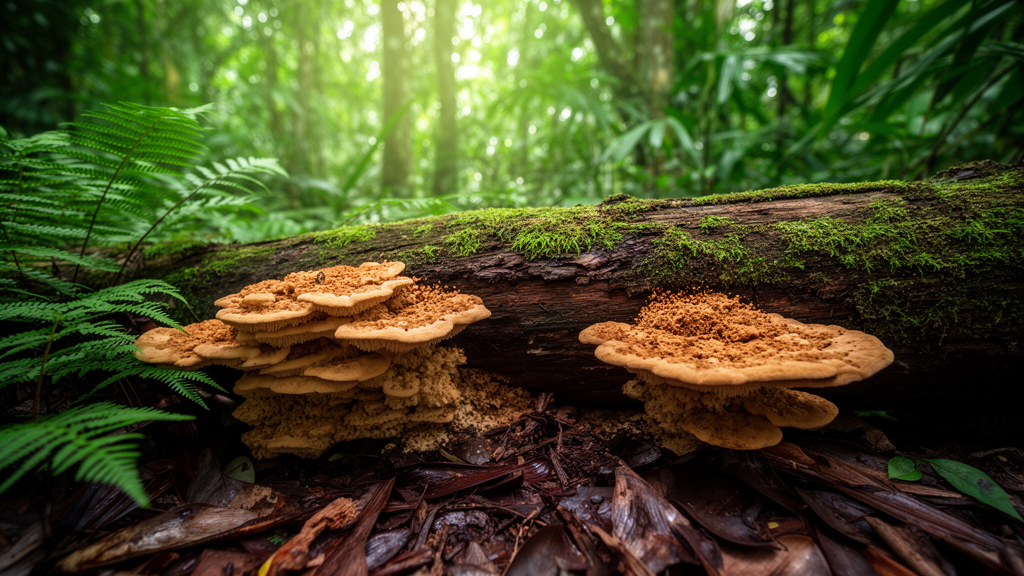
Deep in the tropical forests of Yunnan Province, southwestern China, two previously unknown species of wood-inhabiting fungi have been formally described, adding fresh branches to the fungal tree of life. The new species, Campanella albomarginata and Crustomyces odontoideus, were discovered during a survey of the order Agaricales in the Dehong region and delineated through a combination of detailed morphological examination and molecular phylogenetic analysis. Both were found growing on fallen angiosperm branches in the Tongbiguan Provincial Nature Reserve near Ruili, an area whose humid subtropical climate and extraordinary plant diversity make it a hotspot for undocumented fungal life.
Agaricales is one of the largest orders in the fungal kingdom, encompassing more than 40,000 described species distributed across 560 genera and 62 families. Its members display a spectacular range of fruiting body forms, from classic umbrella-shaped mushrooms with gills to flat, crust-like growths pressed against wood, branching club shapes, and even poroid structures resembling tiny polypores. This morphological breadth has long complicated fungal taxonomy, because superficially similar species can belong to distant lineages, while closely related fungi can look radically different. Molecular phylogenetics, which compares DNA sequences to reconstruct evolutionary relationships, has become an indispensable tool for untangling these patterns and for revealing species that morphology alone would never separate.
The first new species, Campanella albomarginata, belongs to the family Campanellaceae, a lineage circumscribed relatively recently within Agaricales. The genus Campanella, established in 1895, is characterized by small, wood-inhabiting fruiting bodies with a distinctive hymenophore composed of vein-like or ridge-like anastomosing lamellae and smooth, colorless, inamyloid basidiospores. Of the 64 specific names registered in Index Fungorum, only 42 are currently accepted. What makes Ca. albomarginata particularly intriguing is its resupinate, coriaceous fruiting body, a leathery crust spread across the wood surface with a white to cream spore-bearing surface. Only one other accepted species in the genus, Ca. yunnanensis, shares this crust-like form; all remaining species produce pileate fruiting bodies with a cap. The species name refers to the white margin of the type specimen.
Under the light microscope, Ca. albomarginata reveals a monomitic hyphal system, meaning its tissues are built from a single type of generative hyphae, which are colorless, thin-walled, and bear clamp connections, the small bridging structures that fungal hyphae use to maintain paired nuclei during cell division. Its basidia, the spore-producing cells, are subcylindrical and slightly constricted, each carrying four sterigmata, the slender projections on which spores form. The basidiospores are drop-shaped, thin-walled, smooth, and inamyloid, measuring 9.5 to 12 by 5 to 7.5 micrometers, with a mean length of 10.92 micrometers. Capitate cystidia, sterile cells with swollen tips, are also present, measuring 29 to 40 by 6 to 11 micrometers. These microscopic characters, combined with the resupinate habit, distinguish the species from its closest relatives.
The second new species, Crustomyces odontoideus, sits in a very different corner of Agaricales: the small family Cystostereaceae, a group of wood-decaying fungi comprising seven genera. The genus Crustomyces, established in 1979, was revised to include a monomitic hyphal system, a poroid hymenophore, and thick-walled basidiospores. Thirteen species are currently accepted, ten of which occur in China. The new species earns its name from its odontioid hymenial surface, covered with tiny tooth-like projections, a feature that sets it apart within a genus whose members typically have smooth or poroid surfaces. Its fruiting body is annual, resupinate, coriaceous, and fragile, with a slightly pink spore-bearing surface when fresh that turns brownish upon drying.
Microscopically, Cr. odontoideus is characterized by clamped generative hyphae 1.5 to 4 micrometers in diameter and numerous gloeocystidia of two distinct types: moniliform, bead-like cells, and fusiform to subcylindrical cells that taper gradually toward the top. Its basidia are subcylindrical to subclavate with four sterigmata, measuring 11 to 16 by 3.5 to 5.5 micrometers, and its basidiospores are ovoid to broadly ellipsoid, notably small at 4 to 4.5 by 2.5 to 3 micrometers. All tissues test inamyloid and acyanophilous in standard reagents, and remain unchanged in potassium hydroxide, consistent with the generic concept of Crustomyces.
To confirm the evolutionary placement of both species, the research team generated nuclear ribosomal DNA sequences of the internal transcribed spacer (ITS) and the large subunit (LSU) regions from dried voucher specimens deposited in the herbarium of Southwest Forestry University in Kunming. The combined two-marker dataset for the broader analysis encompassed 95 fungal specimens representing 81 taxa from 30 families of Agaricales, with Amylocorticium cebennense serving as the outgroup. Sequences were aligned with MAFFT using the G-INS-I strategy and manually adjusted in AliView. Phylogenetic trees were constructed with maximum likelihood analysis through the CIPRES Science Gateway using RAxML-HPC, with bootstrap support estimated from 1,000 replicates, and with Bayesian inference in MrBayes, run for 7 million generations with two independent runs of four Markov chains each. Branches with maximum likelihood bootstrap values of at least 70 percent and Bayesian posterior probabilities of at least 0.95 were considered strongly supported.
The resulting phylograms placed Ca. albomarginata firmly within Campanella in Campanellaceae, where it formed an independent lineage closely related to Ca. keralensis from India. However, the two species differ morphologically: Ca. keralensis has pleurotoid, cap-bearing fruiting bodies, smaller basidia, longer cheilocystidia, and flexuous-fusoid pleurocystidia. Similarly, Cr. odontoideus was assigned to Crustomyces in Cystostereaceae, forming a separate clade closely related to Cr. tephroleucus with support values of 100/1.00 in the broader analysis. Yet Cr. tephroleucus has tough, poroid fruiting bodies with a white to grayish-white pore surface and shorter clavate basidia. A focused dataset of 30 specimens from 16 Cystostereaceae taxa confirmed the placement, revealing five genera within the family: Cericium, Crustomyces, Cystostereum, Effusomyces, and Parvodontia.
The team also applied a genealogical concordance phylogenetic species recognition analysis, using the pairwise homoplasy index (PHI) test in SplitsTree 4 to check for recombination between the new species and their closest relatives. For Ca. albomarginata, the test against Ca. burkei, Ca. keralensis, and Ca. yunnanensis yielded a statistic of 0.7393, well above the 0.05 threshold that would indicate significant recombination. For Cr. odontoideus, the test against Cr. subisabellinus, Cr. tephroleucus, Cr. laminiferus, and Cr. isabellinus produced a value of 0.8314. In both cases, the absence of recombination supports treating the new taxa as genetically isolated species rather than variants of known lineages, providing independent statistical evidence that complements the morphological and phylogenetic findings.
The discovery underscores how much fungal diversity remains hidden in underexplored tropical and subtropical regions, particularly in Asia. Yunnan Province, with its highly diverse ecological environments, harbors a wide range of animals, plants, and fungi, and researchers believe numerous species remain undocumented. The findings also highlight a recurring theme in modern mycology: significant morphological divergence within a single genus is common in Agaricales, as seen in genera like Marasmius and Resupinatus, where resupinate and pileate species coexist. Only further systematic surveys, combining field collection with DNA-based assessment, can reveal the true diversity and distribution of these wood-inhabiting fungi, enriching the mycological dataset on Campanella and Crustomyces and providing a foundation for future taxonomic, phylogenetic, and biogeographic studies across southwestern China.
Subject of Research: Two new species of Campanella and Crustomyces (Agaricales, Basidiomycota) from China
Article Title: Two new species of Campanella and Crustomyces ( Agaricales , Basidiomycota ) from China
Article References: Liu, W., Deng, Y., Liu, X., & Zhao, C. (2026). Two new species of Campanella and Crustomyces (Agaricales, Basidiomycota) from China. MycoKeys, 138, 95-120. https://doi.org/10.3897/mycokeys.138.203655
Image Credits: AI Generated
DOI: 10.3897/mycokeys.138.203655
Keywords: species, Campanella, Crustomyces, Agaricales, Basidiomycota, China, scientific research
Cite Scienmag News
Roger Howard. (October 18, 2026). Two New Wood-Decay Fungi Discovered in China’s Tropical Yunnan Province. Scienmag. https://scienmag.com/two-new-wood-decay-fungi-discovered-in-chinas-tropical-yunnan-province/
Roger Howard. "Two New Wood-Decay Fungi Discovered in China’s Tropical Yunnan Province." Scienmag, 18 October 2026, https://scienmag.com/two-new-wood-decay-fungi-discovered-in-chinas-tropical-yunnan-province/. Accessed 18 October 2026.
Roger Howard. "Two New Wood-Decay Fungi Discovered in China’s Tropical Yunnan Province." Scienmag. October 18, 2026. https://scienmag.com/two-new-wood-decay-fungi-discovered-in-chinas-tropical-yunnan-province/


