


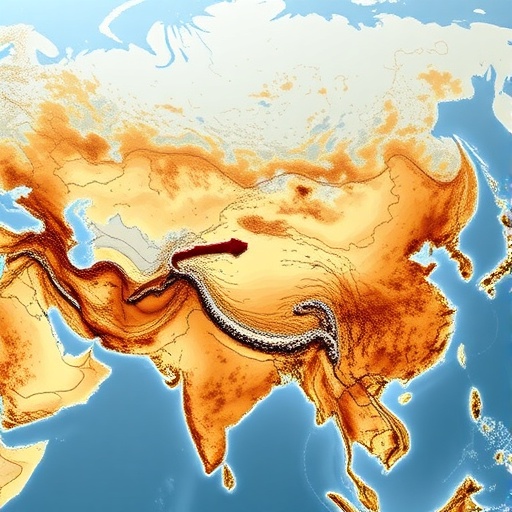
In the vast, water-scarce landscapes of Central Asia, a deficit of rainfall does not stay a deficit of rainfall for long. New research has quantified, with unprecedented precision, how meteorological drought—the absence of precipitation—cascades into agricultural drought, the depletion of moisture in the soil where crops and grasses draw their life. The study, published in Theoretical and Applied Climatology, reveals that on average it takes just under eight months for a rainfall shortfall to seep down into the root zone, and that in some of the region’s most fragile landscapes, even a mild meteorological drought carries a better-than-even chance of pushing soils into drought conditions.
The work, led by Zebin Li of Xi’an International Studies University together with Zhijie Ta, Qian Ren and Zhantao Chen, addresses one of the most persistent gaps in drought science for this region. Central Asia, encompassing the arid expanses of Kazakhstan, Uzbekistan, Turkmenistan and the mountain-fed basins of the Syr Darya and Amu Darya rivers, is a region where food security and ecological stability hang on the delicate balance between atmospheric water supply and soil water storage. Yet while researchers have long known that the two forms of drought are linked, quantitative assessments of the probability and timescale of that link—essential for building effective early warning systems—have remained strikingly limited.
To close that gap, the team assembled four decades of data, spanning 1984 to 2023, drawn from the Global Land Evaporation Amsterdam Model, or GLEAM, a satellite-based and data-assimilating product that estimates root-zone soil moisture—the water held in the layer of soil that plants can actually access. From this record they computed a non-parametric standardized soil moisture index, or SSI, a statistical measure that expresses how far soil moisture in any given month deviates from typical conditions, without assuming that the underlying data follow a normal distribution. Agricultural drought was defined as an SSI falling to minus 0.5 or below.
For the atmospheric side of the equation, the researchers turned to SPEIbase, the widely used global database of the standardized precipitation evapotranspiration index. The SPEI captures not just rainfall deficits but also the evaporative demand of the atmosphere, which rises with temperature—a critical factor in a warming region where actual evapotranspiration has been shown to dominate drought dynamics. By correlating SPEI values accumulated over different time windows with soil moisture drought at various lags, the team identified the optimal propagation time for each location: the delay at which the connection between atmospheric deficit and soil deficit is strongest.
The results paint a picture of a region whose landscapes respond to drought on strikingly different clocks. The mean propagation time across Central Asia is 7.7 months, but that average conceals a clear spatial ordering. In bare land and desert environments, where thin soils and sparse vegetation offer little buffer, the signal from the sky reaches the soil fastest. Forest and grassland areas show intermediate delays, as deeper roots and organic-rich soils moderate the transfer. Cropland exhibits the longest propagation times of all—a finding with immediate implications for agriculture, since it suggests that farmed soils in the region store and release the memory of dry spells over extended periods, delaying but not preventing the onset of agricultural stress.
Propagation time, however, is only half the story. The more consequential question is: given a meteorological drought of a certain severity, how likely is agricultural drought to follow? To answer it, the researchers applied a Gaussian copula, a statistical device that models the dependence structure between two variables regardless of their individual distributions. The copula allowed them to derive the conditional probability of agricultural drought—the probability that SSI drops to minus 0.5 or below—given mild, moderate, severe or extreme meteorological drought, and to compare those probabilities against non-drought conditions using the risk ratio, a standard epidemiological measure of how much a condition elevates risk.
The conditional probabilities climbed steadily with drought severity, as one might expect, but the magnitude of that escalation varied enormously across the region. Around the deserts of the Aral Sea—a landscape devastated by the shrinking of what was once the world’s fourth-largest lake—the probability of agricultural drought exceeded 0.6 even under mild meteorological drought, and climbed past 0.8 under extreme conditions. In other words, in these hyper-arid badlands, a rain deficit almost guarantees that the soil will follow into drought within the characteristic propagation window. By contrast, in the middle and upper reaches of the Syr Darya and Amu Darya river systems, the conditional probability stayed below 0.4 even under extreme meteorological drought, reflecting the buffering role of irrigation networks and groundwater that decouple soil moisture from the vagaries of rainfall.
It is this kind of regional divergence that gives the study its practical punch. By cross-tabulating the risk ratio and the conditional probability, the researchers identified four distinct combinations, each demanding a different response from water managers and forecasters. The first is the high-high pattern, exemplified by the Aral Sea bare lands, where both the amplified risk and the high conditional probability mark what the authors call a dual hotspot—zones where any atmospheric warning signal should trigger immediate agricultural concern. The second is the high-low pattern, seen in the middle-upper Syr Darya and Amu Darya, where irrigation and groundwater dominate the water balance; here, conventional rainfall-based drought indicators can mislead, and monitoring must instead track managed water supplies.
The third combination, low-high, appears across the croplands of northern Kazakhstan, where the long propagation delay means the conditional probability at short lags appears low, but where drought, once it arrives, is delayed yet intense—a slow-motion hazard that could lull forecasters into complacency if lagged responses are not built into warning frameworks. The fourth is the low-low pattern of the Turgay Valley, where the coupling between atmosphere and soil is weak, and where meteorological drought alone is a poor predictor of agricultural stress. Each of the four regimes, the authors argue, calls for its own early warning logic rather than a uniform, region-wide trigger.
The team also confronted the uncertainty inherent in copula-based modeling. A formal uncertainty analysis yielded a mean difference of 0.407 in conditional probability under extreme drought, a non-trivial figure that underscores the challenge of estimating joint extremes from finite observational records. Crucially, however, the spatial pattern—the geographic ordering of high- and low-probability zones—proved robust to that uncertainty, giving confidence that the mapped hotspots are genuine features of the region’s hydroclimate rather than artifacts of the statistical machinery.
The significance of the work extends beyond Central Asia. Globally, drought scientists have increasingly recognized that drought is not a single phenomenon but a cascade, in which deficits propagate through the water cycle—from precipitation deficits to runoff shortages to soil moisture depletion to groundwater decline—each stage with its own lag and threshold. Recent studies across China, Iran and other arid regions have adopted probabilistic and copula-based frameworks to characterize these cascades, and the Central Asian study brings a forty-year, region-wide perspective to that growing body of work. In a water-scarce basin where internal climate variability has already been shown to aggravate agricultural drought, and where compound drought and heat events during the growing season are becoming more frequent, the ability to say how likely, and how quickly, an atmospheric deficit becomes an agricultural crisis is precisely the kind of knowledge that adaptive water management requires.
The practical implications are direct. In the dual hotspots around the Aral Sea deserts, where mild rainfall deficits translate into soil drought with probabilities above 60 percent, monitoring systems should treat even weak meteorological drought signals as actionable. In northern Kazakhstan’s breadbasket, the seven-month-plus memory of cropland soils means that a drought beginning in one season can compromise harvests in the next, arguing for warning systems that look across seasonal boundaries. In the irrigated river corridors, where rainfall tells only part of the story, the findings argue for monitoring irrigation allocations and groundwater levels as first-order drought indicators.
The data underpinning the study are all publicly accessible—SPEIbase from the Spanish National Research Council, GLEAM soil moisture from the GLEAM project, ERA5-Land reanalysis from the Copernicus Climate Change Service, and land cover classifications from the European Space Agency—meaning that other researchers and, in principle, regional forecasting agencies can replicate and extend the framework. As climate change continues to intensify the hydrological cycle across the Eurasian interior, the study offers both a diagnostic baseline and a template: a quantitative, probability-based, region-specific warning framework that converts the slow, invisible seepage of drought from sky to soil into information that farmers and water managers can act upon.
Cite Scienmag News
Alan Morgan. (September 6, 2026). Meteorological droughts trigger delayed, amplified agricultural droughts across Central Asia. Scienmag. https://scienmag.com/meteorological-droughts-trigger-delayed-amplified-agricultural-droughts-across-central-asia/
Alan Morgan. "Meteorological droughts trigger delayed, amplified agricultural droughts across Central Asia." Scienmag, 6 September 2026, https://scienmag.com/meteorological-droughts-trigger-delayed-amplified-agricultural-droughts-across-central-asia/. Accessed 6 September 2026.
Alan Morgan. "Meteorological droughts trigger delayed, amplified agricultural droughts across Central Asia." Scienmag. September 6, 2026. https://scienmag.com/meteorological-droughts-trigger-delayed-amplified-agricultural-droughts-across-central-asia/


