


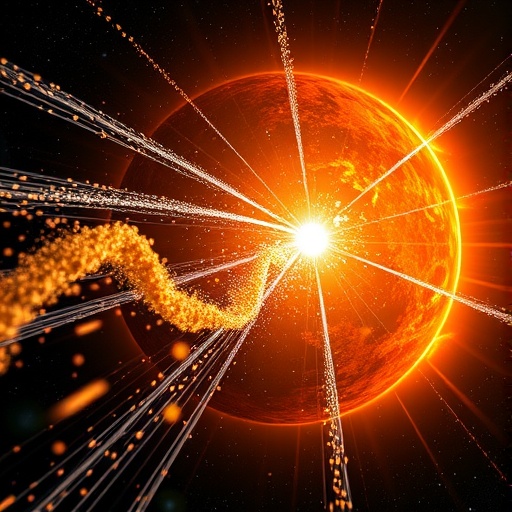
Around 4.6 billion years ago, before Earth, Jupiter, or even the Sun had fully taken shape, the future solar system was a vast, collapsing cloud of gas and dust. Gravity has long been considered the dominant force in this transformation: as the cloud contracted, it spun faster, flattened into a disk, and concentrated material at its center until the young Sun ignited. But new research suggests that another fundamental force was already helping to organize the chaos. Magnetism, preserved inside microscopic minerals in one of the most primitive meteorites ever found, may have influenced the solar system almost from its beginning.
Scientists at the Massachusetts Institute of Technology have identified what they describe as ancient magnetic records inside calcium-aluminum-rich inclusions, or CAIs. These tiny mineral-rich objects formed during the first 200,000 years of solar system history, making them among the oldest solid materials available for laboratory study. Their remanent magnetization indicates that a magnetic field existed while the solar nebula—the rotating cloud from which the Sun and planets emerged—was still collapsing and transforming into a protoplanetary disk.
The discovery challenges the idea that gravity alone drove the earliest stages of planetary formation. Although gravity pulled gas and dust inward, the researchers argue that magnetic forces may have helped transport material through the young disk and toward the growing Sun. Their measurements suggest that the ancient nebular magnetic field had a strength of roughly 150 to 600 microteslas. That range is approximately three to twelve times stronger than Earth’s magnetic field at the surface today, indicating that magnetism was not a minor background effect but potentially a major component of the solar system’s birth.
The evidence comes from meteorite DOM 08006, recovered in 2008 from the Dominion Range in Antarctica. The meteorite is considered exceptionally primitive because it experienced remarkably little chemical and geological alteration after forming. Many meteorites have been repeatedly modified during their long histories: they may have become part of water-rich asteroids, been heated or fractured, transported through the asteroid belt, and eventually delivered to Earth. DOM 08006, by contrast, appears to have preserved an unusually clear record of the environment in which its minerals first formed.
Within small samples of the meteorite, the research team isolated CAIs containing iron-bearing minerals capable of recording magnetic fields. When these minerals cooled or crystallized in the presence of an external field, their magnetic moments could become aligned. Later, as the minerals hardened, that alignment was locked into the crystal structure. This process, known as remanent magnetization, can preserve the direction and intensity of an ancient magnetic field for billions of years—provided the material is not subsequently heated, chemically altered, or exposed to stronger fields that overwrite the original signal.
Reading such a record is technically difficult. CAIs are extremely small, chemically complex, and variable even within a single millimeter-sized fragment. The researchers therefore had to identify suitable inclusions, determine which minerals could carry a stable magnetic signal, and test whether the magnetization was genuinely inherited from the solar nebula rather than produced by later events. The team used a series of sensitive paleomagnetic measurements designed to separate primary magnetization from contamination and secondary magnetic overprints. The surviving signal was consistent with a substantial field present during the earliest stage of solar system formation.
The result builds on earlier work by the same research group, which found evidence for a magnetic field approximately two million years after the solar system began forming. By that later time, the Sun was probably already established and the first planetary building blocks were beginning to assemble. The new measurements push the magnetic record back even farther, into an era when the central star itself may still have been forming. This timing is crucial because it points to magnetism operating before planets existed, when the solar nebula was still being converted from a roughly spherical cloud into a flattened, rapidly rotating disk.
Magnetic fields can influence a protoplanetary disk through interactions with ionized gas, or plasma. As charged particles move through the disk, they generate currents and couple the gas to the field. Those interactions can redistribute angular momentum—the rotational motion that otherwise prevents material from falling directly into the center. If magnetic stresses carried angular momentum outward, gas could move inward toward the growing Sun while the disk continued to rotate. Magnetic turbulence and disk winds may also have lifted material away from the disk or transported it across large distances, helping determine where and how solids condensed into asteroids and planets.
“This transition, from a spherical cloud to a protoplanetary disk, is one of the most significant events in all of solar system history,” says Benjamin Weiss, the Robert R. Shrock Professor of Earth and Planetary Sciences at MIT. Gravity clearly played a central role, he notes, but the new measurements suggest that magnetism also helped shape the process. Cauê Borlina, the study’s lead author and now an assistant professor at Purdue University, says the finding addresses a long-standing question about the period before planets began forming, when the disk existed but its architecture was still being established.
The researchers emphasize that the discovery does not replace gravity with magnetism. Instead, it adds magnetic fields to the physical ingredients needed to explain the solar system’s earliest evolution. The field recorded in DOM 08006 may have influenced the rate at which gas accreted onto the young Sun, the distribution of solids across the disk, and the conditions under which the first planetary seeds emerged. Because similar magnetic processes operate in disks around young stars elsewhere in the galaxy, the finding could also help scientists understand how common planetary systems are assembled. The study appears in the Proceedings of the National Academy of Sciences and was supported in part by NASA.
News Publication Date: 24-Aug-2026
Web References: http://dx.doi.org/10.7288/V4/MAGIC/20586
References: Proceedings of the National Academy of Sciences; DOI: 10.7288/V4/MAGIC/20586
Cite Scienmag News
Violet Maxwell. (August 25, 2026). Meteorite Dust Reveals Magnetic Records That May Explain the Sun’s Formation. Scienmag. https://scienmag.com/meteorite-dust-reveals-magnetic-records-that-may-explain-the-suns-formation/
Violet Maxwell. "Meteorite Dust Reveals Magnetic Records That May Explain the Sun’s Formation." Scienmag, 25 August 2026, https://scienmag.com/meteorite-dust-reveals-magnetic-records-that-may-explain-the-suns-formation/. Accessed 4 September 2026.
Violet Maxwell. "Meteorite Dust Reveals Magnetic Records That May Explain the Sun’s Formation." Scienmag. August 25, 2026. https://scienmag.com/meteorite-dust-reveals-magnetic-records-that-may-explain-the-suns-formation/


