


In the rapidly evolving landscape of battery technology, the demand for ultra-pure chemical precursors has surged, particularly for compounds like dimethyl carbonate (DMC). Known for its vital role as an electrolyte component in lithium-ion batteries, DMC’s purity dramatically impacts battery performance and longevity. However, producing DMC at the exceedingly high purity levels required by modern batteries—exceeding 99.99%—has remained a formidable challenge, largely due to the intrinsic difficulties in separating it from methanol (MeOH) in their azeotropic mixtures. Azeotropes, by their very nature, resist standard distillation techniques due to their fixed vapor-liquid equilibrium compositions. This longstanding hurdle has hampered efficient production, constraining the synthetic and separation methodologies accessible to industry.
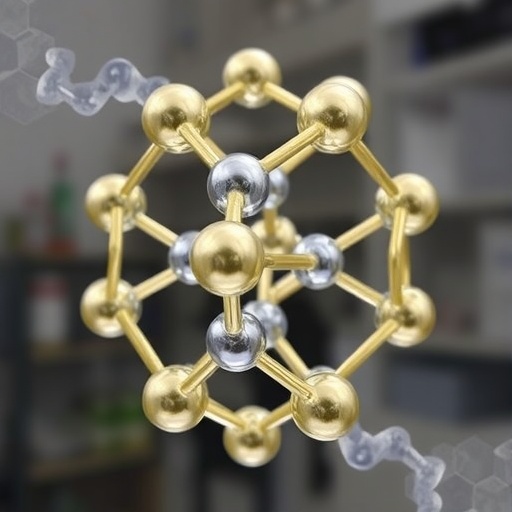
Against this technical bottleneck, a groundbreaking breakthrough has emerged from the realm of materials chemistry, spearheaded by a multinational team of researchers led by Zhou MY, Dong FD, and Yu Y. Their innovative approach centers on the design and deployment of a uniquely structured metal–organic framework (MOF) that employs tetrahedral potassium-ion clusters acting as dynamic pore gates. This transformative development presents not only a novel molecular sieve but a paradigm shift in separation science by eschewing classical sieving methods. Instead, the approach relies on selective coordination chemistry and cooperative ion cluster deformation to discriminate methanol transport through the MOF lattice, thus enabling the unprecedented separation of MeOH from DMC.
At the heart of this innovation lies the ionic MOF’s architecture. Traditional MOFs are known for their highly porous, crystalline networks constructed from metal ions coordinated with organic linkers. These frameworks facilitate a range of applications, from gas storage to catalysis, leveraging the tunable nature of pore sizes and chemical environments within. The teams’ designed MOF subverts conventional pore sieving by introducing tetrahedral clusters of potassium ions at critical junctures, effectively sealing the pore apertures under resting conditions. Here, the ion clusters form an ion cluster “gate,” a concept vastly different from individual ion sieving seen in prior porous materials.
Yet, paradoxically, this tight cluster does not halt molecular traffic indiscriminately. Instead, this gating mechanism exhibits a remarkable capacity for selective transport of methanol. This selectivity derives from the methanol molecules’ ability to transiently interact with the potassium ions, which triggers a reversible reconstitution of coordination bonds within the ion cluster. In essence, methanol molecules engage the ion cluster, inducing a cooperative deformation that opens the gate specifically for their passage. Dimethyl carbonate molecules, by contrast, lack the suitable coordination chemistry and thus are effectively barred. This selective permeation represents a striking feat of molecular recognition, surpassing purely size-exclusion principles.
From an operational standpoint, this ionic MOF demonstrates ultrahigh selectivity in separating methanol from DMC, boasting a MeOH/DMC selectivity ratio exceeding 3,300. Such a level of discrimination renders it possible to produce battery-grade DMC with purity surpassing 99.9999% from equimolar or azeotropic mixtures in a single adsorption cycle. This is a monumental improvement over previous multi-step distillation or extraction methods, marking a step change in energy efficiency and process simplification. The single-pass purity achievement holds immense industrial promise by drastically reducing production costs and environmental impact associated with chemical separations.
Beyond the immediate practical implications, this pioneering work offers insights into the nature of guest-host interactions within MOFs. It exemplifies a guest-binding counterion cluster gating mechanism—a concept that opens new avenues for the design of next-generation molecular sieves. The dynamic nature of the ion clusters as adaptive gates challenges traditional static interpretations of pore structures in crystalline adsorbents. This dynamic gating mechanism could inspire further innovations where selective passage of molecules hinges not merely on pore size but on sophisticated, stimulus-responsive rearrangements at the atomic scale.
Moreover, the discovery reinforces the richness of potassium ions as functional elements in material design. While alkali metals typically play passive roles in many frameworks, here potassium’s coordination flexibility and clustering afford a highly tunable gate function. This may encourage exploration of other metal ion clusters as active gating units, potentially broadening the spectrum of separable molecular pairs in complex mixtures beyond MeOH and DMC.
The prospects for industrial integration of such MOFs appear highly promising. Given the pressing demand for scalable, cost-effective methods to meet the battery industry’s strict purity thresholds, this material could form the cornerstone of a new class of adsorption-based separators. Integration with existing continuous production systems could streamline workflows, reduce solvent waste, and drastically lower energy consumption compared to traditional distillation columns. This aligns perfectly with broader sustainability goals in chemical manufacturing and cleaner energy technologies.
Equally compelling is the fundamental material science intrigue this ionic MOF engenders. It bridges concepts from coordination chemistry, host-guest molecular recognition, and materials engineering into a harmonized function. The cooperative deformation phenomena at the ion cluster level underline a biomimetic aspect reminiscent of ion channel gating in biological membranes, where conformational flexibility governs selective permeability. Such parallels may spark interdisciplinary interest and cross-pollination between chemistry, physics, and bio-inspired materials research.
The implications for broader molecular separations across chemical industries are extensive. Many challenging separations hinge on azeotrope avoidance or breakage, a domain where classical distillation fails or becomes economically prohibitive. The success in cracking the methanol/DMC azeotrope using this MOF sets a precedent that could be extended to other solvent systems, including bio-derived chemicals, pharmaceuticals, and fine chemicals. The principle of guest-triggered gate opening could be tailored to selectively transport other small molecules, shifting the paradigm in separation technology.
In conclusion, this seminal work published in Nature Chemistry heralds a new era for high-precision molecular sieving and azeotrope breaking. By harnessing the power of ionic metal-organic frameworks with dynamic tetrahedral potassium-ion cluster gates, the longstanding challenge of obtaining ultra-pure dimethyl carbonate in a single process has been definitively addressed. This achievement not only facilitates cleaner battery production but also rewrites the fundamental understanding of selective molecular transport in porous materials. As scale-up and industrial adoption unfold, the scientific community and industry stakeholders alike will be watching closely to see how this innovative gating mechanism reverberates across chemical separations and beyond.
Cite Scienmag News
Bethany Barker. (April 26, 2026). Metal–Organic Framework Breaks Methanol/DMC Azeotrope. Scienmag. https://scienmag.com/metal-organic-framework-breaks-methanol-dmc-azeotrope/
Bethany Barker. "Metal–Organic Framework Breaks Methanol/DMC Azeotrope." Scienmag, 26 April 2026, https://scienmag.com/metal-organic-framework-breaks-methanol-dmc-azeotrope/. Accessed 5 September 2026.
Bethany Barker. "Metal–Organic Framework Breaks Methanol/DMC Azeotrope." Scienmag. April 26, 2026. https://scienmag.com/metal-organic-framework-breaks-methanol-dmc-azeotrope/


