


Tuberculosis has quietly reclaimed a grim distinction. In 2023, the disease caused by Mycobacterium tuberculosis once again became the world’s deadliest infectious disease, overtaking COVID-19 as the leading cause of death from a single infectious agent. The World Health Organization estimates that 10.7 million people developed tuberculosis in 2025 and that 1.23 million died from it that year, with an estimated 400,000 cases of rifamycin-resistant or multidrug-resistant disease. Treatment success for drug-susceptible tuberculosis remains high at 88 percent, but outcomes for drug-resistant forms lag behind at 71 percent globally. Against this backdrop, a research team at the University of Michigan and the University of Illinois at Chicago has now reported a large-scale screening campaign aimed at a fundamentally new way of attacking the tuberculosis bacterium’s transcription machinery, publishing their findings in Frontiers in Tuberculosis.
The team’s strategy departs from the standard playbook. Rather than hunting for yet another molecule that binds the bacterial RNA polymerase active site, they targeted the protein-protein interaction between RNA polymerase and CarD, an essential transcription factor that the pathogen cannot survive without. Rifampin, the cornerstone of tuberculosis therapy since the 1980s, works by binding RNA polymerase directly and shortened treatment from 18 months to six to nine months when it entered regimens alongside isoniazid, pyrazinamide, and ethambutol. But rifampin carries well-documented liabilities: long treatment times, activation of the human pregnane X receptor, which induces Cyp3A4 and complicates HIV-tuberculosis coinfection therapy, and the steady accumulation of resistance mutations within RNA polymerase itself. Newer agents such as bedaquiline, approved by the FDA for multidrug-resistant tuberculosis, and delamanid, authorized in Europe but not yet by the FDA, already show acquired resistance, driven in part by mutations in the transcriptional regulator mmpR. Since 2000, only five first-in-class antibiotics have reached the market, and none of them target M. tuberculosis.
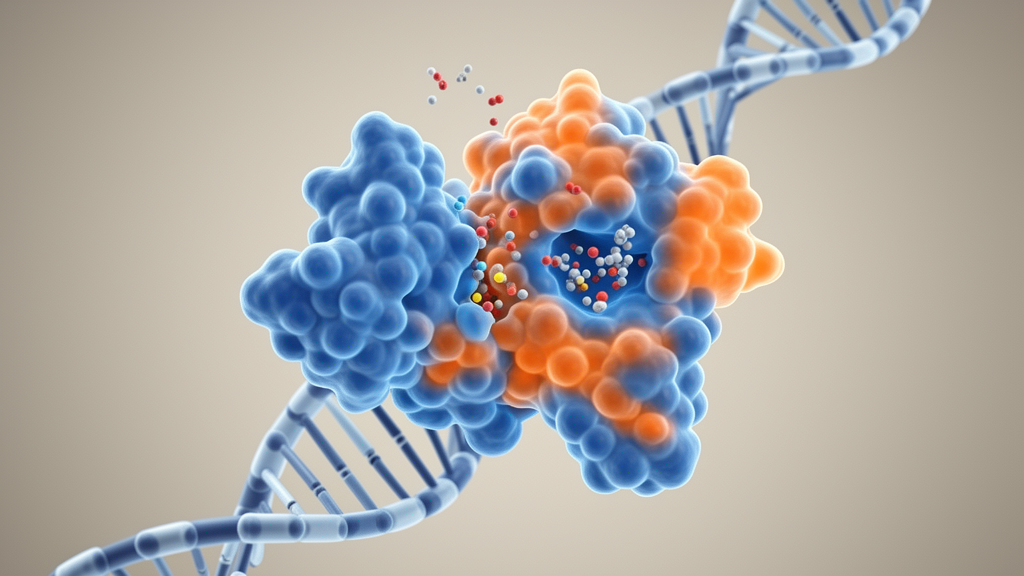
CarD offers a different kind of leverage. After bacterial RNA polymerase binds a promoter and forms the closed complex, the DNA must unwind to generate the open promoter complex, a step widely considered rate-limiting for gene expression. CarD binds to that open complex and stabilizes it, boosting transcription from promoters with short-lived open complexes and dampening transcription from promoters whose open complexes persist longer. Genetic experiments have underscored how indispensable this function is: attempts to delete the carD gene from the M. tuberculosis genome were lethal, and conditional depletion of CarD left the bacterium hypersensitive to reactive oxygen species and rifampin, unable to replicate and persist in mice. Most mutations introduced into CarD through homologous recombination were not tolerated, suggesting that even small structural perturbations cripple the protein. Recent cryo-electron microscopy structures of M. tuberculosis transcription complexes now include CarD, giving medicinal chemists a structural map of the interaction they hope to disrupt.
To monitor the CarD-RNA polymerase interaction in a screening-compatible format, the researchers engineered cysteine mutations into CarD and labeled it with the BODIPY-FL fluorophore. In their fluorescence polarization assay, labeled CarD binds to a complex of RNA polymerase and a native rrnAP3 promoter DNA fragment, and the resulting increase in polarization signal reports on that association. Because both the RNA polymerase and DNA contacts are required for CarD’s highest-affinity binding, the N-terminal and C-terminal domains of CarD and the linker between them all represent potential drug-binding sites. Structural analysis of the CarD C-terminal domain has revealed several potentially druggable pockets, some adjacent to residues critical for promoter DNA interaction and others in the interdomain region, where a small molecule could conceivably freeze the protein in a conformation incompatible with function.
The new study extended an earlier screen of roughly 24,000 compounds to a much larger chemical space. First, the team screened a 4,719-compound drug repurposing library at 20 micromolar to benchmark assay performance. Several compounds initially appeared active, but a substantial fraction showed fluorescence interference, and after filtering, only a small number met hit criteria. One confirmed hit was fidaxomicin, a known RNA polymerase inhibitor that the group had previously characterized as indirectly blocking CarD binding. Notably, the screen did not flag rifampin, which inhibits RNA polymerase without affecting CarD binding, a result the authors cite as validation of the assay’s specificity. Among the apparent hits, the peptide GO-203 looked potent in the primary assay, but follow-up characterization revealed atypical dose-response behavior and fluorescence artifacts. Fluorescence intercalator displacement assays showed that GO-203 and its polycationic R9-containing fragment bind DNA directly, meaning the apparent inhibition arose from DNA binding rather than genuine disruption of the CarD-RNA polymerase interface.
That lesson shaped the main campaign. The team screened 82,516 small molecules from the DART Neurosciences collection, cherry-picked for drug-like properties, each at 20 micromolar in 384-well format. The screen achieved an overall Z-factor of 0.62 and an average per-plate Z-factor of 0.78, values indicating a robust high-throughput assay. Hit selection was deliberately aggressive: compounds needed millipolarization values at least three standard deviations below the negative control and at or above the positive control, yielding 1,242 candidates. Exclusion of compounds exceeding 110 percent of the positive control signal, those with excessive parallel fluorescence intensity, and those flagged for toxicity, chemical reactivity, promiscuity, or PAINS substructures narrowed the pool to 1,054. A counter screen that read plates before DNA addition, designed to catch compounds that fluoresce or quench on their own, further reduced the list to 341, and an intensity threshold cut it to 326 compounds advancing to concentration-response testing.
Concentration-response curves applied additional filters, including molecular weight above 200, Hill slopes below 2, and IC50 values under 100 micromolar, leaving 232 compounds for cluster analysis. Using DataWarrior with Tanimoto similarity clustering at a 79 percent threshold, the team identified four main clusters with average pIC50 values above 4.5, corresponding to IC50 values around 30 micromolar, plus 204 singletons. Fresh powder samples of 22 compounds from four clusters were purchased for reconfirmation. Fluorescence interference proved a persistent obstacle: IC50 values had to be calculated from concentration ranges free of interference, eight compounds yielded values with defined confidence intervals, seven had undefined confidence limits, and six were excluded outright. Eleven purchased analogs from the two most promising clusters showed no significant activity, a sobering result for conventional lead optimization.
Orthogonal counter screens helped clarify what the hits were not doing. In fluorescence intercalator displacement assays using a 60-base-pair lacUV5 duplex and ethidium bromide, none of the compounds displaced the DNA intercalator, ruling out nonspecific DNA binding. In a plasmid-based in vitro transcription assay that detects RNA transcripts bearing 12 repeats of the malachite green aptamer, none of the compounds inhibited RNA polymerase activity. Together, these results support a mechanism distinct from DNA binding or direct polymerase inhibition, consistent with disruption of the CarD-RNA polymerase interaction, although the authors are careful to note that direct binding to CarD or the interface has not yet been demonstrated.
Antibacterial testing added a layer of complexity. Minimum inhibitory concentrations against M. tuberculosis H37Rv, measured by the microplate alamar blue assay, ranged from 1.4 micrograms per milliliter, about 4.3 micromolar, for compound 2B-d to above 100 micrograms per milliliter for several others. Minimum bactericidal concentrations were consistently above 100 micrograms per milliliter for nearly all compounds, indicating limited killing at the tested doses. Compound 2B-d stood out with an MIC90 of 1.4 micrograms per milliliter and a Vero cell TC50 of 24 micromolar, yielding a selectivity index of 5.6, a moderate but real safety margin. Intriguingly, 2B-d showed weak biochemical potency in the fluorescence polarization assay, with an IC50 of 65 micromolar, despite strong whole-cell activity, a discrepancy the authors attribute to possible differences in permeability, efflux, or target accessibility, and they cannot yet rule out that the whole-cell activity arises from mechanisms unrelated to CarD-RNA polymerase inhibition.
Structurally, the most reliable hits from Clusters 1 and 2A share a striking chemotype: two bicyclic heterocycles connected through a methylene linker attached to the nitrogen of a tetrahydropyridine ring, with similar conformational flexibility and planarity. Within Cluster 1, a single methyl substitution at the R2 position lowered the IC50 roughly threefold to 7 micromolar, while enlarging the R1 substituent or replacing the pyrimidine with a carbocyclic ring proved detrimental. Clusters 3 and 4, built around 2-methoxy-5-aminopyridine amide and benzyl-piperazinyl-pyridinamine scaffolds respectively, were largely sidelined by fluorescence interference. The authors argue that the combined 15-compound chemotype from Clusters 1 and 2A, in which eight members have IC50 values below 50 micromolar and six show MIC90 values below 100 micrograms per milliliter, provides a starting point for structure-activity exploration, though they acknowledge that modest potency, fluorescence interference, and weak analog activity currently preclude conventional optimization. Future work will need NMR spectroscopy and X-ray crystallography to confirm direct target engagement, define the binding site, and establish whether these molecules act on CarD itself or on the CarD-RNA polymerase interface, with polar substitutions at the R positions and extended methylene linkers flagged as promising directions. CarD homologues also appear in Chlamydiae, Firmicutes, and Spirochaetes, pathogens responsible for chlamydia, Clostridioides difficile colitis, and Lyme disease, so a validated inhibitor could eventually reach well beyond tuberculosis.
Subject of Research: High-throughput screening for inhibitors of the CarD-RNA polymerase protein-protein interaction in Mycobacterium tuberculosis
Article Title: High-throughput screening to identify inhibitors of the MTB CARD•RNA polymerase protein-protein interaction
Article References: Velazquez, G. M., Sexton, J. Z., Franzblau, S. G., Shetye, G. S., Hossain, A., & Garcia, G. A. (2026). High-throughput screening to identify inhibitors of the MTB CARD•RNA polymerase protein-protein interaction. Frontiers in Tuberculosis, 4, Article 1937953. https://doi.org/10.3389/ftubr.2026.1937953
Image Credits: AI Generated
DOI: 10.3389/ftubr.2026.1937953
Keywords: tuberculosis, Mycobacterium tuberculosis, CarD, RNA polymerase, protein-protein interaction, high-throughput screening, fluorescence polarization, drug discovery, antibiotic resistance, drug repurposing, transcription, medicinal chemistry
Cite Scienmag News
Kristina Jarvis. (October 16, 2026). Massive Molecular Screen Targets a Fatal Weak Point in Tuberculosis Transcription Machinery. Scienmag. https://scienmag.com/massive-molecular-screen-targets-a-fatal-weak-point-in-tuberculosis-transcription-machinery/
Kristina Jarvis. "Massive Molecular Screen Targets a Fatal Weak Point in Tuberculosis Transcription Machinery." Scienmag, 16 October 2026, https://scienmag.com/massive-molecular-screen-targets-a-fatal-weak-point-in-tuberculosis-transcription-machinery/. Accessed 16 October 2026.
Kristina Jarvis. "Massive Molecular Screen Targets a Fatal Weak Point in Tuberculosis Transcription Machinery." Scienmag. October 16, 2026. https://scienmag.com/massive-molecular-screen-targets-a-fatal-weak-point-in-tuberculosis-transcription-machinery/


