


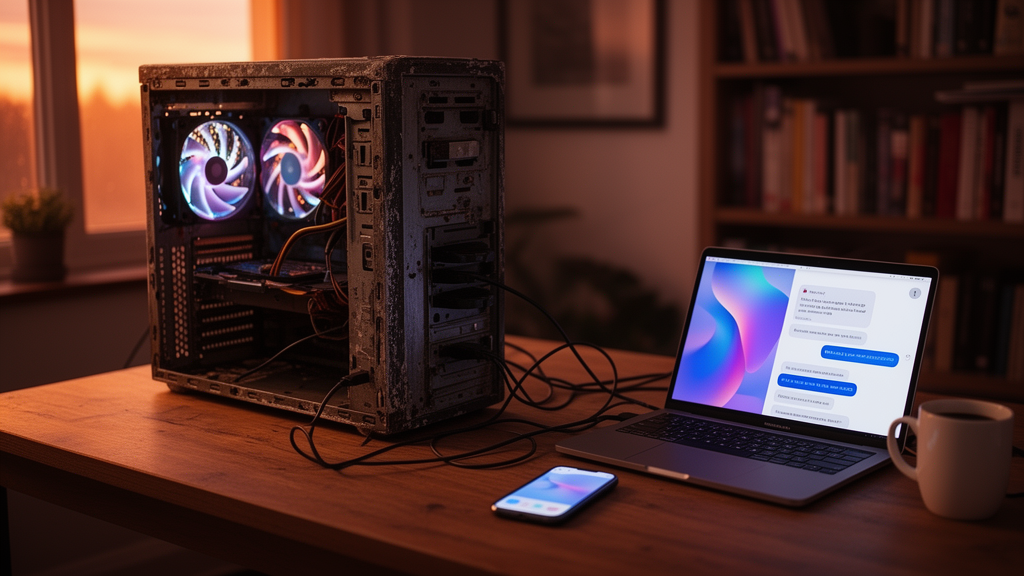
When Microsoft pulled the plug on Windows 10 support in October 2025, an estimated 240 million PCs suddenly found themselves stranded—too old for Windows 11, too functional to justify throwing away. A new study published in Frontiers in Computer Science argues that this wave of obsolescence is not just an environmental problem but an extraordinary opportunity: those aging machines, fitted with a modest consumer graphics card, can be transformed into private AI servers that rival commercial cloud services on cost while keeping every byte of data inside the owner’s own walls.
Researchers Ian Curington of Thames 3D Research and Kevin Lano of King’s College London took a retired enterprise workstation—a Dell Precision T7810 with dual 12-core Xeon processors, 192 GB of memory, and a second-hand NVIDIA GeForce RTX 3060 graphics card purchased for roughly $282—and rebuilt it from scratch as a dedicated large language model (LLM) inference server. They wiped the Windows 10 boot disk, installed Proxmox virtualisation with lightweight Linux containers, and layered on Ollama, an open-source tool for serving local models, together with Open WebUI for a browser-based chat interface. No monitor was attached; the GPU existed purely for computation.
The results were striking. Across ten carefully designed benchmark prompts covering factual retrieval, sustained prose generation, arithmetic reasoning, code writing, long-context summarisation, instruction following, multilingual translation, and multi-turn dialogue, six open-weight models ran stably and entirely within the card’s 12 GB of video memory. Throughput ranged from 29 to 65 tokens per second—fast enough for conversational coding assistants and document summarisation work. The fastest of the stable group, Google’s gemma4:e4b, hit 59–65 tokens per second while also topping the correctness charts, scoring 91.5 percent on the HumanEval Python coding benchmark and 90.4 percent on GSM8K arithmetic problems.
But the study’s most counterintuitive finding concerns the relationship between speed and accuracy. The quickest model tested, a tiny deepseek-r1:1.5b, blazed through prompts at up to 201 tokens per second yet was the least correct on every benchmark, failing to return any answer at all for a third of the coding problems. Meanwhile the slowest model, OpenAI’s gpt-oss:20b, could not fit its 20 billion parameters into the GPU’s memory and spilled onto the CPU, crawling at 17–19 tokens per second—yet it ranked second on code correctness and highest on the TruthfulQA truthfulness benchmark. Choosing a model on speed alone, the authors conclude, would have discarded one of the most capable options available.
The economics are equally compelling. Running the server during working hours cost about $207 per year in electricity at UK regulated rates—measured directly at the wall socket at 150 watts idle and 410 watts under load. Against a mid-range cloud model such as Gemini 2.5 Pro, whose API pricing for 100,000 annual prompts would total roughly $1,562, the local server saves more than $1,350 per year. Against a premium tier like Claude 4 Opus, the cloud bill balloons to around $12,000—roughly 58 times the local electricity cost. Only the cheapest cloud tier, Gemini 3 Flash at about $49 per year, undercuts the local machine, and even that gap narrows dramatically in regions with cheaper electricity.
The carbon accounting favours reuse as well. Applying the UK government’s grid carbon intensity factor, the local server’s annual operating footprint comes to roughly 115 kilograms of CO2-equivalent, compared with estimates of about 170 kilograms for Gemini 3 Flash, 1,132 kilograms for Gemini 2.5 Pro, and 1,387 kilograms for Claude 4 Opus at the same workload. And because the machine already exists, repurposing it avoids entirely the embodied manufacturing emissions that account for roughly 85 percent of a typical desktop’s lifetime footprint. With an estimated 850,000 to one million metric tons of e-waste projected from premature disposal of Windows 10-era machines, the environmental stakes are substantial.
Beyond cost and carbon, the researchers emphasise digital sovereignty—the ability to control one’s own data, software, and infrastructure without depending on external providers. Because inference runs entirely on local hardware, no prompt or document ever leaves the network, a decisive advantage for healthcare, financial, and legal organisations bound by regulations such as the European GDPR. The study notes that France’s government has already directed all departments to reduce dependence on non-European software, and that AI chat tools expose far more personal information than traditional web searches, with some providers using chat data for targeted advertising without offering users an opt-out.
The approach is not without trade-offs. Local models lack live internet access and can go stale; the smallest models are prone to confident errors; and the Proxmox container setup demands technical expertise that smaller organisations may lack. Uptime depends entirely on local hardware, power, and network reliability, with no service-level agreement or built-in redundancy. Maintenance, patching, and upgrades become the operator’s responsibility rather than a vendor’s. The study also cautions that its cost model assumes bounded conversational workloads, not open-ended agentic workflows that can consume unbounded context.
Practical lessons emerged from the benchmarking itself. Video memory is the critical constraint: models whose weights fit entirely within the GPU’s 12 GB ran smoothly, while anything larger spilled to CPU with severe performance penalties and erratic timing. Context length proved a hidden trap as well—Ollama defaults to a 4,096-token window regardless of what a model supports, and the memory-hungry key-value cache that stores conversation history grows linearly with context, sometimes exhausting remaining headroom mid-session without warning. The authors recommend treating context length as a tunable parameter requiring explicit validation rather than accepting defaults uncritically.
Ultimately, the study offers a pragmatic third option for the owners of millions of otherwise-doomed machines: neither disposal nor a full migration to Linux desktop use, but transformation into a private AI node. For organisations weighing privacy obligations, regulatory compliance, or long-term cost predictability against raw performance, the authors argue that local deployment—built from hardware that would otherwise become waste—represents a sustainable and strategically sound alternative to cloud subscription services.
Subject of Research: Repurposing obsolete Windows 10 PCs as on-premises large language model inference servers
Article Title: Reusing obsolete windows 10 PCs for on-premises large language model inference
Article References: Curington, I., & Lano, K. (2026). Reusing obsolete windows 10 PCs for on-premises large language model inference. Frontiers in Computer Science, 8, Article 1911927. https://doi.org/10.3389/fcomp.2026.1911927
Image Credits: AI Generated
DOI: 10.3389/fcomp.2026.1911927
Keywords: Windows 10, large language models, on-premises AI, e-waste, digital sovereignty, GPU inference, Ollama, Proxmox, cloud computing costs, carbon footprint, open-source models, data privacy
Cite Scienmag News
Denise Maddox. (October 16, 2026). Your Old Windows 10 PC Could Become a Free Private AI Server. Scienmag. https://scienmag.com/your-old-windows-10-pc-could-become-a-free-private-ai-server/
Denise Maddox. "Your Old Windows 10 PC Could Become a Free Private AI Server." Scienmag, 16 October 2026, https://scienmag.com/your-old-windows-10-pc-could-become-a-free-private-ai-server/. Accessed 16 October 2026.
Denise Maddox. "Your Old Windows 10 PC Could Become a Free Private AI Server." Scienmag. October 16, 2026. https://scienmag.com/your-old-windows-10-pc-could-become-a-free-private-ai-server/


