


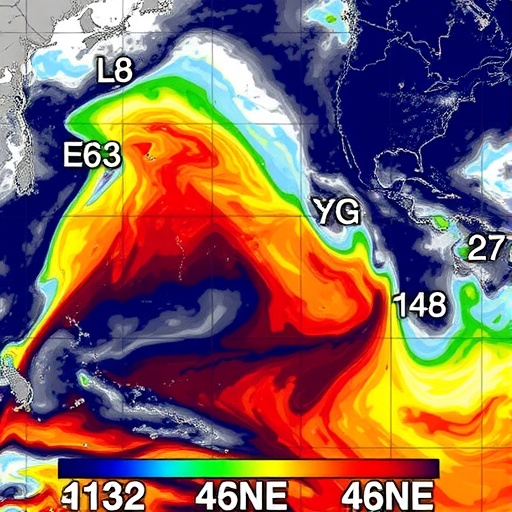
The dynamic and complex interplay between oceanic phenomena and atmospheric processes has long captured the attention of climate scientists globally. A groundbreaking study by Dong, Lin, and Xie, recently published in Communications Earth & Environment, provides profound insights into how mesoscale convection over the Maritime Continent exhibits robust yet nonlinear responses to distinct flavors of the El Niño phenomenon. This research unpacks the intricate sensitivities of tropical convection to various El Niño types, revealing nuances that could reshape our understanding of regional climatic variability and improve predictive capabilities.
The Maritime Continent, a sprawling archipelago stretching across the equatorial Indo-Pacific, acts as a crucial atmospheric and oceanic junction with significant implications for global weather patterns. This region’s mesoscale convective systems significantly influence local rainfall, heat distribution, and even larger teleconnections affecting distant climates. The researchers focus on how El Niño—an irregular periodic variation in winds and sea surface temperatures over the tropical Eastern Pacific—modulates convective activity within this sensitive area.
In recent years, the recognition that El Niño events do not conform to a single archetype has transformed the study of tropical climate interactions. Distinct “flavors” or categories of El Niño, such as the canonical and Central Pacific (Modoki) types, exhibit differing spatial patterns of sea surface temperature anomalies. Dong and colleagues delve into how these variation patterns specifically affect convective intensity and distribution on a mesoscale level, disentangling a dynamic that traditional large-scale analyses often oversimplify.
One core achievement of the study lies in identifying a robust reduction of Maritime Continent convection associated with differing El Niño flavors. However, this reduction is far from linear, highlighting a nonlinear sensitivity that challenges simplistic cause-effect assumptions. The authors deploy advanced climate modeling combined with meticulous observational data assimilation to discern how these nonlinearities manifest, emphasizing their critical importance for accurate climate projections.
A pivotal aspect centers on the physical mechanisms underpinning the convection reduction. The research underscores how altered sea surface temperature gradients reshape atmospheric stability and moisture convergence, directly influencing convective anatomy. By simulating different El Niño patterns, the study demonstrates how shifts in upper-level winds and humidity profiles modulate convective vigor in ways that defy linear extrapolation from temperature changes alone.
This nuanced understanding carries profound implications for the forecast accuracy of regional weather and climate extremes. The Maritime Continent’s role as a heat and moisture engine means changes in its convection can trigger far-reaching impacts on monsoon patterns, tropical cyclone activity, and even mid-latitude circulation systems. Dong et al.’s results suggest incorporating nonlinear sensitivity frameworks could enhance the fidelity of seasonal outlooks and the anticipation of extreme events, both locally and globally.
The authors also explore the significance of mesoscale convective organization, beyond conventional large-scale diagnostics. Their approach underscores that mesoscale processes, including convective clustering and propagation, are fundamental to how El Niño flavors imprint on regional weather. This mesoscale viewpoint unearths subtle feedback loops in the atmosphere-ocean system, emphasizing the Maritime Continent’s unique sensitivity to El Niño diversity.
Remarkably, the study bridges observational climatology with high-resolution coupled climate models to tightly link theoretical predictions with real-world measurements. This integrative methodology bolsters confidence in the reproducibility and robustness of the identified nonlinear sensitivity patterns. It also represents a crucial step forward in addressing previously persistent discrepancies between model forecasts and empirical observations over the tropics.
Another compelling outcome relates to the predictive potential embedded in recognizing distinct El Niño signatures. The authors advocate that a refined classification of El Niño flavors can enhance early warning systems aimed at mitigating adverse socio-economic impacts associated with tropical rainfall extremes. Such improvements in predictability are especially vital for communities dependent on stable water and agricultural regimes in the Indo-Pacific.
The study further opens a pathway to investigating how climate change might influence the frequency or intensity of different El Niño types. Given the documented sensitivity of Maritime Continent convection to these flavors, any shifts induced by anthropogenic warming could dramatically reconfigure regional weather dynamics. This raises critical questions about future climate resilience and the necessity of adaptive strategies informed by evolving ENSO characteristics.
Intriguingly, Dong and collaborators show that even subtle variations in sea surface temperature distributions along the equatorial Pacific can cascade into disproportionately large impacts on convection. This insight challenges prevailing meteorological paradigms that often emphasize linearity or bulk temperature metrics, highlighting the intricate sensitivity of Earth’s climate engine to regional ocean-atmosphere couplings.
The paper’s findings reverberate beyond academic circles, touching upon broader societal stakes including disaster preparedness, agriculture, infrastructure planning, and ecosystem management. As the Maritime Continent anchors a nexus of biodiversity and human population, understanding its convection patterns is central to safeguarding ecological and economic stability amid an increasingly variable climate backdrop.
In sum, this landmark investigation by Dong, Lin, and Xie offers a transformative lens on the nonlinear and multifaceted relationship between El Niño variants and tropical convection over the Maritime Continent. By revealing how mesoscale convective systems respond robustly yet unpredictably to distinct El Niño flavors, the study paves the way for more nuanced climate models, sharpened predictive tools, and ultimately, more effective climate adaptation strategies.
As climate extremes mount, the imperative to refine our grasp of tropical atmospheric dynamics grows ever stronger. This research stands as a clarion call to integrate nonlinear sensitivities and mesoscale nuances into our scientific narratives, deepening the fidelity with which we anticipate and respond to the shifting rhythms of the Earth’s complex climate system.
Cite Scienmag News
Violet Maxwell. (June 8, 2026). Maritime Convection’s Nonlinear Response to El Niño Types. Scienmag. https://scienmag.com/maritime-convections-nonlinear-response-to-el-nino-types/
Violet Maxwell. "Maritime Convection’s Nonlinear Response to El Niño Types." Scienmag, 8 June 2026, https://scienmag.com/maritime-convections-nonlinear-response-to-el-nino-types/. Accessed 4 September 2026.
Violet Maxwell. "Maritime Convection’s Nonlinear Response to El Niño Types." Scienmag. June 8, 2026. https://scienmag.com/maritime-convections-nonlinear-response-to-el-nino-types/


