


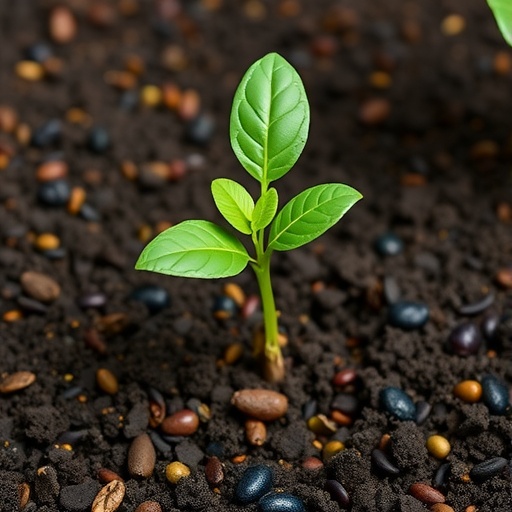
Coffee’s future may depend on what happens beneath the soil. A new study published in Scientific Reports investigates whether two very different biological tools—biochar produced from discarded corncobs and plant growth-promoting rhizobacteria—can work together to improve the early development of Coffea arabica L. seedlings. The research, led by S. Kullachonphuri, T. Sriwichaikaew and M. S. Demyan with colleagues, focuses on a question with global consequences: can agricultural waste and beneficial soil microbes help coffee plants establish stronger roots while reducing pressure on increasingly fragile growing systems?
Coffee seedlings face a difficult transition from nursery conditions to productive plantations. During this early stage, plants must build a functioning root system, acquire nutrients efficiently and tolerate fluctuations in water availability, soil chemistry and microbial communities. Weak establishment can delay growth and leave young plants vulnerable to drought, disease and nutrient deficiencies. Because Coffea arabica is often cultivated in mountainous and environmentally sensitive regions, improving seedling performance without relying exclusively on synthetic fertilizers could offer both economic and ecological advantages. The study examines whether a soil amendment made from corncobs, combined with selected plant growth-promoting rhizobacteria, can provide that advantage.
Biochar is a carbon-rich material created when organic biomass is heated under limited oxygen, a process known as pyrolysis. Unlike ordinary combustion, pyrolysis transforms plant residues into a porous, relatively stable form of carbon. Corncobs are particularly promising feedstock because they are widely generated as agricultural waste and contain structural plant compounds that can produce a mineral-rich biochar. Once incorporated into soil, the material can alter physical and chemical conditions around plant roots. Its pores may retain water and dissolved nutrients, while its surface can provide habitat for microorganisms and sites where chemical compounds attach.
The potential value of corncob-derived biochar is not simply that it adds carbon to soil. Its effects depend on production temperature, particle size, application rate and the characteristics of the original biomass. Biochar can influence soil pH, electrical conductivity, cation exchange capacity and the movement of nutrients such as nitrogen, phosphorus and potassium. These changes may improve the root environment, but excessive application or an unsuitable biochar can also create unfavorable conditions, including nutrient immobilization or salinity. By concentrating on a defined agricultural residue and a specific crop, the research addresses the need to evaluate biochar as a targeted technology rather than treating all biochars as interchangeable materials.
The second component, plant growth-promoting rhizobacteria, operates through a biological pathway. These bacteria colonize the rhizosphere—the narrow zone of soil directly influenced by roots—and can support plants through several mechanisms. Some strains release indole-3-acetic acid and other compounds that stimulate root branching. Others improve access to phosphorus, fix or mobilize nitrogen, produce siderophores that bind iron, or generate enzymes and metabolites that help plants withstand stress. Beneficial bacteria may also compete with pathogens or activate systemic defense responses in the plant. Their performance, however, depends strongly on soil conditions, moisture, organic carbon and compatibility with the host plant.
The study’s central scientific interest lies in the interaction between the two treatments. Biochar may function as more than a nutrient-bearing amendment: its internal pores and chemically active surfaces could create refuges where rhizobacteria survive and multiply. At the same time, bacterial activity may help transform nutrients associated with the biochar into forms more accessible to coffee roots. This possible partnership is sometimes described as a soil “engineered habitat,” in which a physical material supports a living microbial community. Whether that relationship produces a measurable benefit must be established experimentally, because biochar can also change the microbial environment in ways that favor some organisms over others.
For coffee production, the stakes extend far beyond the greenhouse. Coffea arabica represents one of the world’s most valuable beverage crops, supporting millions of farmers and workers across tropical regions. Yet coffee cultivation is increasingly exposed to climate instability, including irregular rainfall, higher temperatures, soil degradation and the spread of pests and diseases. Young plants with larger, more active root systems may be better positioned to survive these pressures, although improved seedling growth alone cannot solve the broader challenges facing coffee landscapes. The combination tested in this research could become part of a wider strategy involving shade management, water conservation, soil protection and the use of locally adapted planting material.
The approach also connects coffee science with the circular economy. Corncobs that might otherwise be burned, discarded or left to decompose can be converted into a stable soil amendment, potentially reducing waste while returning carbon and minerals to agricultural land. If beneficial bacteria can be incorporated into the same production system, farmers could eventually have access to treatments designed around locally available biomass and native or compatible microbial strains. Such a system would not automatically be low-cost or sustainable; pyrolysis requires equipment and energy, and microbial products must remain viable during storage and application. Nevertheless, converting one agricultural by-product into an input for another crop offers a compelling model for resource recovery.
The significance of the Scientific Reports study will ultimately depend on how consistently the treatment improves coffee seedling traits and whether those effects persist beyond the experimental setting. Measurements such as plant height, leaf number, stem diameter, root length, biomass, nutrient uptake and water-use responses can reveal whether a plant is genuinely healthier or merely growing faster under temporary conditions. Microbial colonization and soil chemical analyses are equally important because they help explain why a treatment works. Long-term field trials will also be needed to determine whether early growth advantages translate into stronger plantation establishment, improved coffee yields or greater resilience under drought and disease pressure. Even with those questions remaining, the research highlights a promising intersection of waste valorization, soil microbiology and crop improvement—one in which the next advance in coffee production may begin with a corncob and a community of microscopic allies.
Cite Scienmag News
Violet Maxwell. (August 12, 2026). Corncob Biochar and Beneficial Rhizobacteria Boost Arabica Coffee Seedling Growth. Scienmag. https://scienmag.com/corncob-biochar-and-beneficial-rhizobacteria-boost-arabica-coffee-seedling-growth/
Violet Maxwell. "Corncob Biochar and Beneficial Rhizobacteria Boost Arabica Coffee Seedling Growth." Scienmag, 12 August 2026, https://scienmag.com/corncob-biochar-and-beneficial-rhizobacteria-boost-arabica-coffee-seedling-growth/. Accessed 3 September 2026.
Violet Maxwell. "Corncob Biochar and Beneficial Rhizobacteria Boost Arabica Coffee Seedling Growth." Scienmag. August 12, 2026. https://scienmag.com/corncob-biochar-and-beneficial-rhizobacteria-boost-arabica-coffee-seedling-growth/


