


The strain, named VPDOP1, was identified as Vibrio parahaemolyticus and was isolated through a targeted in situ colonization experiment on polyethylene macroplastics in the Adriatic Sea.
Researchers identified the strain using matrix-assisted laser desorption/ionization time-of-flight mass spectrometry, commonly known as MALDI-TOF MS, and confirmed the identification with whole-genome sequencing. These two methods together provided both a proteomic and a genomic basis for classifying the isolate as V. parahaemolyticus.
Before testing the strain on intact plastic, the team carried out a preliminary screen of its biodegradation potential using the clear-zone method. In this assay, the bacterium was grown in a culture medium containing LDPE powder as the sole carbon source. VPDOP1 produced lysis halos in this medium, an early indication that the strain could interact with the polymer as a carbon source.
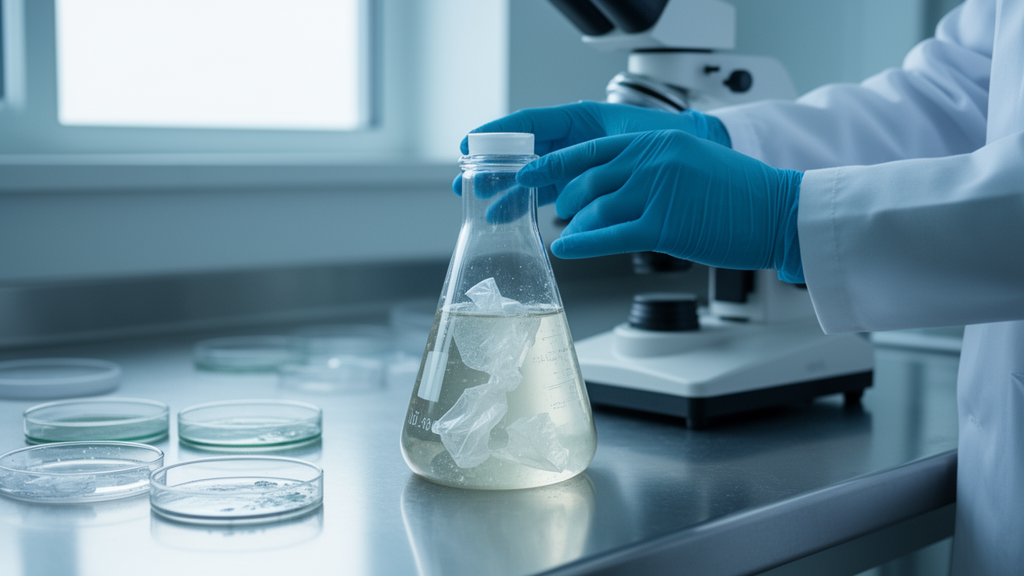
The main experiment followed an 80-day laboratory incubation period. The researchers placed LDPE strips in contact with the strain and tracked biofilm formation dynamics alongside the physicochemical alterations induced in the polymer. After 40 and 80 days of incubation at 25 degrees Celsius, the strips showed a weight loss of 5.5 percent and 7.6 percent, respectively, compared with control strips.
Scanning electron microscopy revealed morphological changes on the surfaces of the incubated strips, and Fourier-transform infrared spectroscopy, or FTIR, detected chemical changes in the polymer. These analyses were performed at the same time points as the weight measurements, allowing the team to link visible surface deterioration with shifts in the material’s chemical signature over the course of the incubation.
The strain also demonstrated the ability to produce hydrolytic enzymes, which was determined using a plate assay. VPDOP1 exhibited amylase, gelatinase, and lipase activity.
Polyethylene is a particularly difficult target for biological degradation. The natural degradation of macroplastics, especially polyethylene, takes a long time and can lead to the persistence of microplastics in the marine environment. As conventional disposal and degradation approaches struggle with this material, research in recent years has increasingly focused on biodegradation through microbial activity as an alternative avenue.
The authors of the study, published in Frontiers in Microbiology, describe the findings as timely and relevant evidence that a marine-derived V. parahaemolyticus strain can form biofilms on LDPE strips and induce measurable surface biodeterioration under laboratory conditions. They emphasize that the result highlights the strain’s promise for future studies on its potential to fully biodegrade marine plastic debris.
It is important to note the scope of the work. The experiment was conducted in the laboratory over a limited period, with weight loss measured against controls at 25 degrees Celsius, and the results demonstrate surface biodeterioration rather than complete biodegradation. The clear-zone assay, microscopy, spectroscopy, and enzyme tests together constitute a preliminary assessment of the strain’s biodegradation potential, and the authors frame the study as a foundation for further research rather than a demonstration of a ready-made solution for marine plastic pollution.
By isolating a strain directly from polyethylene macroplastics colonized in the Adriatic Sea and then characterizing its effects on LDPE under controlled conditions, the research connects an environmental observation with a measurable laboratory outcome, offering a starting point for future investigations into whether such marine bacteria could eventually contribute to managing plastic debris in the ocean.
Subject of Research: Biodegradation of low-density polyethylene by a marine Vibrio parahaemolyticus strain
Article Title: Biofilm-mediated biodeterioration of LDPE strips by an Adriatic sea Vibrio parahaemolyticus strain
Article References: Di Lullo, S., Pieralisi, S., Rocchegiani, E., Leoni, F., Barchiesi, F., Angelico, G., Manuali, E., Petruzzelli, A., Gabucci, C., Nardi, S., Talevi, G., Pittura, L., & Ottaviani, D. (2026). Biofilm-mediated biodeterioration of LDPE strips by an Adriatic sea Vibrio parahaemolyticus strain. Frontiers in Microbiology, 17, 1963993. https://doi.org/10.3389/fmicb.2026.1963993
Image Credits: AI Generated
DOI: 10.3389/fmicb.2026.1963993
Keywords: Vibrio parahaemolyticus, low-density polyethylene, biodegradation, biofilm, microplastics, marine microbiology, Adriatic Sea, FTIR, scanning electron microscopy, biodeterioration, Biofilm-mediated, LDPE
Cite Scienmag News
Drew Townsend. (October 27, 2026). Marine Vibrio strain strips weight from LDPE plastic in lab test. Scienmag. https://scienmag.com/marine-vibrio-strain-strips-weight-from-ldpe-plastic-in-lab-test/
Drew Townsend. "Marine Vibrio strain strips weight from LDPE plastic in lab test." Scienmag, 27 October 2026, https://scienmag.com/marine-vibrio-strain-strips-weight-from-ldpe-plastic-in-lab-test/. Accessed 27 October 2026.
Drew Townsend. "Marine Vibrio strain strips weight from LDPE plastic in lab test." Scienmag. October 27, 2026. https://scienmag.com/marine-vibrio-strain-strips-weight-from-ldpe-plastic-in-lab-test/


