


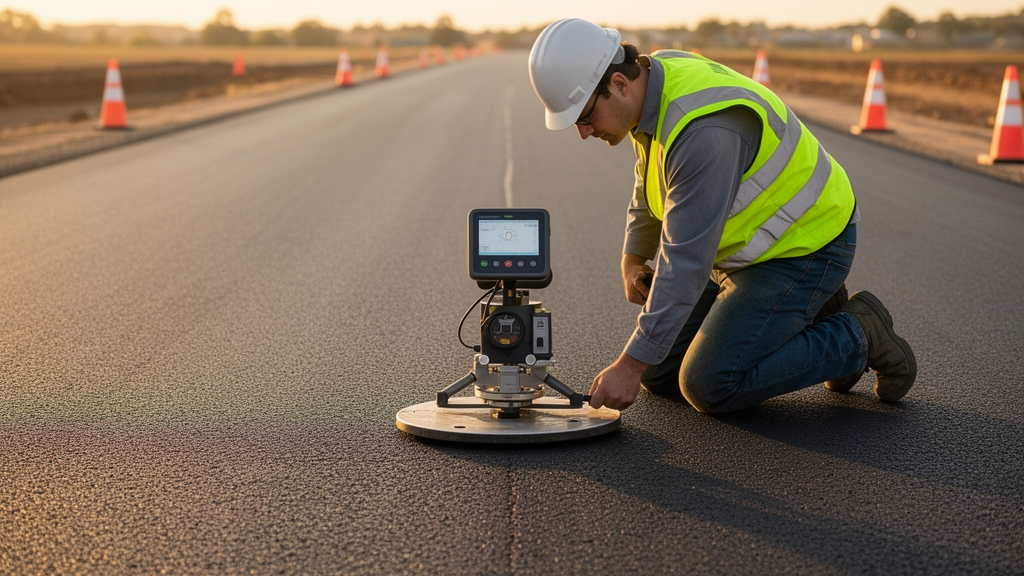
Engineers who need to know whether a freshly laid stretch of asphalt pavement is dense enough have long faced an uncomfortable trade-off. The most trusted way to measure density is to drill a core out of the new pavement and weigh it in the laboratory, but every core is a small wound in the structure the crew just built. A study published in Case Studies in Construction Materials now describes a calibration procedure that lets a handheld non-nuclear density gauge deliver core-equivalent density readings without drilling a single hole in the new pavement.
The device at the centre of the work is the pavement quality indicator, or PQI, one of the most widely used commercial non-nuclear densimeters. Unlike the nuclear gauges that rely on radioactive sources and strict storage, transport and licensing rules, the PQI generates electromagnetic waves that propagate into the pavement and are reflected back to a receiver. Because the dielectric constant of asphalt mixture is higher than that of air, a larger measured dielectric constant corresponds to a smaller air void content and therefore a higher density. The instrument converts the dielectric reading into density through a built-in relationship, allowing many measurements in a short time with minimal training and maintenance.
The problem is that the dielectric response is governed not only by density but also by moisture, temperature, aggregate properties and how well the sensor contacts the surface. Conventional calibration therefore relies on field cores: crews drill samples, measure their saturated surface-dry density in the laboratory, and statistically relate the PQI readings to those reference values. Methods such as the constant offset, slope-and-offset regression, two-point and data-pair techniques all share this dependence on destructive coring, and most are mixture-specific and project-specific.
Before building the calibration framework, the team first established how trustworthy the instrument itself is. On a pavement surface, six marked measuring points were each tested ten times by the same operator. The pooled repeatability standard deviation came out at 0.0014 grams per cubic centimetre, with a repeatability limit of 0.0040 grams per cubic centimetre — roughly 0.058 percent and 0.16 percent of the measured density, far below the tolerances typically allowed in asphalt construction. A reproducibility test in which two operators independently measured the same six points produced a pooled reproducibility standard deviation of 0.020 grams per cubic centimetre and a reproducibility limit of 0.055 grams per cubic centimetre; every operator-to-operator difference fell within that limit. In short, the instrument’s random error is small, which is a prerequisite for any meaningful calibration.
The researchers then quantified the operational factors that bias the readings. Rotating the instrument through 0, 90, 180 and 270 degrees at two test points produced density values that fluctuated only within a narrow range, suggesting orientation has limited influence under the tested conditions, although the authors note that further validation across different surface textures, mixture types and density levels is still needed. Temperature was a different story. Four asphalt slabs conditioned stepwise from 15 to 65 degrees Celsius showed a consistent increase in electromagnetic density as temperature rose, with the increase becoming more pronounced above 45 degrees. Because thermal expansion would actually lower the true bulk density as temperature rises, the authors conclude that the instrument’s own response is likely the dominant source of this apparent temperature dependence.
Moisture proved equally influential. Slabs were tested in four states: fully saturated and surface-dried, completely oven-dried, lightly wetted with the equivalent of a 0.11-millimetre water film, and covered with a continuous film equivalent to roughly 1.11 millimetres of water. Higher moisture consistently produced higher density readings, so the practical recommendation is straightforward: the pavement surface must be dry when the PQI is used, echoing earlier reports that PQI measurements are acceptably accurate only when the asphalt is dry and cooled.
The core-free calibration method itself unfolds in four steps. First, field PQI measurements are taken following a five-point averaging method, repeated three times, with the surface temperature recorded alongside the readings. Second, a temperature correction function converts the field reading into an equivalent value at 25 degrees Celsius, the reference temperature used for laboratory core density determination. Third, an inter-method calibration converts that corrected electromagnetic density into a calibrated density equivalent to the standard bulk density from the saturated surface-dry method. Fourth, a minimum-difference matching algorithm selects which of eight candidate calibrations best represents the actual pavement condition at the test point.
The laboratory work behind those functions was deliberately thorough. Slab specimens were prepared from asphalt mixture taken directly from the paving site in insulated buckets, compacted to eight target air void contents spanning 3.0 to 6.5 percent — a range chosen to cover typical design and construction variability in dense-graded pavements. For the inter-method functions, seven slabs were prepared at each air void content: six supplied paired data of PQI electromagnetic density at 25 degrees and core-derived bulk density for least-squares linear regression, while the seventh was reserved for independent validation. All eight fitted functions were significant at the p < 0.001 level, with coefficients of determination between 0.960 and 0.987, and the independent validation errors stayed within plus or minus 0.003 grams per cubic centimetre.
The field demonstration took place on a test road on Dahe Road, part of the Fourth Ring Road in Zhengzhou, China, built with an AC-25 dense-graded asphalt mixture. At one test point, the five-point averaged PQI reading was 2.434 grams per cubic centimetre at a surface temperature of 32 degrees. Temperature correction brought that to 2.417 grams per cubic centimetre at the 25-degree reference. Substituting this value into the eight air-void-specific calibration functions produced eight candidate densities, and the minimum-difference match identified the 4.5 percent air void level, where the candidate of 2.408 grams per cubic centimetre differed from its standard bulk density by only 0.002 grams per cubic centimetre. When the final calibrated density was compared with the bulk density from a field core at the same point, the absolute difference was just 0.003 grams per cubic centimetre.
The authors are careful about the limits of the evidence. Because only one field test point was used, no statistical comparison with conventional core-based calibration was possible, and they call for validation on multiple test points under broader conditions. The method’s validated domain covers dense-graded asphalt mixtures with 3.0 to 6.5 percent air void contents and pavement temperatures from 5 to 65 degrees Celsius; performance under extreme temperatures, in other mixture types, and across production variability and calibration transferability remains to be verified. Even so, the demonstrated agreement with core measurements — achieved without drilling into the new pavement — points toward a quality control workflow that is faster, cheaper and kinder to the structure it is meant to protect, with the authors flagging multi-factor adaptive real-time calibration and cross-scenario transferable reliability as the next steps.
Subject of Research: A core-free calibration method for non-destructive PQI-based asphalt pavement density measurement
Article Title: A core-free calibration method for non-destructive PQI-based asphalt pavement density measurement
Article References: Zhang, H., Li, Y., Ma, S., & Hu, K. (2026). A core-free calibration method for non-destructive PQI-based asphalt pavement density measurement. Case Studies in Construction Materials, 25, Article e06659. https://doi.org/10.1016/j.cscm.2026.e06659
Image Credits: AI Generated
DOI: 10.1016/j.cscm.2026.e06659
Keywords: asphalt pavement, density measurement, PQI, non-destructive testing, calibration, temperature correction, air void content, dielectric constant, quality control, construction materials, electromagnetic densimeter, core-free
Cite Scienmag News
Denise Maddox. (October 27, 2026). Core-free calibration brings faster, non-destructive asphalt pavement density testing. Scienmag. https://scienmag.com/core-free-calibration-brings-faster-non-destructive-asphalt-pavement-density-testing/
Denise Maddox. "Core-free calibration brings faster, non-destructive asphalt pavement density testing." Scienmag, 27 October 2026, https://scienmag.com/core-free-calibration-brings-faster-non-destructive-asphalt-pavement-density-testing/. Accessed 27 October 2026.
Denise Maddox. "Core-free calibration brings faster, non-destructive asphalt pavement density testing." Scienmag. October 27, 2026. https://scienmag.com/core-free-calibration-brings-faster-non-destructive-asphalt-pavement-density-testing/


